
Showing posts with label painting. Show all posts
Showing posts with label painting. Show all posts
Saturday, July 17, 2021


Thursday, July 15, 2021
Because the Birds (pictures I like)

Sunday, March 10, 2019

Thursday, March 7, 2019

Wednesday, September 14, 2016


Wednesday, September 3, 2014
Time Enough? (an IWSG post)

Of course, what I want to do is get all philosophical about time, about how time is finite, about what it would be like to be able to step outside of time... Except I can't really imagine that. My view of time is kind of like a painting. Or, maybe, a movie. Time only exists within the movie and, if you could only step out of it, you could see the whole thing at once, be in any part of it. That kind of thing. Except, conceptually, as soon as I remove myself from the movie, I put myself in another one, because I still imagine a sequence of events and, without time, there can't be a sequence, so it's not something I can properly imagine.
None of that is what I really want to talk about anyway...
Sometimes, there are events that remind us of the finite-ness of time, that there will be an ending. At least, for us. Well, for all of time, but I expect TIME to go on much for much longer than I will. At any rate, the sudden departure of Tina Downey of Life Is Good from TIME has served as a reminder. Time is, after all, finite. There's a deadline on the things I want to accomplish in life.
I suppose most people have all sorts of things they want to accomplish and that they all feel like they have plenty of time in which to do it. There's always tomorrow, right? But there's not always tomorrow, and, sometimes, tomorrows quit coming sooner than we think they will.
I know that Tina was writing a book. Mostly, though, I think she was working on the writing skills she would need to really write the book. What it means, though, is that I'll never get to read the book. Neither will you. And, you know, maybe it wouldn't have been any good and, in the scheme of things, it doesn't matter, but, maybe, it would have been life-changing. For me. Or for you. Or for someone. That book that really inspired a life and changed its course.
We'll never know.
I have a lot of books like that. Unfinished ones, I mean; I'm not claiming that I'm writing great, life-changing, works of literature. I have PROJECTS! The idea that I could leave TIME with them unfinished... well, it kind of panics me. I don't want to leave things unfinished. Well, I don't want to leave these things unfinished. I'm sure I will always feel that way about whatever projects I have in the works, but other projects are in the future, and I have nothing invested in that stuff yet. These things, these things I have going on now, I know I don't want to leave still in progress. Especially the stuff that relates to The House on the Corner. Too many people ask me when the next when will be finished for me to be okay with just not doing it.
None of this is meant to change the focus from Tina's passing out of TIME, but it was one of the first things I thought of, "I'll never get to read her book." Which, then, has applications for all of us. Not just writers, all people who are doing things. Who have projects of whatever sort. Some of which sit around and sit around and are left abandoned for months or, even, years on end with the thought, "I'll get to it. Sometime." But "sometime" doesn't always come.
So... I am reminded to look at the things I want to do and evaluate them on the basis of what it's okay with me to leave unfinished. Like, I would like to spend time painting, but it won't really bother me if I leave TIME and there are big stack of unpainted miniatures in my garage. It's not like I'm the only one that could paint them. But no one can write the stories that are in my head. Even with notes about them, no one can write them the way I will, so that's the thing I need to get busy with, working on the things that only I can do so that they're not left unfinished should I have to leave.
And that's what I'm going to go do...
Sunday, November 17, 2013
Winterblast in the SofA District (a local color post)
Apparently, I don't know all that much about where I live. No, seriously, every time I think I have a grip on Sonoma County, I find out that I'm wrong. Well, not that I'm wrong, exactly, but just that there's always something else I wasn't expecting.
Like last week, my wife tells me that she wants to go to this Winterblast celebration in the SofA District over this past weekend, and I was all "huh? SofA District? We have a sofa district?" I couldn't figure out why there would be a need to have a whole district for sofas. That is, unless they could fly like that one in Hitchhiker's.
"The South of A Street District. It's like the artists' quarters."
"We have an artists' quarters?"
"Yeah, that's what they call it."
Just to make this clear, this was the 9th Annual Winterblast. The 9th one! And I was only just hearing about it. But, then, I don't always pay the best attention to things going on around me. But that's beside the point. The point is that we went to this Winterblast Celebration. A Celebration which included a sofa parade. At night. Because the whole celebration was at night, which made taking pictures more difficult than I would have liked, but I managed to get some that work.
This being an artist event, though, meant that there was a lot of cool artwork on display, and, yes, I took pictures. Unfortunately, I didn't do a great job of keeping track of what artists painted what stuff, so I'm going to show you some of my favorite pieces and, then, give you some links to the artists' sites.


 BrinoIsm
Saltworkstudio
Serena Hazard (actually, the first one with the tree is from this artist)
I did get the information for this last piece I'm going to show you. It's by Michele Bottaro, and it was my favorite painting I saw at the event. Really cool... and not for sale! (Not that I could afford it if it was, but, still...)

There was also art on building walls and such, like
 and this heart in someone's window that I got with the full moon above it:
 And there were some street dancers:

 And, then, of course, there was the SofA Parade:


 And, if you remember this post, you might recognize this couch (it really seems to get around):


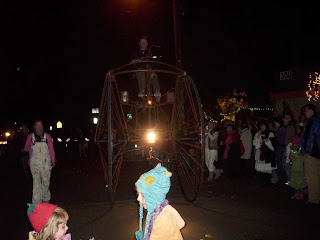

 All in all, it was a pretty good event. I would have spent a lot more time looking at the art, but it was fairly crowded and hard to move from studio to studio. I think the event could benefit from some extended hours and a parade that happens when it's still light out. I guess we'll see what happens next year.
Like last week, my wife tells me that she wants to go to this Winterblast celebration in the SofA District over this past weekend, and I was all "huh? SofA District? We have a sofa district?" I couldn't figure out why there would be a need to have a whole district for sofas. That is, unless they could fly like that one in Hitchhiker's.
"The South of A Street District. It's like the artists' quarters."
"We have an artists' quarters?"
"Yeah, that's what they call it."
Just to make this clear, this was the 9th Annual Winterblast. The 9th one! And I was only just hearing about it. But, then, I don't always pay the best attention to things going on around me. But that's beside the point. The point is that we went to this Winterblast Celebration. A Celebration which included a sofa parade. At night. Because the whole celebration was at night, which made taking pictures more difficult than I would have liked, but I managed to get some that work.
This being an artist event, though, meant that there was a lot of cool artwork on display, and, yes, I took pictures. Unfortunately, I didn't do a great job of keeping track of what artists painted what stuff, so I'm going to show you some of my favorite pieces and, then, give you some links to the artists' sites.


Saltworkstudio
Serena Hazard (actually, the first one with the tree is from this artist)
I did get the information for this last piece I'm going to show you. It's by Michele Bottaro, and it was my favorite painting I saw at the event. Really cool... and not for sale! (Not that I could afford it if it was, but, still...)


Sunday, February 24, 2013
Rules of Grammarization
[Let me point out that this post actually has nothing to do with "grammarization." I actually made up a word to go in that spot that was supposed to be a play off of another word, but, when I looked it up (just to be sure), it meant something... well, it meant something that has nothing to do with any of this. "Grammarization" was the best substitute I could think of, and, at least, it has to do with grammar.]
Some of you newer people may not know about the rep I've developed with grammar, especially commas. I'm like the comma police or something, or so people seem to think. But, you know, one thing is true: I do think rules are important, especially when it comes to grammar. How we speak and what we type say so much about us. And it may not be what we're trying to say. But people make decisions about the kind of person they think we are based upon our ability to communicate. It may not be fair, but that's how it is. [In fact, I just saw a survey, recently, showing that grammar is the #2 thing that people use to evaluate a potential partner (after teeth). At least, on paper it is.] So I think it's especially important for writers to know the rules. [If you don't, learn them, or, at least, get someone that does (know them) to help you make your manuscript look like you do.]
But all of this gets kind of sticky. Why should we, any of us, follow the rules? Aren't they there to be broken? To be ignored? Aren't they all subjective anyway?
Not really, no.
I'm gonna bring Picasso back up (not for the last time). The reason he was able to "break the rules" of painting is that he had mastered them. He was possibly the greatest classical painter of his day, but painting the way everyone else painted didn't interest him, so he explored new territory. He broke the rules. It was only possible because he knew them so well.
What it comes down to is how on purpose your disregard for the rules is. So, on the one hand, when we write, it may be okay to break some rules here and there, but, when we're breaking those rules on accident because we don't know the rule or don't know how to apply the rule, it makes us look amateurish at best. Haphazard. Inconsistent. On the other hand, when it's purposeful, it suddenly becomes artistic and meaningful.
One of the things I see most often is long, run on, sentence fragments. Yeah, that sounds oxymoronic, but it is what it is. I see it both in the manuscripts of the middle schoolers I teach, which is to be expected, and from adults, which shouldn't be happening. But it's easy to get lost in a long thought and forget to include a sentence. Let's try to put together an example:
"When I got up for school, brushing my teeth and eating breakfast, though I dropped toothpaste on my shirt and didn't notice and missed the bus when I went to change."
See, that looks like a run on sentence except that there isn't a sentence anywhere in there, so what you have is a string of fragments. I expect to deal with this kind of stuff with my creative writing class, but it's more than a little distressing to see it all over the blogs of (supposed) writers.
And don't even start me on commas.
Look, I know a lot of the rules are arbitrary and some of them are even kind of stupid. For instance, I was just reading last week about how the rule about splitting infinitives came into being, and it was, really, more like an misinterpretation than anything else. Some guy (no, I don't remember his name) was translating some Latin, and he realized that in Latin they don't split infinitives, so, he thought, we shouldn't either. The thing is, though, in Latin, the verb is always one word due to the way they conjugate, so you can't actually split an infinitive. Prior to that, splitting an infinitive, "to boldly go," was perfectly normal in English and in all of the Germanic languages. But, suddenly, this one guy decides it's wrong, and we've had this rule, now, for a few hundred years that no one can follow. Is it, "boldly, to go" or "to go boldly"? The problem is that "boldly" only modifies "go" not "to go," so only "to boldly go" sounds right.
And, yeah, I hear you all screaming about why, then, should we follow grammar rules?
I'm not saying that you should. Necessarily. If you know the rules and know how to use the rules, do whatever you want to with them. If you're just busy writing "like you talk" or saying "well, that's just the character's voice" just so that you don't need to bother to know the rules, well, then, the likelihood is that your writing is busy being juvenile, inconsistent, and, well, unreadable. Except by other people who can't tell the difference. At least, not on a conscious level. Meaning, they can't look at your writing and tell you what's wrong with it, but they may be able to set it against someone else's writing and say the other one is better.
To put it another way, hordes of people might like Twilight, because they can't evaluate the grammar (or the story), but people that know the rules tear it apart. The fact that Stephen King ripped Twilight a new one while praising Harry Potter ought to tell you something.
Anyway... All of that to say you need to learn your rules and, probably, you ought to be following them. Actually, it's kind of like driving. If I'm gonna get in a car with someone that's gonna speed, I want it to be a Nascar driver or a cop or someone that's had training and knows how to do it safely. I don't want it to be my college roommate who's doing it just to see how fast he can get the car to go (going over 100 mph isn't as fun as it sounds). All I have to say is that a lot of you (meaning no one in particular) need to slow down, maybe take some driving classes, and follow the rules of the road.
Now the disclaimer:
This post is sort of a prelude to a book review I have coming up. I don't want to spend the book review talking about rules and such, so this will be here to refer back to instead.
Some of you newer people may not know about the rep I've developed with grammar, especially commas. I'm like the comma police or something, or so people seem to think. But, you know, one thing is true: I do think rules are important, especially when it comes to grammar. How we speak and what we type say so much about us. And it may not be what we're trying to say. But people make decisions about the kind of person they think we are based upon our ability to communicate. It may not be fair, but that's how it is. [In fact, I just saw a survey, recently, showing that grammar is the #2 thing that people use to evaluate a potential partner (after teeth). At least, on paper it is.] So I think it's especially important for writers to know the rules. [If you don't, learn them, or, at least, get someone that does (know them) to help you make your manuscript look like you do.]
But all of this gets kind of sticky. Why should we, any of us, follow the rules? Aren't they there to be broken? To be ignored? Aren't they all subjective anyway?
Not really, no.
I'm gonna bring Picasso back up (not for the last time). The reason he was able to "break the rules" of painting is that he had mastered them. He was possibly the greatest classical painter of his day, but painting the way everyone else painted didn't interest him, so he explored new territory. He broke the rules. It was only possible because he knew them so well.
What it comes down to is how on purpose your disregard for the rules is. So, on the one hand, when we write, it may be okay to break some rules here and there, but, when we're breaking those rules on accident because we don't know the rule or don't know how to apply the rule, it makes us look amateurish at best. Haphazard. Inconsistent. On the other hand, when it's purposeful, it suddenly becomes artistic and meaningful.
One of the things I see most often is long, run on, sentence fragments. Yeah, that sounds oxymoronic, but it is what it is. I see it both in the manuscripts of the middle schoolers I teach, which is to be expected, and from adults, which shouldn't be happening. But it's easy to get lost in a long thought and forget to include a sentence. Let's try to put together an example:
"When I got up for school, brushing my teeth and eating breakfast, though I dropped toothpaste on my shirt and didn't notice and missed the bus when I went to change."
See, that looks like a run on sentence except that there isn't a sentence anywhere in there, so what you have is a string of fragments. I expect to deal with this kind of stuff with my creative writing class, but it's more than a little distressing to see it all over the blogs of (supposed) writers.
And don't even start me on commas.
Look, I know a lot of the rules are arbitrary and some of them are even kind of stupid. For instance, I was just reading last week about how the rule about splitting infinitives came into being, and it was, really, more like an misinterpretation than anything else. Some guy (no, I don't remember his name) was translating some Latin, and he realized that in Latin they don't split infinitives, so, he thought, we shouldn't either. The thing is, though, in Latin, the verb is always one word due to the way they conjugate, so you can't actually split an infinitive. Prior to that, splitting an infinitive, "to boldly go," was perfectly normal in English and in all of the Germanic languages. But, suddenly, this one guy decides it's wrong, and we've had this rule, now, for a few hundred years that no one can follow. Is it, "boldly, to go" or "to go boldly"? The problem is that "boldly" only modifies "go" not "to go," so only "to boldly go" sounds right.
And, yeah, I hear you all screaming about why, then, should we follow grammar rules?
I'm not saying that you should. Necessarily. If you know the rules and know how to use the rules, do whatever you want to with them. If you're just busy writing "like you talk" or saying "well, that's just the character's voice" just so that you don't need to bother to know the rules, well, then, the likelihood is that your writing is busy being juvenile, inconsistent, and, well, unreadable. Except by other people who can't tell the difference. At least, not on a conscious level. Meaning, they can't look at your writing and tell you what's wrong with it, but they may be able to set it against someone else's writing and say the other one is better.
To put it another way, hordes of people might like Twilight, because they can't evaluate the grammar (or the story), but people that know the rules tear it apart. The fact that Stephen King ripped Twilight a new one while praising Harry Potter ought to tell you something.
Anyway... All of that to say you need to learn your rules and, probably, you ought to be following them. Actually, it's kind of like driving. If I'm gonna get in a car with someone that's gonna speed, I want it to be a Nascar driver or a cop or someone that's had training and knows how to do it safely. I don't want it to be my college roommate who's doing it just to see how fast he can get the car to go (going over 100 mph isn't as fun as it sounds). All I have to say is that a lot of you (meaning no one in particular) need to slow down, maybe take some driving classes, and follow the rules of the road.
Now the disclaimer:
This post is sort of a prelude to a book review I have coming up. I don't want to spend the book review talking about rules and such, so this will be here to refer back to instead.
Tuesday, October 16, 2012
Allegory of the Miniatures (part 3)
Which brings us to college...
And this is a much longer story, but I'm gonna cut to the part where I was working in a used book store in charge of the comic books. It was rather like a dream job at the time. Heck, it's still kind of a dream job. The owner of the place bought things, frequently, on whims, which was the state of things when I started working for him. For whatever reason, he had miniature sets kind of all over the place, but, mostly, he had Grenadier's Dragon of the Month kits.
 During my freshman year at college, a bunch of us had started playing Battletech, so I had started painting again. And my boss had all of these dragons lying around. I started lusting after them. I couldn't afford them, though; however, all I really wanted to do was paint them.
Now, he'd had these sets lying around for, well, years, actually and never sold a single one, which is I why he gave me the job of being in charge of the comics and everything that went along with them, because, as evidenced, he was no good at deciding what to stock. But that's beside the point. Because he's had them lying around for years, I said, "Hey, why don't you let me paint a couple of these, and we'll put them on display and see if they sell." What the heck, right?
Just a note: I was still using oils, but oils had these great metallics that you couldn't get in acrylics at the time. Games Workshop rectified that sometime or other and, eventually, other companies followed with some excellent (acrylic) paints. [Just a personal note to any of you out there involved in this stuff: Games Workshop has what are probably the highest quality miniatures on the market if you're using them for gaming. They lack diversity, though, because their minis support their games. However, I don't much care for their paints. They tend to dry too glossy for my tastes.]
So here's how this worked:
These dragon kits sold for $10.00. They were lead, and they were heavy. He paid me $5.00 each to paint a few of them, and he put them up in display case (with the expensive comics) for $20.00 each. Remember, he'd been collecting these up for years and had never sold a single one (I think he had something like 3 dozen dragons. I know! He couldn't tell me why he'd kept buying them, either, but there it was). As soon as he started putting them in the case, people started buying them. I literally could not paint them quickly enough. People started coming in just looking for the dragons. Even after he marked them up to $30.00. No, I didn't get a raise in how much I was being paid to paint them.
I still have one of them, though.
 The only reason I have it is that my boss, the owner of the store, died, and it was the last one I had painted. That's not the original paint job. After he died, his son (or someone) boxed up a bunch of stuff that was mine (the dragon was mine because he didn't want it, I guess); he dropped it or something and broke it to pieces. Maybe that's why he gave it me. At any rate, that dragon had a hard life of having to be fixed over and over again. Eventually, I re-primed him and painted him with acrylics (you could never get a look like this with oils).
I do, now, have a large collection of (unpainted) dragons. Unpainted, because I've never had anywhere to display them if I did paint them, and they're easier to store in their disassembled states. One day, though...
In a lot of ways, this was like working for a publisher. I did the work, and he made the money. Sure, I got paid a decent amount for doing the painting, I suppose, and I got the enjoyment of doing the painting, but he made four times off of each figure what I did, and that was when he was selling them for $30.00, because there were certain of the dragons, like the Gold Dragon
 and the Spectral Dragon,
 that he would sell for $50.00. You could say that both of us got what we wanted out of it, and, in some respects, that would be true, but I was never happy with the disparity; there was just nothing I could do about it if I wanted to get to paint the dragons.
It's too bad miniatures cost so much these days, or I might consider going back into dragon painting. However, your general dragon miniature starts at around $25.00 these days, and the nice ones (the ones that are more along the scale of the Grenadier dragons) are much higher (like this one from Games Workshop that's more than $50.00).
 So... I've kept it no secret about how I feel about traditional publishing and the way traditional publishers are just out to use authors for monetary gain, but, by my own experience, I can't say that there's not a time and a place for them. I would never enter into a deal, now, like the one I was in then, but at that time and in that place, it served my needs. I suppose what I would say about that in relation to traditional publishing, now, is that, if you're looking at traditional publishing, do make sure that it is actually going to serve your needs. Don't find out after the fact that you've been lead into a relationship that is only going to take advantage of you and give you nothing in return.
Next: how I spent years painting a Confederate army and how I came to hate the color grey.
Oh, and, just in case anyone is interested, that Green Dragon is still for sale. heh
And this is a much longer story, but I'm gonna cut to the part where I was working in a used book store in charge of the comic books. It was rather like a dream job at the time. Heck, it's still kind of a dream job. The owner of the place bought things, frequently, on whims, which was the state of things when I started working for him. For whatever reason, he had miniature sets kind of all over the place, but, mostly, he had Grenadier's Dragon of the Month kits.
Now, he'd had these sets lying around for, well, years, actually and never sold a single one, which is I why he gave me the job of being in charge of the comics and everything that went along with them, because, as evidenced, he was no good at deciding what to stock. But that's beside the point. Because he's had them lying around for years, I said, "Hey, why don't you let me paint a couple of these, and we'll put them on display and see if they sell." What the heck, right?
Just a note: I was still using oils, but oils had these great metallics that you couldn't get in acrylics at the time. Games Workshop rectified that sometime or other and, eventually, other companies followed with some excellent (acrylic) paints. [Just a personal note to any of you out there involved in this stuff: Games Workshop has what are probably the highest quality miniatures on the market if you're using them for gaming. They lack diversity, though, because their minis support their games. However, I don't much care for their paints. They tend to dry too glossy for my tastes.]
So here's how this worked:
These dragon kits sold for $10.00. They were lead, and they were heavy. He paid me $5.00 each to paint a few of them, and he put them up in display case (with the expensive comics) for $20.00 each. Remember, he'd been collecting these up for years and had never sold a single one (I think he had something like 3 dozen dragons. I know! He couldn't tell me why he'd kept buying them, either, but there it was). As soon as he started putting them in the case, people started buying them. I literally could not paint them quickly enough. People started coming in just looking for the dragons. Even after he marked them up to $30.00. No, I didn't get a raise in how much I was being paid to paint them.
I still have one of them, though.

I do, now, have a large collection of (unpainted) dragons. Unpainted, because I've never had anywhere to display them if I did paint them, and they're easier to store in their disassembled states. One day, though...
In a lot of ways, this was like working for a publisher. I did the work, and he made the money. Sure, I got paid a decent amount for doing the painting, I suppose, and I got the enjoyment of doing the painting, but he made four times off of each figure what I did, and that was when he was selling them for $30.00, because there were certain of the dragons, like the Gold Dragon


It's too bad miniatures cost so much these days, or I might consider going back into dragon painting. However, your general dragon miniature starts at around $25.00 these days, and the nice ones (the ones that are more along the scale of the Grenadier dragons) are much higher (like this one from Games Workshop that's more than $50.00).

Next: how I spent years painting a Confederate army and how I came to hate the color grey.
Oh, and, just in case anyone is interested, that Green Dragon is still for sale. heh
Wednesday, October 10, 2012
Allegory of the Miniatures (part 2)
So... Giant robot models. They were a turning point I didn't see coming. These things
 were fully articulated, which was really cool. They were a whole new level of complexity and a lot of fun to build, because, if you messed them up, they wouldn't move, and you didn't want that. My robot models were the envy of the neighborhood and the end of my career selling models. See, after I started on the robots, I never went back to mere airplanes again, and I wouldn't sell my robots. Period. I had a table in my room with all of them set up on it. This was one of my favorites:
 A few of them even transformed.
 There were at least three variations on the transforming kit. Basically, they were all the same model, but, you know, I had to have each one. Besides, they were the most challenging, because the pieces had to be able to slide around. A kid that lived across the street bought one, because I wouldn't sell him mine, and he didn't even get the basic airplane mode out of his. His ended up a huge mess that he dumped on me to see if I could fix, but, you know, once those things are glued, there's not much you can do with them.
Anyway... High school started. I had this one friend; he was kind of my only friend at the time. Yeah, middle school was not a happy time for me, but, then, who is it a happy time for? But I digress...
I had this one friend who was in the school D&D club. Now, I didn't play D&D or any RPGs or anything, because, well, my parents wouldn't have approved. Not that I ever asked, because, when I was in about 6th grade, I'd ordered the books Clash of the Titans and Dragonslayer from my Scholastic order form at school, and my dad threw them away when I brought them home, because they had "magic" in them. It was rather traumatic and the end of any discussion with my parents about what I was reading. I figured role playing games were a bit too far to push it, though, so I'd never gotten involved. At that point.
Anyway... I had this friend, also a freshman, in the D&D club, and he mentioned to them my giant robot models. For some reason, none of them believed they existed. I think, by this time, the models were no longer being available in stores (I know I wasn't able to find them anymore, at any rate), so he started begging me to bring them to school to show the club. After a few weeks, I succumbed, and I brought a few of them to school with me. I have to say it didn't help my "nerd rating" and I already went to a nerd school, as my brother used to say.
Just to put this in perspective, these giant robots came with pilots. You can see the head of one looking out through the turret from the tank above. The "glass" cockpit cover on the top robot opened, and you could see the cockpit interior and pilot in there, too. These little pilot figures were around the size of 20mm miniatures, the standard size for D&D. Actually, they were slightly smaller, but close enough. And this is where everything changed:
1. I discovered that there was a game called Battletech that was based on this giant robot idea. It was more of a board/tabletop game than an RPG (at the time), and I immediately got interested in it. When my friend moved later that year, he gave me his Battletech stuff, which consisted of the basic game and one book of mechs.
2. I got flooded with requests to paint miniatures from guys in the D&D club. Yeah, they were so impressed with my models that they all wanted me to paint their figures for them. I started out charging $1.00 a figure but pretty quickly found that that wasn't going to work. See, one guy immediately brought me a huge bag of 30-40 loose figures, which I thought was pretty good money, but everyone else started offering me more money to bump their figures up the painting list. In the end, I was getting around $3.00/figure for fairly basic paint jobs. And, remember, I was using oils, because I just kept right on using my model paints. It was what I was used to using. The detail on the minis wasn't great, but it was a lot better than what they'd had doing it themselves, so everyone was happy.
Eventually, I started buying mech miniatures of my own for Battletech and started painting those, too. When I was a junior, the school shut the D&D club down, and, between that and the fact that I was never home anymore, I quit painting for other people. At that time. I continued to use oils on my miniatures for the next many years, but more on that next time...
Here are some pics of my oil painted mechs (ignore the dust contamination (I will never figure out how things accumulate dust while in a box!) and missing antennas). Several of these are the same class as the models I have. Wherever they are.


Anyway... High school started. I had this one friend; he was kind of my only friend at the time. Yeah, middle school was not a happy time for me, but, then, who is it a happy time for? But I digress...
I had this one friend who was in the school D&D club. Now, I didn't play D&D or any RPGs or anything, because, well, my parents wouldn't have approved. Not that I ever asked, because, when I was in about 6th grade, I'd ordered the books Clash of the Titans and Dragonslayer from my Scholastic order form at school, and my dad threw them away when I brought them home, because they had "magic" in them. It was rather traumatic and the end of any discussion with my parents about what I was reading. I figured role playing games were a bit too far to push it, though, so I'd never gotten involved. At that point.
Anyway... I had this friend, also a freshman, in the D&D club, and he mentioned to them my giant robot models. For some reason, none of them believed they existed. I think, by this time, the models were no longer being available in stores (I know I wasn't able to find them anymore, at any rate), so he started begging me to bring them to school to show the club. After a few weeks, I succumbed, and I brought a few of them to school with me. I have to say it didn't help my "nerd rating" and I already went to a nerd school, as my brother used to say.
Just to put this in perspective, these giant robots came with pilots. You can see the head of one looking out through the turret from the tank above. The "glass" cockpit cover on the top robot opened, and you could see the cockpit interior and pilot in there, too. These little pilot figures were around the size of 20mm miniatures, the standard size for D&D. Actually, they were slightly smaller, but close enough. And this is where everything changed:
1. I discovered that there was a game called Battletech that was based on this giant robot idea. It was more of a board/tabletop game than an RPG (at the time), and I immediately got interested in it. When my friend moved later that year, he gave me his Battletech stuff, which consisted of the basic game and one book of mechs.
2. I got flooded with requests to paint miniatures from guys in the D&D club. Yeah, they were so impressed with my models that they all wanted me to paint their figures for them. I started out charging $1.00 a figure but pretty quickly found that that wasn't going to work. See, one guy immediately brought me a huge bag of 30-40 loose figures, which I thought was pretty good money, but everyone else started offering me more money to bump their figures up the painting list. In the end, I was getting around $3.00/figure for fairly basic paint jobs. And, remember, I was using oils, because I just kept right on using my model paints. It was what I was used to using. The detail on the minis wasn't great, but it was a lot better than what they'd had doing it themselves, so everyone was happy.
Eventually, I started buying mech miniatures of my own for Battletech and started painting those, too. When I was a junior, the school shut the D&D club down, and, between that and the fact that I was never home anymore, I quit painting for other people. At that time. I continued to use oils on my miniatures for the next many years, but more on that next time...
Here are some pics of my oil painted mechs (ignore the dust contamination (I will never figure out how things accumulate dust while in a box!) and missing antennas). Several of these are the same class as the models I have. Wherever they are.

Thunderbolts (I have this in model form)

Hunchback (one of my favorite mechs) and a... Commando? I think. (no models for these)

Rifleman and Archer (no models for these, either)

Crusader (I think there was a model for this one, but I can't remember for sure)
 Both of these were models.
 As was this one (pictured above).


The only writing lesson I have from this is that sometimes you can take what you learned in one genre (models) and apply it to another genre (miniatures). Although I loved models and would kind of like to sit down and do one now, they never brought the same satisfaction as painting miniatures. I wouldn't have guessed that when I was 12, though. You have to be open to growth and change.
Note:
Make sure you come back on Monday for an awesome give away!
Yeah, some of you may have what I'll be giving away, but it will still be awesome, and you can tell all your friends that don't have it!
Tuesday, October 9, 2012
Allegory of the Miniatures (part 1)
[Disclaimer: Some of this information is located in my "crafty" tab. There are also pictures there, if you haven't already seen them.]
I started painting when I was pretty young. Not like finger painting, either. What I mean is that I got serious about it at a point when most kids aren't interested in devoting that much time to something that requires that much sitting. Now, I loved to play outside as much (or more) than the next kid, but I also wanted my models to look good. Maybe it was my love of Star Wars that did it.
See, it was Star Wars that really sparked my interest in models. I'd had a few kits, but, like everyone else, I just put them together right out of the box with only the naked plastic to show for it. That meant airplanes that were completely white or cars that were completely black. Or red. But, mostly, black. That all changed when, around the age of 8, I got my first Star Wars model kit: an X-wing fighter. I loved it! Except I wasn't happy with it when it was all finished, because X-wing fighters, while mostly white, are not completely white, and I needed my model kit to look like an X-wing fighter. A real one. So I demanded model paints.
Just to be clear for those of you that don't know, model paints are oil based. Yes, this will be important. They have to be oil based, because water based paints, acrylics, won't stick to plastic. They just run off. Unless you prime the miniature, first, with a base coat of paint that acrylics will stick to, but I was 8, and I had no idea about any of that stuff. What I knew was that there were special paints for models in the model section of the toys, and I wanted some.
You do know that there is no longer a model section in most toy departments, right? It kind of makes me sad. Model building is actually something I would love to do with my kids, but, even if stores did still carry models, they are now much too expensive, which, I'm sure, is why stores don't carry them anymore. The same kit I might have paid $3.00 for when I was kid would be at least $30.00 these days, and, unfortunately, it's just not worth it.
Anyway... I started painting my models, but I still wasn't happy with them. For one thing, I wasn't really able to get them to look as good as I wanted them to look, but, mostly, it was that the idea, as it was presented to me, that you put the kit together, and, then, you painted it. This caused some problems, especially with airplane kits, in that, when you were finished, you'd have a painted exterior, but everything in the cockpit (or the interior of the car) was bare plastic, and it really detracted from the overall look of the models.
During this same time period, I was learning about various painting styles from my mother in her ceramics class at my church. The real issue, though, was that we used acrylics on the ceramics, and they are a lot more versatile than oils. Really, the only way you can do anything interesting with oils is by doing airbrushing, which I wanted to do, but airbrush kits were expensive, and I wasn't willing to save up to buy one when I didn't know how to use it. Let me just say that you can't do any kind of real detail work with oils without an airbrush because the paint dries too quickly on any kind of detail brush, and the oil paints completely ruin brushes that aren't made specifically for them, and those brushes don't come in detail size.
The important things to know are that by middle school, I had
1. learned a pretty good bit about painting on a large scale by doing ceramics.
2. taken to painting the pieces of my model kits as I assembled them so that the interiors were also painted.
What all of this lead to was me owning a bunch of models that I didn't really want anymore, because I'd progressed so far beyond the skill I was at when I first did the older kits. Although I could go back and paint the exteriors, I couldn't take them apart and paint the insides. This lead to some creativity.
I had a thing for magnifying glasses, and I had pretty cool one that had a 6" diameter. I liked setting off firecrackers with it when we had fireworks at the 4th of July. Sometimes I'd lite the fuses, but, sometimes, I'd burn right into through the body of the firecracker. We never got a lot of fireworks, so this kind of stuff made them last a lot longer. A lot of my friends would blow up their models at the 4th every year, but that was too easy and no fun. What I decided to do was to use my magnifying glass to make "battle damage" on the models. I eventually worked out some cool techniques which left them looking like they had smoke damage and all sorts of things. Once I finished giving a model I didn't want anymore "enough" battle damage, I would completely melt it down with the magnifying glass. Yeah, it probably wasn't the safest thing to be doing, but it was a lot of fun.
This went on until I got to some airplane that the kid across the street really liked. I mean, he really liked it, and he protested me destroying the plane. After a prolonged argument, he decided he would buy it from me to keep me melting it down. How could I refuse that? That first model, I sold for the same thing I paid for it. I figured it was a bargain, and I went out and bought a new kit. Pretty soon, I had kids from all throughout the neighborhood buying models from me. I sort of couldn't keep up with the demand. In fact, I sold off all of the models I didn't really want at an increasing rate that allowed me to buy more and more kits. I sold them all until I was down to the models I really wanted to keep, and I got offered some pretty high prices for some of those. Well, they seemed high to me. There was this one plane in particular that I got consistent offers of $15 for, a kit I'd paid, probably, $3 for, but I wouldn't sell it, because it was my favorite one. Sometimes, kids would go buy kits and pay me to build and paint them for them. It was a pretty sweet business for a 12-year-old is all I can say.
All of this continued until I discovered giant robot models.
 I had most of these, and, actually, theoretically, they are still in storage at my parents' house, though I have no idea what kind of condition they may be in after all of this time. I wish I had pictures of my actual work, but this was 30 years ago, so you're just out of luck. I had almost every kit they made, though, and they were really cool as the robots stood over a foot tall. But more on all of this next time...
Note:
Just to relate all of this to writing in a more direct way than the overall allegory I'm building:
Learning to write is rather like building a model kit. At first, everyone just puts the kit together and ends up with a rather plain looking whatever with no embellishment. Eventually, you figure out about painting and decals so that the it's a little dressier, but it's still not much on complexity. And even more eventually, you learn how to build your writing piece by piece just like painting the interior portions of the model first. Your writing gains depth and complexity and, maybe, even your own customizations like battle damage or mixing kits or whatever. You don't start out at the end, though. You have to learn to just glue the kits together in the beginning.
I started painting when I was pretty young. Not like finger painting, either. What I mean is that I got serious about it at a point when most kids aren't interested in devoting that much time to something that requires that much sitting. Now, I loved to play outside as much (or more) than the next kid, but I also wanted my models to look good. Maybe it was my love of Star Wars that did it.
See, it was Star Wars that really sparked my interest in models. I'd had a few kits, but, like everyone else, I just put them together right out of the box with only the naked plastic to show for it. That meant airplanes that were completely white or cars that were completely black. Or red. But, mostly, black. That all changed when, around the age of 8, I got my first Star Wars model kit: an X-wing fighter. I loved it! Except I wasn't happy with it when it was all finished, because X-wing fighters, while mostly white, are not completely white, and I needed my model kit to look like an X-wing fighter. A real one. So I demanded model paints.
Just to be clear for those of you that don't know, model paints are oil based. Yes, this will be important. They have to be oil based, because water based paints, acrylics, won't stick to plastic. They just run off. Unless you prime the miniature, first, with a base coat of paint that acrylics will stick to, but I was 8, and I had no idea about any of that stuff. What I knew was that there were special paints for models in the model section of the toys, and I wanted some.
You do know that there is no longer a model section in most toy departments, right? It kind of makes me sad. Model building is actually something I would love to do with my kids, but, even if stores did still carry models, they are now much too expensive, which, I'm sure, is why stores don't carry them anymore. The same kit I might have paid $3.00 for when I was kid would be at least $30.00 these days, and, unfortunately, it's just not worth it.
Anyway... I started painting my models, but I still wasn't happy with them. For one thing, I wasn't really able to get them to look as good as I wanted them to look, but, mostly, it was that the idea, as it was presented to me, that you put the kit together, and, then, you painted it. This caused some problems, especially with airplane kits, in that, when you were finished, you'd have a painted exterior, but everything in the cockpit (or the interior of the car) was bare plastic, and it really detracted from the overall look of the models.
During this same time period, I was learning about various painting styles from my mother in her ceramics class at my church. The real issue, though, was that we used acrylics on the ceramics, and they are a lot more versatile than oils. Really, the only way you can do anything interesting with oils is by doing airbrushing, which I wanted to do, but airbrush kits were expensive, and I wasn't willing to save up to buy one when I didn't know how to use it. Let me just say that you can't do any kind of real detail work with oils without an airbrush because the paint dries too quickly on any kind of detail brush, and the oil paints completely ruin brushes that aren't made specifically for them, and those brushes don't come in detail size.
The important things to know are that by middle school, I had
1. learned a pretty good bit about painting on a large scale by doing ceramics.
2. taken to painting the pieces of my model kits as I assembled them so that the interiors were also painted.
What all of this lead to was me owning a bunch of models that I didn't really want anymore, because I'd progressed so far beyond the skill I was at when I first did the older kits. Although I could go back and paint the exteriors, I couldn't take them apart and paint the insides. This lead to some creativity.
I had a thing for magnifying glasses, and I had pretty cool one that had a 6" diameter. I liked setting off firecrackers with it when we had fireworks at the 4th of July. Sometimes I'd lite the fuses, but, sometimes, I'd burn right into through the body of the firecracker. We never got a lot of fireworks, so this kind of stuff made them last a lot longer. A lot of my friends would blow up their models at the 4th every year, but that was too easy and no fun. What I decided to do was to use my magnifying glass to make "battle damage" on the models. I eventually worked out some cool techniques which left them looking like they had smoke damage and all sorts of things. Once I finished giving a model I didn't want anymore "enough" battle damage, I would completely melt it down with the magnifying glass. Yeah, it probably wasn't the safest thing to be doing, but it was a lot of fun.
This went on until I got to some airplane that the kid across the street really liked. I mean, he really liked it, and he protested me destroying the plane. After a prolonged argument, he decided he would buy it from me to keep me melting it down. How could I refuse that? That first model, I sold for the same thing I paid for it. I figured it was a bargain, and I went out and bought a new kit. Pretty soon, I had kids from all throughout the neighborhood buying models from me. I sort of couldn't keep up with the demand. In fact, I sold off all of the models I didn't really want at an increasing rate that allowed me to buy more and more kits. I sold them all until I was down to the models I really wanted to keep, and I got offered some pretty high prices for some of those. Well, they seemed high to me. There was this one plane in particular that I got consistent offers of $15 for, a kit I'd paid, probably, $3 for, but I wouldn't sell it, because it was my favorite one. Sometimes, kids would go buy kits and pay me to build and paint them for them. It was a pretty sweet business for a 12-year-old is all I can say.
All of this continued until I discovered giant robot models.

Note:
Just to relate all of this to writing in a more direct way than the overall allegory I'm building:
Learning to write is rather like building a model kit. At first, everyone just puts the kit together and ends up with a rather plain looking whatever with no embellishment. Eventually, you figure out about painting and decals so that the it's a little dressier, but it's still not much on complexity. And even more eventually, you learn how to build your writing piece by piece just like painting the interior portions of the model first. Your writing gains depth and complexity and, maybe, even your own customizations like battle damage or mixing kits or whatever. You don't start out at the end, though. You have to learn to just glue the kits together in the beginning.
Tuesday, October 2, 2012
Doing Your Best With What You Have (an IWSG post)
I hate my camera...
I've been taking pictures of some old miniatures I pulled out of storage recently. Well, I didn't exactly mean to go digging around for miniatures, but, a couple of weeks ago when I was pulling bikes out of the garage, I noticed that the clasps on my miniature case had, um, exploded. From the heat. Not that it gets all that hot in the garage, but the case was on top of a stack of boxes that stopped just under a window, so it had been in the sun all summer. The case is old (like 20 years old) and plastic, so I suppose the daily exposure to the sun caused the clasps to shatter. I brought it in to make sure the miniatures were okay (they were) and decided I should get some pictures up on Facebook with my other miniature pictures. [I think this link should allow anyone that wants to see what I've posted so far to see. I think.]
[But here's a teaser:
All of that to say, "I hate my camera." It's old, and it's wearing out. It often refuses to focus. I can hear the mechanism inside trying, but it just won't do it. Then, of course, there was the whole episode while at Disneyland when the camera refused to even turn on.
But it's what I have at the moment, so I do the best I can with it. Yeah, I could go buy a new one, but I don't want to just go out and buy another cheap camera that wouldn't really be any better than this one, so I'm working with the one I have until we can actually get something better.
And that's how life is a lot of the time. You do what you can with what you have rather than just do nothing. Not that some people don't choose to just do nothing, but how much sense does that really make? When you wait for everything to be "perfect," you don't ever do anything.
I mean, for most of us, owning a car is always like this. You drive the piece of crap you have, right? Do you ever really go outside to go to work and look at your car and think, "I can't go to work in this. I'll wait till I have a better car, a new car, before I go to work." If you don't go to work, that new car will never happen, so you make do with the car that ought to be wearing a diaper and needs chemo for the cancer it has because it won't quit smoking.
All of this goes for writing and everything related to writing. You do what you can with what you have at the moment and keep trying to make it better. Better by degrees. And you learn from it.
When I finished The House on the Corner, I didn't have any money to pay for anything like, oh, a cover or marketing or anything. Which is still true, but, you know, doing the best I can. Anyway, I'd finished it and, after some research, knew I wasn't interested in pursuing traditional publishing, so it was time to do the best I could, which was this:
 It's not what I wanted, but it's what I had, so I went with it rather than not drive to work, as it were. The thing is, if I hadn't gone with that, I would never have gotten to this:
 Better by degrees.
It can be hard to look at what other people have and look at what you have and decide to keep going. It would be so much easier to just give up. Let the piece of crap in the driveway continue to sit in the driveway and hide in your house because you're too ashamed to be seen driving around in that book with no cover.
And I have to mention it: editing.
Editing is a big deal. A poorly edited book can be a huge issue for a lot of people. BUT! As hard as I seem to be on the whole editing thing sometimes, I'm not as bad as I sound. As I said back in this post, my real issue is with people who have the "I'm not gonna leave the house" attitude about editing. "I could do better, but I'm going to choose not to because it's too much trouble." That bothers me. If you have a good story, it's well written, and you've utilized all of you editing avenues, you should not stick your book in a drawer because it doesn't look good. Drive that "piece of crap" (being metaphorical here -- I don't mean it's a piece of crap necessarily) to work, just like I drove my coverless book, and keep making it better by degrees. As you learn new things or have more resources, make it better. Make it the best that it can be at any given moment.
That's all anyone can do -- the best you can with what you have at any given moment. And don't be intimidated by the fact that some people have better than you. Some people just start out with more. No, it's not fair, but that's how life is. It shouldn't stop you from doing the best that you can right now.
end of line...
But don't forget to come back tomorrow for the FREE! release of part 6 of Shadow Spinner:

I've been taking pictures of some old miniatures I pulled out of storage recently. Well, I didn't exactly mean to go digging around for miniatures, but, a couple of weeks ago when I was pulling bikes out of the garage, I noticed that the clasps on my miniature case had, um, exploded. From the heat. Not that it gets all that hot in the garage, but the case was on top of a stack of boxes that stopped just under a window, so it had been in the sun all summer. The case is old (like 20 years old) and plastic, so I suppose the daily exposure to the sun caused the clasps to shatter. I brought it in to make sure the miniatures were okay (they were) and decided I should get some pictures up on Facebook with my other miniature pictures. [I think this link should allow anyone that wants to see what I've posted so far to see. I think.]
[But here's a teaser:
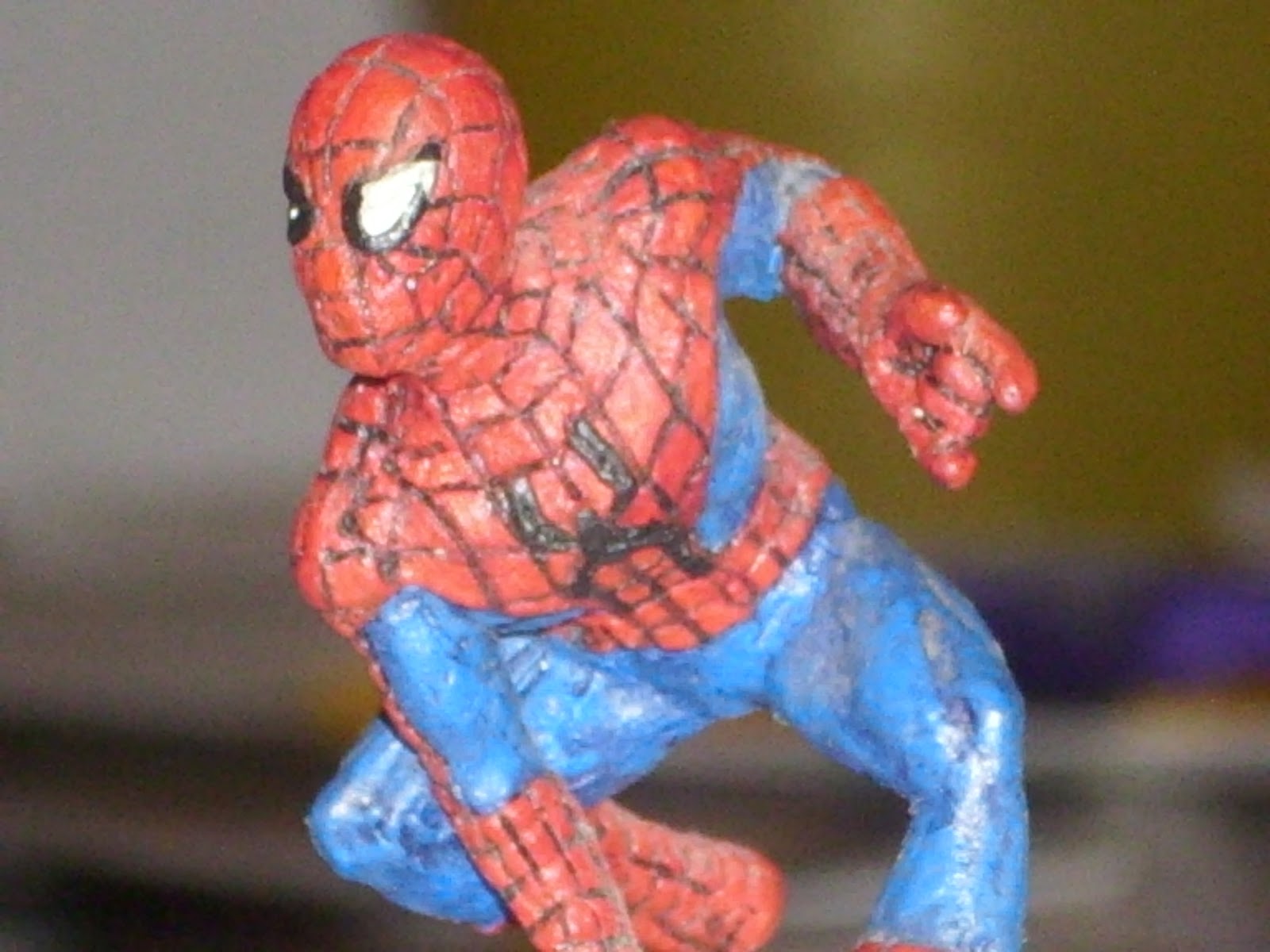
All of that to say, "I hate my camera." It's old, and it's wearing out. It often refuses to focus. I can hear the mechanism inside trying, but it just won't do it. Then, of course, there was the whole episode while at Disneyland when the camera refused to even turn on.
But it's what I have at the moment, so I do the best I can with it. Yeah, I could go buy a new one, but I don't want to just go out and buy another cheap camera that wouldn't really be any better than this one, so I'm working with the one I have until we can actually get something better.
And that's how life is a lot of the time. You do what you can with what you have rather than just do nothing. Not that some people don't choose to just do nothing, but how much sense does that really make? When you wait for everything to be "perfect," you don't ever do anything.
I mean, for most of us, owning a car is always like this. You drive the piece of crap you have, right? Do you ever really go outside to go to work and look at your car and think, "I can't go to work in this. I'll wait till I have a better car, a new car, before I go to work." If you don't go to work, that new car will never happen, so you make do with the car that ought to be wearing a diaper and needs chemo for the cancer it has because it won't quit smoking.
All of this goes for writing and everything related to writing. You do what you can with what you have at the moment and keep trying to make it better. Better by degrees. And you learn from it.
When I finished The House on the Corner, I didn't have any money to pay for anything like, oh, a cover or marketing or anything. Which is still true, but, you know, doing the best I can. Anyway, I'd finished it and, after some research, knew I wasn't interested in pursuing traditional publishing, so it was time to do the best I could, which was this:


It can be hard to look at what other people have and look at what you have and decide to keep going. It would be so much easier to just give up. Let the piece of crap in the driveway continue to sit in the driveway and hide in your house because you're too ashamed to be seen driving around in that book with no cover.
And I have to mention it: editing.
Editing is a big deal. A poorly edited book can be a huge issue for a lot of people. BUT! As hard as I seem to be on the whole editing thing sometimes, I'm not as bad as I sound. As I said back in this post, my real issue is with people who have the "I'm not gonna leave the house" attitude about editing. "I could do better, but I'm going to choose not to because it's too much trouble." That bothers me. If you have a good story, it's well written, and you've utilized all of you editing avenues, you should not stick your book in a drawer because it doesn't look good. Drive that "piece of crap" (being metaphorical here -- I don't mean it's a piece of crap necessarily) to work, just like I drove my coverless book, and keep making it better by degrees. As you learn new things or have more resources, make it better. Make it the best that it can be at any given moment.
That's all anyone can do -- the best you can with what you have at any given moment. And don't be intimidated by the fact that some people have better than you. Some people just start out with more. No, it's not fair, but that's how life is. It shouldn't stop you from doing the best that you can right now.
end of line...
But don't forget to come back tomorrow for the FREE! release of part 6 of Shadow Spinner:

Monday, October 1, 2012
Remembering Miniatures
I haven't talked about the fact that I paint in a while. Mostly, it's because I haven't done any painting in a longer while. Since I got serious with the whole writing thing back in 2010, I pretty much set the brush aside. I just haven't had the time for it. Not to mention the fact that all of my painting stuff is still packed up since we moved last year, and I haven't worked out yet where to set any of it up.
But I've really been wanting to paint, lately. And do some gaming. Tabletop gaming. Oh, yeah, before you get all confused, I don't do canvas painting; I paint miniatures. I used to also do tabletop wargaming with them, but it's been even longer since I've done that. Like 20 years. Not that I haven't done tiny bits of tabletopping in there, but I haven't done anything serious in 20 years. It's one of the things I miss doing, but there's just not time or space for it, right now.
But I digress...
All I really want to do today is show you some pictures of some of my old figures from when I played Warhammer Fantasy Battle. My main army was Wood Elves.
 This is not an army. This is a unit of rangers.
 All of the shields are individually painted. No decals.
One of the reasons I loved Wood Elves is that the Wood Elf army gets Treemen.
 Who wouldn't want one of those on your side?
They also got beast masters, which were pretty cool, too.
 But the main thing about the Wood Elf army that I loved was the Wardancers.
 They didn't wear armor, because they had magic tattoos. Yeah, my guy doesn't have any tattoos (long story that has nothing to do with the miniatures -- maybe one day I'll explain), but he's still cool.
Here is the commander of the ranger unit:
 And the sorceress:
 And the musician:

Anyway... that's just a look. I have some more stuff coming up about miniatures and painting, so I thought I'd let you guys see what I'll be talking about before I talk about it.
But I've really been wanting to paint, lately. And do some gaming. Tabletop gaming. Oh, yeah, before you get all confused, I don't do canvas painting; I paint miniatures. I used to also do tabletop wargaming with them, but it's been even longer since I've done that. Like 20 years. Not that I haven't done tiny bits of tabletopping in there, but I haven't done anything serious in 20 years. It's one of the things I miss doing, but there's just not time or space for it, right now.
But I digress...
All I really want to do today is show you some pictures of some of my old figures from when I played Warhammer Fantasy Battle. My main army was Wood Elves.


One of the reasons I loved Wood Elves is that the Wood Elf army gets Treemen.

They also got beast masters, which were pretty cool, too.


Here is the commander of the ranger unit:


Anyway... that's just a look. I have some more stuff coming up about miniatures and painting, so I thought I'd let you guys see what I'll be talking about before I talk about it.
Subscribe to:
Posts (Atom)