Some of you may have noticed the spate of movie reviews on my blog, lately, and the more astute of you may have noticed that most of these (nearly all) have been for movies that are nominated for Best Picture at this year's Academy Awards. See, several years ago, my wife and I decided to actually try to see the movies that were nominated before the awards were given out. [She's not all that into the big, blockbuster-type summer movies (with some exceptions (Avengers)), so this our movie thing that we do together.] It didn't go so well that year, because we waited until after the nominations were announced, and many of the movies were no longer at the theater and not yet available on DVD. Since then, we've been working on our technique.
Last year, we managed to see six of the nine nominated films before the awards ceremony (we've seen all but one, at this point). Although I was glad that Argo won (for Affleck's sake), I think Lincoln was the better film. At least, Day-Lewis won for best actor, though, because anything other than that would have just been wrong.
This year, we are up to six of the nine nominated films (as I write this, because I think we'll be at seven before this actually gets posted). Of course, my belief is that the count should be seven of 10, because Saving Mr. Banks certainly should have been nominated. Some of what I've read suggests that it didn't get nominated due to Meryl Streep and that she was actively campaigning to keep that nomination from happening. And I get that a big part of the Academy Awards is political, but that kind of stuff just bothers me. And, no, I don't know Meryl Streep, so I can't say that that's true, but I did read about her anti-Disney speech, and I do know that that film should have been nominated.
But maybe it wasn't nominated so that it wouldn't win. I mean, if it was nominated, it would be difficult to justify picking a different movie over it, like, say, 12 Years a Slave, but, if it's not nominated at all, then it can't win. Which is messed up logic, too, but the Academy people do like to go with "important" movies and, maybe, it's still too close to The Artist's win in 2011 for them to go with another Hollywood-ish film even if this one is deserving (as opposed to The Artist, which wasn't).
Anyway...
At the moment, from the nominated movies, I'm going with 12 Years a Slave as the eventual winner. I don't think it's the best film, but I do think it's the most likely to win. Of the ones I've seen, I think Dallas Buyers Club is the most deserving of the Best Picture Oscar, but I don't think it will win. I do hope that Matthew McConaughey gets Best Actor, though; he was tremendous in a similar fashion as Day-Lewis in Lincoln.
Did I say there should be 10 nominations this year? Actually, I don't really think that. I think there should only be nine, because The Wolf of Wall Street doesn't deserve its nomination. It's this year's Beasts of the Southern Wild, the movie that people can't bring themselves to say that they don't get. Sometimes, when a movie doesn't make sense, it really just doesn't make sense. Don't pretend you get it by talking about how deep it is and how other people just don't understand, especially if, then, you're not going to bother explaining because, you know, if you didn't get it on your own, you just can't get it. Do people still believe that line? I suppose they must.
Anyway, I've already been through that class, so it doesn't work on me. Heck, I've been on the other end of that, so it really doesn't work on me. [Seriously, one of my English profs in college would give A's to any paper that was just outside of his understanding. Or, you know, if it was too confusing but you could make him think he just wasn't "getting" it. Rather than look like he didn't get it, he'd just give the paper the A.]
Captain Phillips is this year's Life of Pi for me. It's the movie I just can't manage to make myself want to see. We knew when it was out in theater that we should go see it. We talked about it a lot. It always came down to, "Well, do you want to see it?" "No, do you?" "No..." And, so, we never went to see it, and there's probably no way, now, to see it before Oscar night without buying it, and I really don't want to do that. Although, if we manage to get in the other two beforehand, we might break down. It has been mentioned.
And, yeah, I did, eventually, see Life of Pi, and, yeah, it would have been a cool movie to see in the theater just for the visual aspect of it, but, beyond that, I wasn't overly impressed (you can click the link and read the review if you want).
I guess the real question from all of this is, when all is said and done, "Do I feel, really, like I've watched the year's best movies?" Yes, actually, on the whole, I do, especially this year. There are movies I enjoy more just for the thrill of watching them, but I don't have any illusions of that making them better movies than they are. As with food, enjoyment does not equal quality or goodness (for you). Look, I loved Thor: The Dark World, and I would (and will) watch it again, but Dallas Buyers Club is a better movie. I'll probably never watch Dallas Buyers Club again; it's not the kind of thing you want to watch again (most people, anyway); but I'm really glad I saw it the one time, because it was a powerful and moving movie.
So, mostly, yeah, I think they do a pretty decent job of picking out the "best" movies. The movies with something to say. Except 2011. I don't know what was going on that year. At any rate, that we watch these movies allows me to step a little outside of the movies I would normally watch. It's like (exactly like) reading a book outside of your favorite genre, and it's always good to experience new things. Some of them will suck (Wolf), but some of them will be extraordinary and you'll be really glad you stepped outside of your box even if you're just going to get right back inside (because I totally plan to see Robocop). The thing is, if you do it enough, you'll find that your box isn't quite cube-shaped anymore, and that's a good thing.
Oh, and just to throw it out there, my wife is totally going for American Hustle. I think it's the hair.
Showing posts with label artist. Show all posts
Showing posts with label artist. Show all posts
Sunday, January 26, 2014


Sunday, November 17, 2013
Winterblast in the SofA District (a local color post)
Apparently, I don't know all that much about where I live. No, seriously, every time I think I have a grip on Sonoma County, I find out that I'm wrong. Well, not that I'm wrong, exactly, but just that there's always something else I wasn't expecting.
Like last week, my wife tells me that she wants to go to this Winterblast celebration in the SofA District over this past weekend, and I was all "huh? SofA District? We have a sofa district?" I couldn't figure out why there would be a need to have a whole district for sofas. That is, unless they could fly like that one in Hitchhiker's.
"The South of A Street District. It's like the artists' quarters."
"We have an artists' quarters?"
"Yeah, that's what they call it."
Just to make this clear, this was the 9th Annual Winterblast. The 9th one! And I was only just hearing about it. But, then, I don't always pay the best attention to things going on around me. But that's beside the point. The point is that we went to this Winterblast Celebration. A Celebration which included a sofa parade. At night. Because the whole celebration was at night, which made taking pictures more difficult than I would have liked, but I managed to get some that work.
This being an artist event, though, meant that there was a lot of cool artwork on display, and, yes, I took pictures. Unfortunately, I didn't do a great job of keeping track of what artists painted what stuff, so I'm going to show you some of my favorite pieces and, then, give you some links to the artists' sites.


 BrinoIsm
Saltworkstudio
Serena Hazard (actually, the first one with the tree is from this artist)
I did get the information for this last piece I'm going to show you. It's by Michele Bottaro, and it was my favorite painting I saw at the event. Really cool... and not for sale! (Not that I could afford it if it was, but, still...)

There was also art on building walls and such, like
 and this heart in someone's window that I got with the full moon above it:
 And there were some street dancers:

 And, then, of course, there was the SofA Parade:


 And, if you remember this post, you might recognize this couch (it really seems to get around):


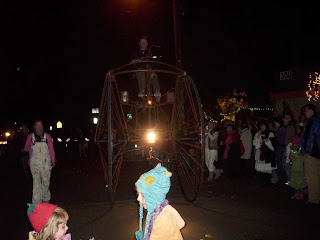

 All in all, it was a pretty good event. I would have spent a lot more time looking at the art, but it was fairly crowded and hard to move from studio to studio. I think the event could benefit from some extended hours and a parade that happens when it's still light out. I guess we'll see what happens next year.
Like last week, my wife tells me that she wants to go to this Winterblast celebration in the SofA District over this past weekend, and I was all "huh? SofA District? We have a sofa district?" I couldn't figure out why there would be a need to have a whole district for sofas. That is, unless they could fly like that one in Hitchhiker's.
"The South of A Street District. It's like the artists' quarters."
"We have an artists' quarters?"
"Yeah, that's what they call it."
Just to make this clear, this was the 9th Annual Winterblast. The 9th one! And I was only just hearing about it. But, then, I don't always pay the best attention to things going on around me. But that's beside the point. The point is that we went to this Winterblast Celebration. A Celebration which included a sofa parade. At night. Because the whole celebration was at night, which made taking pictures more difficult than I would have liked, but I managed to get some that work.
This being an artist event, though, meant that there was a lot of cool artwork on display, and, yes, I took pictures. Unfortunately, I didn't do a great job of keeping track of what artists painted what stuff, so I'm going to show you some of my favorite pieces and, then, give you some links to the artists' sites.


Saltworkstudio
Serena Hazard (actually, the first one with the tree is from this artist)
I did get the information for this last piece I'm going to show you. It's by Michele Bottaro, and it was my favorite painting I saw at the event. Really cool... and not for sale! (Not that I could afford it if it was, but, still...)


Tuesday, October 8, 2013
The Emotional Lawn (an Indie Life post)
I've never been a big fan of yard work. Evidently, my parents weren't either, because, as a kid, I did the bulk of the yard work. Fortunately, for my kids, we don't have a lawn or, even, much of a yard, and what there is is rocks (because that's what the previous owners had put in rather than have a tiny lawn to tend (and, I have to say, these rocks are terrible. Tiny and red, they get tracked everywhere, because they quite easily get stuck in shoes and stuff)). But, when I was a kid, we had a big yard with lots of trees. And lots of leaves. And I hated raking. More than raking, I hated bagging the leaves. It was the worst.
The yard also had a steep hill down to the sidewalk (on two sides, since we lived on a corner), but, even with the hill, I preferred mowing to raking. Besides, when I mowed, I would mow designs into the yard. Not permanent designs, because, once the yard was mowed, there was no design. But, still, my dad always got pissed when I was doing diagonals and stuff and would yell at me for messing up the grass. Seriously. (And I always wanted to say, "Then you mow it," but I never did.)
In my current "yard," though, even with the rocks, there are weeds. They grow up between the rocks, and it's difficult to get rid of them. For one thing, you can't just go out and mow them down. The last several weeks, I've sort of let the weeds take over, because they were growing up faster than I could pull them out.
And that's what it's like, sometimes, being an indie author. For one thing, you have to tend your own emotional lawn. Those big name authors often have plenty of people to help with theirs, not to mention the fans which will plant plenty of flowers (praise). But indies... well, they get to tend their lawns pretty much on their own.
And it can be tough. You get your book out there, but, really, no one knows who you are, and it doesn't generate the kind of sales you'd hoped for, and you don't get the kinds of reviews you'd hoped for, either in number or quality, or you get that one really bad review that just breaks your heart and makes you wonder what you're doing anyway, and, suddenly, your emotional lawn is full of weeds: resentment, envy, bitterness, even thoughts of revenge. Basically, you have a lawn that's invested in how others treat it. You're allowing people outside of yourself to control what grows in your own emotional lawn.
And, really, why should those other people care what's growing in your lawn?
Even the people that do care, close friends and family, and may try to help you out with the weed pulling ("That bad review doesn't mean anything." "Keep working at it, sales will get better." "Don't worry that <someone else> is doing better than you."), won't keep it up for long if you continue to allow strangers the power to grow weeds in your emotions.
Really, you are the only person that can control what you have growing in your emotional lawn. You have to cultivate grass, an attitude of doing your thing without regard to the outside. You have to tend the grass, work at it, mow it, water it. You do just have to keep working and doing your own thing. And, when you see a weed popping up, you have to go over and pull that sucker up, because they breed like crazy, so you can't let them start.
Why is this important? Because, as an indie author, your lawn is almost as important as your books. Maybe as important. Maybe, even, more important. When you're big and famous (and rich), you can pass almost anything off as just being the product of an eccentric artist-type, but, when you're a little indie guy, how you behave (what your lawn looks like) is a lot of what attracts new readers, so, if you have a ton of weeds (bad behavior and attitude), it won't matter how good your books are, people won't want to come around. (That's why when authors have public meltdowns over bad reviews (or whatever) can ruin their careers before they even get started.)
So, yeah, maintaining your emotional lawn as an indie author is a lot of work. But it's one of those things that has to be done. But, you know, you can always have fun with it and mow in some diagonals, checker boards, or, even, swirls.
This post has been brought to you in part by Indie Life.
The yard also had a steep hill down to the sidewalk (on two sides, since we lived on a corner), but, even with the hill, I preferred mowing to raking. Besides, when I mowed, I would mow designs into the yard. Not permanent designs, because, once the yard was mowed, there was no design. But, still, my dad always got pissed when I was doing diagonals and stuff and would yell at me for messing up the grass. Seriously. (And I always wanted to say, "Then you mow it," but I never did.)
In my current "yard," though, even with the rocks, there are weeds. They grow up between the rocks, and it's difficult to get rid of them. For one thing, you can't just go out and mow them down. The last several weeks, I've sort of let the weeds take over, because they were growing up faster than I could pull them out.
And that's what it's like, sometimes, being an indie author. For one thing, you have to tend your own emotional lawn. Those big name authors often have plenty of people to help with theirs, not to mention the fans which will plant plenty of flowers (praise). But indies... well, they get to tend their lawns pretty much on their own.
And it can be tough. You get your book out there, but, really, no one knows who you are, and it doesn't generate the kind of sales you'd hoped for, and you don't get the kinds of reviews you'd hoped for, either in number or quality, or you get that one really bad review that just breaks your heart and makes you wonder what you're doing anyway, and, suddenly, your emotional lawn is full of weeds: resentment, envy, bitterness, even thoughts of revenge. Basically, you have a lawn that's invested in how others treat it. You're allowing people outside of yourself to control what grows in your own emotional lawn.
And, really, why should those other people care what's growing in your lawn?
Even the people that do care, close friends and family, and may try to help you out with the weed pulling ("That bad review doesn't mean anything." "Keep working at it, sales will get better." "Don't worry that <someone else> is doing better than you."), won't keep it up for long if you continue to allow strangers the power to grow weeds in your emotions.
Really, you are the only person that can control what you have growing in your emotional lawn. You have to cultivate grass, an attitude of doing your thing without regard to the outside. You have to tend the grass, work at it, mow it, water it. You do just have to keep working and doing your own thing. And, when you see a weed popping up, you have to go over and pull that sucker up, because they breed like crazy, so you can't let them start.
Why is this important? Because, as an indie author, your lawn is almost as important as your books. Maybe as important. Maybe, even, more important. When you're big and famous (and rich), you can pass almost anything off as just being the product of an eccentric artist-type, but, when you're a little indie guy, how you behave (what your lawn looks like) is a lot of what attracts new readers, so, if you have a ton of weeds (bad behavior and attitude), it won't matter how good your books are, people won't want to come around. (That's why when authors have public meltdowns over bad reviews (or whatever) can ruin their careers before they even get started.)
So, yeah, maintaining your emotional lawn as an indie author is a lot of work. But it's one of those things that has to be done. But, you know, you can always have fun with it and mow in some diagonals, checker boards, or, even, swirls.
This post has been brought to you in part by Indie Life.
Tuesday, July 9, 2013
The Importance of Liking Your Own Work -- Part Two (an Indie Life post)
A couple or few weeks ago, someone said to me that one of the reasons that she likes my blog is that I know how to take criticism. That, of course, started me to thinking, and the first thing I thought of was the incident that I talked about in part one of this. The point of that is this: when you approach a topic (whatever that topic is, from an idea to a creation) from a stance of confidence, it allows you to take any incoming information (critique) and say one of two things:
1. Well, that's obviously not valid, so I can discard that.
2. Oh, that might be valid; let me look at it and see.
When you lack confidence, when you don't believe in yourself (whether it's an idea or a creation), you only have access to one of those options.
You can either discard everything (because you have to) and cling to whatever belief you have, even when you have nothing to back it up with other than dogma (as I was talking about here (which is not to say that that behavior is only about religion; it's not. It's just as common in politics or science or, even, dieting)). Or you accept everything that challenges you as valid and try to accommodate all of it, which can be rather tumultuous, like being battered by waves at sea.
For an artist, a creator, either of those can be crippling.
You get people, on one end, exploding all over the Internet about anything negative that's said about their work (of which I have firsthand experience) and people on the other end trying to incorporate every critique given to them, even when they conflict with each other. Neither person has any actual confidence in what they've created.
So what is it that allows someone to take criticism well?
When it's an idea or belief, confidence comes from knowledge. From having researched your position, looking at the different perspectives, and coming to the best conclusion you can from the facts at hand. When someone throws something at you that you've already researched, you can disregard it. If it's new data, you can go look at it and see if it changes your perspective. Either way, you're approaching the situation from an area of confidence (that you just wouldn't have if you've accepted your stance on someone else's say so).
When it's about something that you've created, at it's essence, it's the same issue. The key, though, is having created something that you like. If it's the way you want it, it's rather the same kind of thing as having done the research on an issue or a belief. So, if someone comes to you and says, "I don't like the way you had that fart joke in there," if it's something you like (and think is funny), then you can shrug and say, "That's too bad." Or, maybe, someone says, "Hey, what if this thing happened here instead of that other thing?" and, maybe, it's something you never considered, but, then, you can look at it and see if it changes what you've done with your story and see if it really is a good suggestion or not.
If you don't like all of your story or don't know what works or are too busy trying to write a story that other people will like instead of one that you like, you have no way of evaluating what people say to you about what you've written, because you have nothing to judge it against. If you can't say, "I like it," then, well, you have nothing.
Here are two examples:
In one book I was reviewing, I mentioned that it felt like there were two stories going on that didn't fit together well. One of the main characters had absolutely nothing to do in the entire book except that, at one point, he shows up some place and does one thing that has significance to the story. And it's completely accidental on his part as he doesn't go there purposefully to do that thing, he just appears there and his appearance causes the thing to happen. I mentioned that, if that was his only role in the whole book, then, maybe, those two stories should be separate.
The author let me know that originally, it had been two different stories but someone else told him he should combine them, and he'd listened. He'd listened because he had not been satisfied with either story, felt they were both missing something. So, instead of working to make them both into stories that he liked, he started taking suggestions on how to make them better. He wasn't satisfied with the end product, either, but, once he'd put it out there that way, he felt he had to defend it even though he acknowledged the issues, issues he himself had with the novel but couldn't reveal in public. So he had meltdown online over my review and proceeded to call me all sorts of names and, well, it was messy.
But it was because he didn't have a story he actually liked.
For myself, one of the things people mention about The House on the Corner is that it starts slow. I spend too much time on character development. But, as I was just talking about in my review of Doc, it's the character development that's important to me. The action of the story is only there to reveal the characters to us, so I want to know the characters. So, when someone tells me I "take too long" to get to the story, that I don't start with a lot of action, well, I'm okay with that, because my story is doing what I want it to do. [I want it to be clear that the choices of Tom and Sam and Ruth happen because of whom they are as characters and not because of the arbitrary whims of meeting the needs of the plot.] I'm in a place of confidence, because I like my story. The negative criticism doesn't matter so much.
All of this brings me back to a point that I've made frequently over the course of my blog: as a writer, write the story you like. Don't worry about anything else. If you like it, there's very little chance that there won't be other people out there that like it, too. If, however, you try to write the story that other people like, you won't be able to do it. You'll write a story that some people like, maybe, but will have to deal with the other people that don't like it and, probably, won't like it yourself. And you may end up with something that no one likes. If you write the story that you like, well, at least, you like it. And that's what let's you look at a 1-star review and say, "You know what, that's okay, because I'm happy with what I've written." And, in the end, that's all that's really important.
This post has been brought to you by Indie Life.
1. Well, that's obviously not valid, so I can discard that.
2. Oh, that might be valid; let me look at it and see.
When you lack confidence, when you don't believe in yourself (whether it's an idea or a creation), you only have access to one of those options.
You can either discard everything (because you have to) and cling to whatever belief you have, even when you have nothing to back it up with other than dogma (as I was talking about here (which is not to say that that behavior is only about religion; it's not. It's just as common in politics or science or, even, dieting)). Or you accept everything that challenges you as valid and try to accommodate all of it, which can be rather tumultuous, like being battered by waves at sea.
For an artist, a creator, either of those can be crippling.
You get people, on one end, exploding all over the Internet about anything negative that's said about their work (of which I have firsthand experience) and people on the other end trying to incorporate every critique given to them, even when they conflict with each other. Neither person has any actual confidence in what they've created.
So what is it that allows someone to take criticism well?
When it's an idea or belief, confidence comes from knowledge. From having researched your position, looking at the different perspectives, and coming to the best conclusion you can from the facts at hand. When someone throws something at you that you've already researched, you can disregard it. If it's new data, you can go look at it and see if it changes your perspective. Either way, you're approaching the situation from an area of confidence (that you just wouldn't have if you've accepted your stance on someone else's say so).
When it's about something that you've created, at it's essence, it's the same issue. The key, though, is having created something that you like. If it's the way you want it, it's rather the same kind of thing as having done the research on an issue or a belief. So, if someone comes to you and says, "I don't like the way you had that fart joke in there," if it's something you like (and think is funny), then you can shrug and say, "That's too bad." Or, maybe, someone says, "Hey, what if this thing happened here instead of that other thing?" and, maybe, it's something you never considered, but, then, you can look at it and see if it changes what you've done with your story and see if it really is a good suggestion or not.
If you don't like all of your story or don't know what works or are too busy trying to write a story that other people will like instead of one that you like, you have no way of evaluating what people say to you about what you've written, because you have nothing to judge it against. If you can't say, "I like it," then, well, you have nothing.
Here are two examples:
In one book I was reviewing, I mentioned that it felt like there were two stories going on that didn't fit together well. One of the main characters had absolutely nothing to do in the entire book except that, at one point, he shows up some place and does one thing that has significance to the story. And it's completely accidental on his part as he doesn't go there purposefully to do that thing, he just appears there and his appearance causes the thing to happen. I mentioned that, if that was his only role in the whole book, then, maybe, those two stories should be separate.
The author let me know that originally, it had been two different stories but someone else told him he should combine them, and he'd listened. He'd listened because he had not been satisfied with either story, felt they were both missing something. So, instead of working to make them both into stories that he liked, he started taking suggestions on how to make them better. He wasn't satisfied with the end product, either, but, once he'd put it out there that way, he felt he had to defend it even though he acknowledged the issues, issues he himself had with the novel but couldn't reveal in public. So he had meltdown online over my review and proceeded to call me all sorts of names and, well, it was messy.
But it was because he didn't have a story he actually liked.
For myself, one of the things people mention about The House on the Corner is that it starts slow. I spend too much time on character development. But, as I was just talking about in my review of Doc, it's the character development that's important to me. The action of the story is only there to reveal the characters to us, so I want to know the characters. So, when someone tells me I "take too long" to get to the story, that I don't start with a lot of action, well, I'm okay with that, because my story is doing what I want it to do. [I want it to be clear that the choices of Tom and Sam and Ruth happen because of whom they are as characters and not because of the arbitrary whims of meeting the needs of the plot.] I'm in a place of confidence, because I like my story. The negative criticism doesn't matter so much.
All of this brings me back to a point that I've made frequently over the course of my blog: as a writer, write the story you like. Don't worry about anything else. If you like it, there's very little chance that there won't be other people out there that like it, too. If, however, you try to write the story that other people like, you won't be able to do it. You'll write a story that some people like, maybe, but will have to deal with the other people that don't like it and, probably, won't like it yourself. And you may end up with something that no one likes. If you write the story that you like, well, at least, you like it. And that's what let's you look at a 1-star review and say, "You know what, that's okay, because I'm happy with what I've written." And, in the end, that's all that's really important.
This post has been brought to you by Indie Life.
Tuesday, November 6, 2012
The Tick (or How I Wish I Could Write) (an IWSG post)
There are always two forces at play: the way things are and the way we want things to be. Both things pull at us: acceptance and desire. It's a rough road, but it's one we all have to make our way down. Well, that's not actually true. Giving into acceptance is always an option. Allowing things to just be the way they are even when we want things to change.
However, there are areas where acceptance can be a good thing. To a certain extent.
A while back, I had the opportunity to hear Jeff Kinney speak. He's the guy that writes the Diary of a Wimpy Kid books. Now, I've never read any of them, but my kids have really enjoyed them, so I wanted to hear what he had to say, so my younger son and I went to a Q&A and book signing he had at the Shulz museum. The thing I found most interesting is that he never wanted to be a writer; he wanted to be a cartoonist (see the link to the Shulz museum?). However, the more he tried to get into being a cartoonist, the more he found he didn't quite fit. It came down to the fact that he couldn't draw a circle.
I'm almost completely serious about that. What he actually said is that it was because he couldn't draw the same character over and over and have that character look the same each time he drew it. He also said he can't draw circles and implied that those two things are related, which I can see. If, as an artist, you can't freehand a circle, it makes it difficult to draw heads.
After many years of trying to be a cartoonist and just not being able to get anyone to pick him up and having the reason repeatedly be that it was because his characters never looked the same, he realized he was going to have to do something else. But what? This is that point where the struggle between the way things are and the way you want things to be can be really debilitating. He could have just given up. Thrown in the towel. Gone off to flip burgers.
He could have surrendered and just accepted that he couldn't be a cartoonist and gone off to do something else entirely. Like flip burgers.
Instead, he wrote The Diary of a Wimpy Kid, because, in that format, it didn't matter that he couldn't draw a circle. It was okay for his characters to never match. Sure, it's still not in his ideal world how he would have it be, but he's doing something close to what he wanted to do, and he's been very successful at it.
At this point, you may be wondering what any of this has to do with The Tick.
The Tick, of course, is a comic book, but it's not one I ever read. The character was invented by Ben Edlund, and the comic series started up at a time when I just wasn't interested in spoofs and the like. Actually, it was my low time for comics in general, the end of high school and beginning of college. I'd pretty much dropped down to just Spider-Man, X-Men, and Batman at that point. Once I got back into comics for real, I didn't pick it up because it was farther into the series than I wanted to try to go back and get, and I hated picking up series, especially new series, somewhere in the middle.
However, when The Tick came out as a live action TV series in 2001 with Patrick Warburton as The Tick, I was all over that. Mostly because of Warburton who has the greatest voice/chin combo in the world, but, after I started watching it, it became because of the writing. Which is Wow. I mean, there were such great lines in this show:
The point, though, is this:
I wish I could write like that. I really do. Ben Edlund is credited with writing the TV show, but I'm not sure if he was the only writer or not. I do know that Douglas Adams was the only writer of his books, and I wish I could write like that, too. Do you see a connection here?
But, see, I just don't think that way. At all. I read (or watch, because Monty Python falls into this same category) this stuff, and all I can think is "where in the world did that come from?" My mind just really isn't wired that way. So this stuff that I love, this bizarre stuff that I wish I could do, I will never be able to do. It's just not my thing.
So I could decide that since I can't write in this "Monty Python" way that I just won't write at all. I could decide that.
But I don't.
I don't decide that, because I'm a good writer. I'm a good story teller. I'm just not good at those kinds of stories with bizarre leaps of logic.
And you know what? That's okay, because I'm embracing the kind of writing that I am good at, because I like that stuff, too. Like Jeff Kinney. He never became a comic strip artist and had his own syndicated strip the way he wanted, but he is doing cartoons, and he likes what he's doing even if it's not the thing he most wanted to do. It's that conflict between what is and what is wished for.
All of that to say this:
Just because you may not be able to do something (like bizarre humor or epic fantasy or hard sci-fi) that you really want to do doesn't mean that you can't do something like it. Try things out and figure out which thing you are good at and grow that thing. Grow into that thing. Maybe it's not what you always dreamed about, but it might be close. Or it might be something you end up liking even more. The point is that you shouldn't give up the struggle just because that one thing, that one thing you always thought was the only thing, is out of reach. Keep struggling and striving and working and being but don't ever just accept defeat. Accept the thing you can't do and subvert the things you can do to get as close to that thing as you can.
However, there are areas where acceptance can be a good thing. To a certain extent.
A while back, I had the opportunity to hear Jeff Kinney speak. He's the guy that writes the Diary of a Wimpy Kid books. Now, I've never read any of them, but my kids have really enjoyed them, so I wanted to hear what he had to say, so my younger son and I went to a Q&A and book signing he had at the Shulz museum. The thing I found most interesting is that he never wanted to be a writer; he wanted to be a cartoonist (see the link to the Shulz museum?). However, the more he tried to get into being a cartoonist, the more he found he didn't quite fit. It came down to the fact that he couldn't draw a circle.
I'm almost completely serious about that. What he actually said is that it was because he couldn't draw the same character over and over and have that character look the same each time he drew it. He also said he can't draw circles and implied that those two things are related, which I can see. If, as an artist, you can't freehand a circle, it makes it difficult to draw heads.
After many years of trying to be a cartoonist and just not being able to get anyone to pick him up and having the reason repeatedly be that it was because his characters never looked the same, he realized he was going to have to do something else. But what? This is that point where the struggle between the way things are and the way you want things to be can be really debilitating. He could have just given up. Thrown in the towel. Gone off to flip burgers.
He could have surrendered and just accepted that he couldn't be a cartoonist and gone off to do something else entirely. Like flip burgers.
Instead, he wrote The Diary of a Wimpy Kid, because, in that format, it didn't matter that he couldn't draw a circle. It was okay for his characters to never match. Sure, it's still not in his ideal world how he would have it be, but he's doing something close to what he wanted to do, and he's been very successful at it.
At this point, you may be wondering what any of this has to do with The Tick.
The Tick, of course, is a comic book, but it's not one I ever read. The character was invented by Ben Edlund, and the comic series started up at a time when I just wasn't interested in spoofs and the like. Actually, it was my low time for comics in general, the end of high school and beginning of college. I'd pretty much dropped down to just Spider-Man, X-Men, and Batman at that point. Once I got back into comics for real, I didn't pick it up because it was farther into the series than I wanted to try to go back and get, and I hated picking up series, especially new series, somewhere in the middle.
However, when The Tick came out as a live action TV series in 2001 with Patrick Warburton as The Tick, I was all over that. Mostly because of Warburton who has the greatest voice/chin combo in the world, but, after I started watching it, it became because of the writing. Which is Wow. I mean, there were such great lines in this show:
- And, so, may Evil beware and may Good dress warmly and eat plenty of fresh vegetables.
- And isn't sanity just a one-trick pony anyway? I mean, all you get is one trick, rational thinking, but, when you're good and crazy, oooh, oooh, oooh, the sky is the limit.
- Destiny's powerful hand has made the bed of my future, and it's up to me to lie in it. I am destined to be a superhero. To right wrongs, and to pound two-fisted justice into the hearts of evildoers everywhere. And you don't fight destiny. No, sir. And you don't eat crackers in the bed of your future, or you get all... scratchy.
- Eating kittens is just plain... plain wrong! And no one should do it! Ever!
- Everybody was a baby once, Arthur. Oh, sure, maybe not today or even yesterday, but once. Babies, Chum: tiny, dimpled, fleshy mirrors of us-ness that we parents hurl into the future like leathery footballs of hope. And you've got to get a good spiral on that baby or evil will make an interception.
- I'm taking off the kid gloves and putting on the very mad gloves.
- Well, once again, my friend, we find that science is a two-headed beast. One head is nice; it gives us aspirin and other modern conveniences. But the other head of science is bad. Oh, beware the other head of science, Arthur; it bites.
- You know why super villains are so unhappy, Arthur? They don't treasure little things.
- When you get in bed with evil incarnate, it always steals the covers.
The point, though, is this:
I wish I could write like that. I really do. Ben Edlund is credited with writing the TV show, but I'm not sure if he was the only writer or not. I do know that Douglas Adams was the only writer of his books, and I wish I could write like that, too. Do you see a connection here?
But, see, I just don't think that way. At all. I read (or watch, because Monty Python falls into this same category) this stuff, and all I can think is "where in the world did that come from?" My mind just really isn't wired that way. So this stuff that I love, this bizarre stuff that I wish I could do, I will never be able to do. It's just not my thing.
So I could decide that since I can't write in this "Monty Python" way that I just won't write at all. I could decide that.
But I don't.
I don't decide that, because I'm a good writer. I'm a good story teller. I'm just not good at those kinds of stories with bizarre leaps of logic.
And you know what? That's okay, because I'm embracing the kind of writing that I am good at, because I like that stuff, too. Like Jeff Kinney. He never became a comic strip artist and had his own syndicated strip the way he wanted, but he is doing cartoons, and he likes what he's doing even if it's not the thing he most wanted to do. It's that conflict between what is and what is wished for.
All of that to say this:
Just because you may not be able to do something (like bizarre humor or epic fantasy or hard sci-fi) that you really want to do doesn't mean that you can't do something like it. Try things out and figure out which thing you are good at and grow that thing. Grow into that thing. Maybe it's not what you always dreamed about, but it might be close. Or it might be something you end up liking even more. The point is that you shouldn't give up the struggle just because that one thing, that one thing you always thought was the only thing, is out of reach. Keep struggling and striving and working and being but don't ever just accept defeat. Accept the thing you can't do and subvert the things you can do to get as close to that thing as you can.
Subscribe to:
Posts (Atom)