Showing posts with label punctuation. Show all posts

Friday, January 30, 2015

A Shot in the Light: parts I-IV (a book review post)

You can find my review for part one, "A Flock of Ill Omens," here.
You can find my review for part two, "In Short Supply," here.
I had intended to review parts three and four separately, but, before I got finished with part three, the individual parts became unavailable, so I'll be reviewing the first collection with a focus on parts three and four, since I haven't talked about them, yet.

The first thing I want to note is that the editing fell into a sinkhole or something somewhere between parts two and three. I believe that I noted in my review of part one that it was pretty clean but, by part three, it was like having the maid who doesn't do windows. In other words, the grammar and punctuation errors started getting in my way of seeing the view. Now, I will admit, editing issues stand out more to me the less I'm enjoying something or, to put it another way, I more easily overlook those kinds of copy-editing issues when the story is compelling. There was nothing here by part three to keep me from noticing every single error, some of them the kind of errors that shouldn't have existed to begin with. Example: Periods and commas NEVER fall on the outside of a quotation mark. If you look above to the links I've included, you can see that the commas, even though they are not part of the titles, are within the quotes. That's the proper way to do it. That should be a simple thing, and the increasing volume of people punctuating only outside of quotation marks is becoming troubling, and it's not something I expect to find in the work of an experienced author.

The other thing that was tiresome was the overuse of the past perfect and past perfect continuous verb tenses. I'm not sure exactly when this started happening, but I started noticing it in part three. The chapters started beginning with these elaborate thought flashbacks of everything that had been happening to the character since the last time we'd seen that character. For instance:
He'd left the apartment before everybody got up, deciding there was no better time to get the lay of the land. He'd started with Fort McPherson, an Army base he'd been to for Special Forces training twice upon a time, so the sense of familiarity had given him an advantage when he went to see what was going on.... Once he'd made his way onto the grounds, he'd stood in the trees to watch for a long time.
That goes on for almost that entire chapter, telling us everything very passively after the fact. This is the very definition of "telling" and not showing. There's no tension, because we know everything already happened from the character's perspective and he's just thinking through it all. Not to mention that passive storytelling just grows boring after a while.

 And I'm not even going to mention the fact that "army" and "special forces" shouldn't be capitalized. Oh, wait...

Now, I'm going to jump back to an issue I mentioned in part one, because it comes up again part three: the use of bug bombs to sterilize living environments. It bothered me when it was done in part one because, really? I mean, don't you think that if we could use bug bombs to kill viruses on open surfaces that we would be using bug bombs to kill viruses? By "we," I mean hospitals and health care people. For all I know, there are "normal" people out there who do use bug bombs in this way, and I bet they wonder why they still get sick. But I digress. After it happened in part one, it was possible that it was a misconception of the specific character; I didn't believe that, but it was possible. In part three, some other character wants to do the same thing, so it became apparent that it was an author issue as it seems to be common knowledge among all of the characters (who are all supposed to be intelligent and accomplished). This kind of research flub really bothers me.

And it's not the only one.

Also back in part one, one of the characters finds an office complex full of people who died from the flu. It was like they all got sick at once and died before any of them could get home. Or to a hospital. Or anything. This is after the author has already shown us other people with the flu being sick for long periods before succumbing, so I didn't understand why would have this building full of dead people. But I reserved judgement on that in case there was something else going on. However, by part three, finding office complexes full of dead people has become kind of normal, and it makes me wonder, again, if the author did any research beyond watching The Walking Dead. People don't get the flu and drop dead from it a few hours later. Employers don't keep people at work who are puking and running high fevers. This idea that there would be whole office complexes of people who died because they got too sick to leave is just.. wrong. Poison gas, maybe, but not any kind of disease. Biology just doesn't work that way.

On top of the scientific inaccuracies, one of the main ways the author moves the plot forward is by having the (supposedly intelligent) characters repeatedly doing stupid things. Like sneaking out alone. In fact, in part four, every main character but one sneaks off alone at some point and, each time, something bad happens. It became too much for me and, again, made me think of shows like The Walking Dead and Breaking Bad where stupidity is substituted in for personality so that the author(s) can move the plot forward. That was actually the breaking point for me, that all of these characters kept doing this stuff. Actually, it was all because of one character: Sydney. She sneaks out after someone else who has sneaked out, and she has no good reason to do it. The author prompted her by giving her a "bad feeling," but it was so that she would be there to rescue Theo when the bad stuff started happening. Sorry (not sorry), but I hate contrived plot points.

Honestly, it was a struggle for me to get through part four of A Shot in the Light. I only did it because I had previously stated that I would give it through part four. All of the issues with the story that I mentioned in my first two reviews are still present along with the issues that have been added in. So that's it for me. I won't be continuing to the next part or collection or whatever is next.

I will point out again, though, that the writing is fast-paced and there's a lot going on in the story. For most people, the grammar/punctuation issues are not going to be a problem. And, maybe, details like the bug bombs won't be an issue for most people, too. Based on the other reviews for "A Flock of Ill Omens," I have to assume that that is so. I do have a mild curiosity as to what is going on "big picture" in the book, but it's not enough to prompt me to struggle through the rest of the series.

Monday, July 14, 2014

Secrets (a book review post)

Secrets is a great example of how even a poorly written novel can be popular. And, when I say "poorly written," I mean it on just about every level that you can mean it. Still, though, it's better than Snow Crash but, then, Snow Crash is a level of stupidity all its own.

The first and most obvious issue the book has is that it needed an editor. This may be the most poorly edited book I've ever read. There were misspellings, homophones, tense issues, missing words, wrong words (above and beyond the homophones, which are, technically, wrong words), missing letters, wrong letters... um, did I cover everything? I'm not actually sure. And it's not that there were these things; it's that there were these things on every page. And not that there was, like, one per page, it was a handful per page. And I haven't even mentioned the punctuation... oh, wait, there, I did. Let me just say, and not just to whomever edited the book (I'm assuming the author (but I don't know that)), but to everyone (because this is becoming a real peeve of mine): a dash is not a "catchall" piece of punctuation. You can't just stick in a dash (either kind) because you feel like it. Dashes have a purpose, and they are much more limited than most people think. [Let me just put it like this: Quit using dashes! Seriously.] There were more punctuation issues than just the dashes, but it was like someone just sneezed dashes all in the book.

At any rate, if editing is an issue for you, don't attempt this book, because you will want to pull out a red pen and mark all over your Kindle screen (or whatever screen).

The next issue is that it's first person but not just first person: It's written from two different first person perspectives in alternating chapters. Which, in and of itself isn't an issue [I mean, I've done that, so who am I to complain, right?] except that both perspectives are written in exactly the same voice. There is nothing to differentiate them and, especially considering one is male and one is female, there ought to be some differentiation. The author doesn't even bother to give us alternate perspectives on the same event once we get past the first few chapters. For the most part, they just pick up where the other left off or show us what is happening where the other character isn't. Not to mention the fact that [spoiler alert] during the climax, when Olivia starts to doubt Holden, there is no suspense because we've been in Holden's head the whole book (and so has she, actually, for part of it) and we know how he feels about her.

[More spoiler alert.]

The story itself is pretty typical; in fact, I felt like I was watching a cheap knockoff of Buffy the Vampire Slayer through most of the book. So let's see:
1. Female protagonist born with a hidden destiny that she doesn't know about.
2. Bad boy romantic interest whom only she can save and turn to the light.
3. Good boy romantic interest to create some tension.
4. Traumatic death of a loved one.
5. Enigmatic mentor who never tells her anything useful other than that she's "special."
Yeah, it's got it all. Actually, it's worse than what I'm saying, too, because the female protagonist, who hasn't been in a relationship for over a year, finds herself instantly infatuated with two men at the exact same time. What are the odds? [Is the sarcasm coming through?] She immediately begins acting in ways that are just not her. Of course, we don't know that other than that she tells us that "she never does this kind of thing."

There are two things here:
We have to take Olivia's word about things way too often. The author never shows us how Olivia supposedly really is. For instance, when Quintus tells her that she's been born this guardian (the first one in 2000 years, so she's mega-special), he says to her something along the lines of "Haven't you always been a loner? Someone on the outside looking in?" But we never see that about Olivia. In the book, she has an awesome best friend who has been with her since middle school (that doesn't sound like a loner) and she's quite adept at being a socialite, so none of that stuff rings true in the book (it reminded me of Percy Jackson and how, at least in The Lightning Thief, he is constantly telling the audience he's one thing (a rebel and troublemaker) while acting completely the opposite).

It's quite difficult to take Quintus as a love interest seriously since Holden is the one offering the alternate perspective to Olivia's. To put it another way: Quintus is never a credible threat.

And speaking of vampires, Holden is "Vampire Lite." It's like the author really wanted to do a vampire story, but she also wanted her vampires to be able to go out in the daylight, so she just calls them "jinn," instead. Or "jinni." She seems to use the terms interchangeably, and they have nothing to do with the actual jinn mythology. It's just a word she uses, which, actually, bothers me. If you're not basing it on the actual thing, make up a word, or, you know, make your vampires all sparkly. Oh, and jinn have demons in them that operate much the way Whedon's vampires do without the actual changing into vampires.

Perhaps the thing that bothered me most, though, is the sudden, inexplicable, telepathic bond Olivia and Holden develop. It's all very much "we love each other so much, we know each other's thoughts! We're just made for each other! Two halves of the same soul!" [Yeah, I want to go wash my mouth out from just typing that.] So, yeah, their connection is so deep that they spontaneously develop the ability to read each other's minds. And, yet, at the end, even though Olivia has been inside Holden's mind, she doubts whether he really loves her and thinks that maybe he's just been using her the whole time.

Mostly, I just found the book tedious. There's nothing in it that hasn't been done elsewhere and done much better. If it had been well edited (or just edited), I might even would say: If this is the kind of thing you like (cliche love-at-first-sight stories), give it a read; as it is, I can't say that. Evidently, though, based on the other reviews and ratings, most people don't care about that kind of thing, so, I guess, if you like cliche love-at-first-sight paranormal(ish) love stories and don't mind bad grammar and poor punctuation, give it a read. I won't be going on to the next book, though...

Which reminds me! Considering the cliffhanger ending (which I won't spoil), it shows how much this book didn't hold my attention, because I don't care what happens enough to endure another of these books. The two stars I'm giving it is me being generous. I'd say it's probably a 1.5 star book.

Thursday, August 22, 2013

The Religion of Writing: Part Seven -- The Priesthood

The idea of the priesthood in a religion is an interesting one. Generally speaking, the idea of priests (no matter what they're called: pastors, rabbis, politicians) starts out as a group of people meant to help their congregation or flock. They're assistants.

But it never ends up that way, because those guys always end up with the authority. No longer are they there to help people out, they're there to tell them what to do, how to think, what's right and what's wrong.

It's not all their fault.

People like to have other people in authority over them. They like to have people tell them what to do so that, if (when) it goes wrong, they have someone else to blame. Besides, thinking is hard, so why not have someone else do it for you? Also, for instance, reading the Bible is a lot of hard work, so, if you can have someone else do that and just tell you what it says, why not? It certainly makes life a lot easier and more convenient.

So, ideally, you'd have people reading the Bible and going to a priest (or whomever) and saying, "I don't quite understand this; can you help me with it?" And the priest would say, "Well, because I have studied this stuff and based on these other texts, my interpretation of this is... Now, here are some other resources you can use to figure this out, because you shouldn't just take my word for it."

Instead, you have, "What does the Bible say?" And you get:

  • The Bible says <group a> are all going to Hell in a handbasket.
  • The Bible says <group b> are all going to Hell so fast that they don't even get a handbasket.
  • The Bible says <group c> aren't even going to make it to Hell because God is going to strike them down here on Earth.
  • The Bible says that if you wink your left eye while crooking your pinky you will also go to Hell.
  • Or if you crack your egg on the small end. (How's that for a literary allusion?)
Basically, you have people preaching their own, personal feelings as scripture, because, I'm here to tell you, the Bible does not say "abortion is a sin," and anyone that tells you that the Bible says that is a liar. Whether abortion is a sin is based upon an interpretation of other things the Bible says, so the correct way of dealing with that is to say, "Based upon these passages, I have come to believe that abortion is wrong," or, conversely, "Based upon these [other] passages, I do not believe abortion is wrong." Because the Bible does not speak about abortion.
For example.
And, yeah, I picked a touchy subject, but it was the first thing that popped into my head, and, no, I am not going to go into my personal opinion (because it doesn't matter and isn't what we're talking about), and, yes, there are passages of scripture which support both sides of that argument. (Maybe, I should have chosen the death penalty as my example, but I think people could get just as riled over that.)

[I do know that it's not like this everywhere, but those other places are the exceptions, not the rule.]

At any rate, the point of the priesthood (and, yes, I do include politics and, even, science) in any religion should be to help people to understand things and come to their own conclusions, not just deliver the "Word of God" and expect people accept it blindly. Except that, like I said, people want to accept things blindly. It doesn't take so much work.

Which, in a roundabout way, brings us to editing and editors, the priesthood of the publishing industry. You know, because "no one can edit their own work. They're too close to it." Which is just like "common people shouldn't read the Bible. It's too confusing to them. Only the priests should read it and tell the people what it says." And before you accuse me of Catholic bashing again (which is not to say that I'm not bashing that idea), most religions promote that kind of thought. Sure, the Baptists want you to have your Bibles with you on Sunday so that you can open them up and read along with the pastor, but the pastor is actually going to tell you what that thing you just read means, and you don't have to worry your pretty little heads over it. And, sure, Bible studies are promoted... full of handy little guide books that will explain everything for you. Forget any other interpretation which may be possible.

So, yeah, I hate that whole "no one can edit their own work" thing. And I hate that publishers give editors greater power over the work than the author, the one that knows the work and what it's there to communicate. Or not communicate. Or whatever. There was a time when an editor was just someone that came alongside the author to help. "Hey, this may not be the correct word here." "This sentence is confusing; what did you mean?" "What happened to Billy? He just disappears after chapter four?" Editors were meant to help authors think about what they had written and make sure they were saying what they thought they were saying. And the grammar? The author was expected to know all of that, because why? He was the author and knowing how to write, the grammar and punctuation, was his job.

But, you know, if we can let the editors be the authority on grammar and whatnot, why should we bother to know that stuff? So we fail to be as knowledgeable as we could and, then, complain at what the "editors" (and publishers) did to our works. [Not that that is the case with all authors, but there are plenty of big name authors out there that take issue with the editing in their works, and there are plenty of "author's preferred editions" out there trying to overcome what the editor did.]

Here's the thing that complicates all of this: Many, probably most, authors out there do need an editor. Or three. And I don't just mean someone to catch typos, either; I mean someone that can help them make their stories readable. And I kind of have to wonder at that point, if that kind of editing is needed, if that person should be seeking publication at all. For instance, there's an article or something written by Lovecraft about all of the things a "novice author" needs to master before seeking publication; many of those things were grammar related (this is not that article, but it does summarize it and link to the original text) and almost all of them are things authors (or publishers) expect editors to do these days. And Lovecraft has not been the only author to to talk about how novice writers need to learn their stuff before trying to get published. Don't let the editor be the authority.

And I'm hearing, again, many of you saying, "But you're too close to your own writing." To that, I will respond with a quote from my wife (because she's smart that way (and we talk about this kind of stuff all the time)):
To that I would say: Then what did we spend all that time in high school and college to learn to write for? We had to self-edit our papers, theses, and so on. We had to learn structure, pay attention to spelling, provide references and all of that. Did we forget it all just because, maybe, we're writing fiction? Do we believe that editors (people who edit) just sprang from the womb able to do it, or is it something they maybe learned? It's like a priesthood.
And, yes, that's what gave me the idea for the title of this one, because it is like a priesthood, and only the priests are allowed to edit. And that's just... foolish.

Of course, the key here in all of this is knowing your strengths and knowing where you need to get help. No matter what it has sounded like I've been saying in this post, I'm not advocating for people not to get editing help. Far from it. I wish more people would get better editors. What I am saying is that the idea that no one can edit their own work is fallacious. What I am saying is that authors shouldn't just give over authority of their own manuscripts to other people. What I am saying is that authors do their parts of the job and learn all the technical skills about writing as they can, because, to paraphrase Lovecraft, "Anyone can learn that stuff in school." The implication there is that if you don't know it, go back to school and learn it. Be able to approach an editor with, "I'm not sure about this part right here (whether it's a grammar question or a structure question); what do you think?" rather than, "Here's my manuscript; you do the rest." Know your stuff well enough to be able to tell editors, "No, what you're saying doesn't fit with my manuscript."

There was one point when Lovecraft was still starting out when he sent this:
"If the tale cannot be printed as it is written, down to the very last semicolon and comma, it must gracefully accept rejection. Excision by editors is probably the one reason why no living American author has any real prose style."
I'm pretty sure no one these days would get published under any traditional model with that attitude, and it was already rare a century ago, but Lovecraft did get published and is still considered the master of his... field? Genre? Man, I don't even quite know what to call what he did, and I don't like the title "weird fiction" which is what I often see it being called. The point is that he became his own authority. Clearly, self-editing is possible. Tolkien often had to go back and re-edit his manuscripts because the editors, not being as skilled or as knowledgeable as him, would cause problems in his works. The first edition of The Hobbit doesn't have "dwarves" in it; it has "dwarfs," which is a completely different connotation, because the editor thought Tolkien had made a mistake and didn't bother to check with him about it. That was not the only time that happened in the early days of Tolkien's books being published.

Editors have no special gifts. They have not received divine inspiration. They are not magical. They do not know anything that any author cannot learn. Any author should learn. But, of course, if you don't bother to learn that stuff, I suppose an editor can seem like an all-knowing priest.

Tuesday, June 18, 2013

What Your Blog Says About You: Part Four -- Presentation

This post is coming out of the original idea (almost two years ago) that spawned this series in the first place: presentation. Now, when I say presentation, I do not mean of the actual blog itself; I mean the posts. The look of the blog, the decoration, is a completely separate issue and one that I don't feel qualified to speak about as I barely pay attention to what a blog looks like. Maybe some people do, but that's not me. In the same way, I try, at this point in my life, to pay as little attention to the cover of a book as I can (but that's a post for another day (and something I've talked about before (somewhere))).

For most people, the number one thing that will affect whether someone will give your blog the time of day is post length. And, if you've been around my blog for longer than, oh, a couple of seconds, you'll see that this is something I completely disregard, but, in that, I'm in the minority. Most people want short posts. Short posts with, maybe, a list involved and, even better, pictures. And, if you really want to grab people's attention, it should be a picture of a cat being weird or spazzing out. But the real thing is length. People want to glance at your blog and think, "Oh, I have time to read that." If there is anything to make them think that they will have to come back later, most of them won't bother. So, yes, if you're really trying to bring in followers, I think it's good advice to keep your posts between 400 and 600 words.

Personally, I prefer longer posts with more substance, and I will keep a post open all day in order to finish it if I need to (as I sometimes do with some of Briane's longer posts). As such, I also prefer to write posts with actual substance rather than talking about talking about that substance as most people do. I'm more of the essay test rather than the multiple choice option. As such, I'm okay with the fact that some people skip over my posts as being too long. But it's something to be aware of in the way that you approach the way you post and has everything to do with the personality of your blog.

The next thing is a big one for me, something I hate and mentioned in part three, and that thing is constantly apologizing for not having posted recently. Seriously, just don't do that. So many people have what amounts to a running blog of apologizing for not having posted and promisings to do better. Especially those people with posted schedules. That's the worst. First, I'd say, just don't post a schedule. Do what you do and let that be it (sort of like letting your yes be yes and no be no without making promises you may break). But, really, I think most of the people that post schedules for what and when they're going to blog do it for themselves--to try and impose it on themselves--rather than to inform the reader of what's going on. At any rate, people with posted schedules seem to be the worst about actually following those schedules or posting in any consistent manner, and, then, every time they post, it's an apology for being behind or having not posted in three weeks or three months or whatever. Honestly, I don't care why you haven't posted. Whatever it was that caused you not to post was something that was more important to you than posting on your blog, and, actually, that's okay. You don't actually owe anyone anything. No one is paying you (probably) to be posting, so don't apologize for not doing it. Because, honestly, I don't care about your apology. And, especially, I don't care about reading an apology from you every few weeks. Tell me something interesting. So, unless there is some really interesting reason as to why you didn't post (other than that "life has just been SO busy!"), just get to the interesting and skip the apologizing. Really, people understand that there is a life outside of blogging (except, maybe, Alex, who I think may actually be a computer program that goes around commenting on blogs).

And, then, here's the thing that started this whole idea: If you are going to have a blog, especially a blog about writing or if you're writer with a blog about something else but as a representation of you're writing, LEARN HOW TO WRITE!

Having said that, I will say this:
If you're not a writer and have no aspirations to being a writer, it's not such a big deal. Which is not to say that you can be all slapdash with it, but I know I'm not very critical about the writing of people that just have a blog for fun-ish type reasons. I mean, most people don't read and write at that high a level (last I checked, it was 4th grade, but it's been a while since I've checked), which takes us back to the math thing: If you're not in a math field, I don't expect that you should be able to do advanced algebra or anything like that. Basic arithmetic, yes, but not the more complicated stuff. English is the same way. So, if you're not a writer and not trying to be a writer, I don't expect more than the basics and am not going to be... distressed... when that's all I see.

However, if you are a writer, learn to do it. Learn how to use proper grammar and punctuation. And practice it on your blog. Your blog should be a reflection of your style, and, if your style is not knowing the difference between "than" and "then" or "accept" and "except" or "site" and "cite," words that have distinct definitions and should not be so easily confused, then I'm not going to have much interest in reading any books that you write. And, well, probably, will not have much interest in following your blog for very long.

Just to be clear: I'm not talking about typos here; I'm talking about consistently using the wrong words. And, maybe, it's elitist, but, if it is, I can't help it. Learn your words. Especially "than" and "then." I hate reading through posts that use "than" every time "then" should be used. It makes me want to pull out my red grading pen, but, well, that doesn't work out so well with my monitor, so I have learned restraint.

And, really, if you're writer and most of your posts have to do with writing, I will have no respect for you if you can't manage to do it correctly while telling everyone else how to do it. The writing, that is.
[As an example, during a-to-z, someone had a post about the proper usage of semi-colons and, then, had a handful of incorrect usages in the post. Yes, I pointed it out only to have my comment deleted. The only thing that upset me about that is that blogger had at the end of the post something about letting her know if she'd gotten anything wrong. All I can say about that is "don't ask if you don't mean it."]

Having said all of that, yes, I do know that I probably have an unfair advantage in the whole grammar department, but I also view it as a writer's job to know, well, how to do the whole grammar thing. Especially the things that have hard and fast rules, like the definitions of words. I'm not necessarily going to get all picky on the commas. Not all of them, anyway, because, sometimes, comma usage is subjective and is dependent upon what the author wants the sentence to say. Sometimes.

So there's my rant. But, seriously, if you're writer, even if it is just a blog, you ought to have your best face on it. Sure, some people can't tell the difference, but is it worth the risk? [I have quit following more blogs because of the bad writing on the blog than for any other reason.]

All of that to say: how you present yourself is important. There are probably other things I could mention here, but I think these are the top three. Which wraps up what your blog says about you... at least for the moment.

Wednesday, October 31, 2012

Allegory of the Miniatures (part 5)

That time back in Shreveport was the last time I spent any considerable amount of time painting for other people, although I have sold some figures here and there in the last many years. Most for way too cheap. For instance, I wish I hadn't sold this one, at least not at what I let it go for:
But that's not really the point.

Before I get to the point, here's the last army type group of miniatures I painted. I intended to sell them when I started out on them, but, by the time I was finished with them, I decided I wanted to keep them. It's a group of Eldar troops from Warhammer 40,000.


The main thing here is learning to know what you're good at and recognizing it as such. When you're good at something but go around denying it, it comes off as fake or lame. Either you are so insecure that you have no faith in yourself and refuse to believe other people when they compliment you or you're just playing at the denial to get people to pump you up with comments like, "no, you really are good." Neither option works to your benefit. People get tired of being around someone that refuses to believe in his/herself, and false modesty, eventually, becomes offensive and tiresome as well.

Saying, "I'm good at this," or, even, "I'm better than you at this," is not arrogant when it's demonstrably true; otherwise, it's just delusional. And it's not the same thing as going around acting as if you are the king of the world. Arrogance is saying "I'm better than you at this; therefore, I am better than you." I'm a better football player, so I am better. I'm president of the student council, so I am better. I make more money than you, so I am better. The value of a person is not dependent upon a skill.

Likewise, humility is not acting as if you're not as good as other people. Humility is lifting other people up. Helping to elevate them. Being willing to bend down and give someone a hand. It doesn't do anyone any good when you can see that someone needs help with something and, yet, you go around self-effacingly saying, "no, really, you're great!" to that person and not helping them. Humility is being willing to get down in the ditch in your best suit and pulling someone out of the mess they're in. Humility is saying being aware that having more money or more power or more fame does not make you more worthy of person-ness.

So, as I've said in the past, yes, it's important to know where your skills are lacking, important to know in what areas you need to ask for help, but it's equally important to know what you're good at so that you know when to offer a hand to someone else that could use some help.

I am not the best painter out there. Far from it. If you want to see some really great painting, look up the Golden Demon winners from the miniature contest that Games Workshop does every year. Those things are amazing, and I sometimes wish I had invested the time to get that good. However, I was the best painter in the group I hung out with and, probably in that corner of Louisiana. If there was anyone better he was sequestered in a basement somewhere not letting anyone see what he was doing. At that point, it doesn't really matter anyway.

I spent a lot of time painting with my friends and showing them different techniques, not hoarding my knowledge. Yeah, I spent time putting myself out of business, as it were. The guy who bought me all the paints used to come over and paint with me all the time. We'd get two miniatures of the same type, and I'd show him what I was doing while he tried to reproduce it. And my cousin... well, my cousin would come over and paint so that he could get me to "help" him on the detail stuff that he couldn't do. Yeah, it was his way to get out of paying me to paint for him, but, hey, it gave me someone to talk to when I'd otherwise have been sitting there alone.

As the title says, all of this is an allegory. When I talk about grammar and punctuation, it is no way meant to be about "being better than anyone." I am, however, better at grammar and punctuation. No, I don't know that about each and every one of you individually, but I do know that in a general sense I'm better at grammar and punctuation. So, if I talk about comma usage, it's not about me going off about being better; it's about me trying to give you the tools to also be better. Like sitting down and painting with you and showing you how to do a proper dry brush stroke. If I review a book and talk about repetitive use of the word "then," it's not about me saying that I'm a better writer or a better person; it's to point out that there is such a thing as overuse of that word. I'm sure I have my own word reliances of which I may not always be aware. Like suddenly.

Anyway... I hate the idea of explaining an analogy, but, after you work with kids long enough, you kind of learn to explain everything. Better to explain it than to leave it open to someone not getting the point. So, if you know what I was talking about this whole time, that was great. If you didn't, don't tell anyone. Just say, "oh, yeah, I knew you were talking about grammar all along" and let it go at that.

Which is not to say that the painting story wasn't true; it was. I also felt like talking about painting. One of these days I'll get back to it for a little while.

Tuesday, September 18, 2012

On the, comma (or Don't Tell Me When To Breathe)

Oh, the comma, that bane of punctuation. But, first, a story:

A woman, a blond, if you must know, needed to have her hair done. She called around to find out if there was anywhere that would do her hair while she was wearing headphones. Finally, after calling a dozen or so places, she found one, and she went in. However, the hair stylist was surprised to find the woman wearing  actual headphones rather than earbuds, which is what she had expected. Who still wore actual headphones?

She said to the woman, "I can't do your hair while you're wearing those."

"You said on the phone that you could."

"Yes, but I thought you meant earbuds."

"What's an earbud?"

The hair stylist just blinked at the blond woman with the headphones on. They stared at each other for several awkward moments until the stylist said, "Look, can't you just take those off long enough for me to do your hair?"

The blond woman became instantly irate, "No! I can never take them off! Never!"

They stared at each other some more.

Finally, the blond said, "Can't you just work around them?"

Shrugging, the stylist said, "I can try."

The blond took her seat in the chair, and the hair stylist went to work. But it was more difficult than she thought it would be, and the piece of metal going across the woman's head was in the way, and the large pads on the woman's ears were in the way, and the stylist kept wondering what could be so important that the woman needed to leave the headphones on for. When she'd had about as much "working around them" as she could take, and the blond woman looked rather like she'd dozed off, the stylist thought, "Surely, I can move them just for a moment to get this last bit and put them back on before the woman even knows I've moved them." So she pulled the headphones back from the woman's ears.

Immediately, the woman began gasping and clawing at her throat and she fell to the floor and resembled nothing more than a fish that had been spilled from a fish bowl.

In a panic, the stylist called 9-1-1, and the ambulance came, but it was too late, and the blond woman was dead. The ambulance took the woman away after asking many questions about what had happened. The police came and asked more questions about what had happened, then they went away, too. After everyone was gone and just the poor hair stylist was left alone, she saw the headphones lying on the floor up under the chair where they had been forgotten by everyone. She picked them up, finding that they were still attached to the old fashioned walkman with an actual cassette tape in it.

Overcome by curiosity, she put the headphones on and pressed the "play" button. This is what she heard:
"Breathe in... Breathe out... Breathe in... Breathe out... Breathe in..."

At this point, you might be wondering what that has to do with commas, and you'd probably be correct to wonder that, but it does relate, so just give me a moment. (Mostly, though, I just think it's funny.)

Commas! Why are commas so difficult? Really, why are they? There's one fundamental reason that they've become such a difficult piece of punctuation to figure out. People are confused by what they do and what they're for. Those are two completely separate things, but, because they do this one thing, people have come to think that's also what they're for when it's not at all what they're for. What they do is merely a byproduct of what they're for.

Have I confused everyone yet?

Before I go on, let's talk about what a comma does, because this is what causes all the problems, especially the problem that I hate so much, the comma after the conjunction. See, what a comma does is to tell people where to pause in their reading. Or, as everyone likes to call it, where to take a breath (as if people mostly read out loud, when, in truth, people hardly ever read out loud). What happens, then, is that writers start throwing in commas where they would pause if they were saying their sentences out loud. This leads to commas in places where they don't belong as in the sentence, "But, he went home." That sentence shouldn't have any comma, but, for some reason, people want there to be a pause there, so they throw that comma in to indicate the pause.

So here's the thing: don't tell me when to breathe! No, really, don't do it. For one thing, the vast, VAST majority of my reading happens in my head, so I don't need any help with breathing when I'm doing that. For another thing, I, um, know how to breathe. Really, I don't need your help, and, if I did, I'd probably have a larger problem than what a comma could fix.

Also, don't try to tell me how to read. If your writing is good enough, you don't need to tell me how to read your sentences, the sentences will lead me in the reading. So don't try to tell me how I should go about reading the sentences you write. If I can't figure it out, there's either something wrong with my reading ability (and there's not) or you need to work on your writing some more. Or you're just being totally anal about the whole thing and want people to only read the same way you do, and that's just not okay.

And that takes us to what a comma is for. A comma is meant to convey meaning. As it is with adverbs, the comma is to provide clarity, or, in the words of wikipedia: "...the comma is used where ambiguity might otherwise arise..." See, this has nothing to do with telling the reader where s/he should take a breath. That kind of advice is just for music and swimming as far as I know (because, well, it's not good when you take a breath when your face is in the water).

Now, I'm not going to go through all the specific uses of the comma, because, frankly, there are just too many, and most of you are probably loosely acquainted with them, anyway. And some of them are optional and use the word "may" (as in "you may use a comma with a long prepositional phrase"), and that can lead to all sorts of confusion, because how do you know when you should or not? What I will say is this: if your comma doesn't add to the meaning of the sentence, you probably don't need it. By that I mean, if there could be confusion without the comma, you should have one. Unless you need a semicolon instead, but that's another issue, and I'm not going into that, right now (just know that almost all of you (and I don't mean you you, I mean people you, because people hardly even know what that little guy is called anymore) out there need to learn how to use the semicolon. He is your friend and should not be so overlooked).

However, I will mention one comma usage rule that everyone should go learn, because this is the most common error I see. Yes, even more than that stinking comma after a conjunction, and I think this is the one that causes that particular confusion anyway. Adverbial phrases should always be set apart by commas. Um, did I say always? Because I mean always. If you've written your sentence, which contains an adverbial phrase, correctly, you can pull that phrase (or dependent clause) right out of the sentence and still have a sentence remaining. It shouldn't mean the same thing without the phrase (because, if it does, you don't need that phrase to begin with), but you should have an intact sentence (you know, with a subject and a predicate (a verb)) remaining. This is the important thing, so pay attention:
Adverbial phrases, without the commas to set them apart from the rest of your sentence, can easily become entangled in your sentences and cause confusion. That's why adverbial phrases need a comma on both sides.
[One other note: there are some adverbs that always require commas, but it's really because they act as adverbial phrases all by themselves. You should learn these words. There really aren't that many of them.]

Here are some examples of correct ways of punctuating adverbial phrases:

  • <adverbial phrase>,<independent clause>, <conjunction> <independent clause>. OR <adverbial phrase>, <independent clause> <conjunction> <dependent clause>.
  • <independent clause>, <adverbial phrase>, <conjunction> <dependent or independent clause>.
  • <independent clause>, <conjunction>, <adverbial phrase>, <independent clause>. OR <independent clause> <conjunction>, <adverbial phrase>, <dependent clause>.
  • <independent clause>, <conjunction> <independent clause>, <adverbial phrase> OR <independent clause> <conjunction> <dependent clause>, <adverbial phrase>.
As you can see, I could go on with those for... well, quite a while. But that should give you an idea of the basics. Of course, you have to know the difference between an independent and a dependent clause, which I'll have to talk about at some point, but, really, that's a basic thing, and, if you don't know, you should go back and chastise every English teacher you ever had for not drilling that into your head. Or flog yourself for not paying enough attention in class.

It all looks and seems so much more complicated than it actually is; that's all I can really say about it. But, if you look at the above sentence structures, you may be able to see what causes these common mistakes:
<independent clause>, <conjunction> <adverbial phrase>, <some clause or other> -- The conjunction is NOT part of the adverbial phrase, so there NEEDS to be a comma between the conjunction and the phrase so that the phrase can be "lifted out."
<independent clause> <conjunction>, <some clause or other> -- This one is just wrong. That comma ALWAYS comes after the independent clause and you shouldn't have one after the conjunction unless there is an adverbial phrase (or a long prepositional phrase). [If you have a word like "however," there should be a semicolon involved, but we're not getting into that, right now.]

But let's make it even easier, because easier is better, right? Do this:
Write without any commas. After you've finished your section or whatever or waited a few days, gotten some distance from what you've written, or, even better, get someone else, go back and read through it and look for places where the writing is confusing. If it's confusing, there's a good chance you need a comma. Or commas. Look for places where the comma dispels ambiguity, not places where you want your reader to breathe.

As one final note, I will say this:
The Internet and texting are in the process of changing comma rules once again. We use them less, mostly, because we write shorter, less complex sentences. Personally, I use more commas than I specifically need to when I write, because I tend to put them in everywhere they're "supposed" to go. You know, by following all of the comma rules. However, I would say that the only real rule you need to know is "Commas are for meaning not for breathing." If you get that down, you should be okay. If the comma doesn't add to the clarity of the sentence, take it out. If not having one causes confusion, put one in. And watch your adverbial phrases, because they run into your clauses and cause confusion. You might know what you mean, but there's a good chance your reader will get confused.
In the end, too many commas are better than not enough as far as meaning goes, so, if you're not sure, put that comma in there. As long as you're not telling me to breathe!

Sunday, September 16, 2012

Remember that one teacher?

You know the one, right? That teacher that everyone dreaded getting. The one with the hard rep. The one you couldn't make excuses with or sluff assignments. The one that gave you nightmares...

There were only two types of students in that teacher's classes, the ones that made A's and everyone else. The ones that made A's were few, and no one made B's. You either worked your... bottom off or you did poorly. That's just how it worked. You know, except for that one kid that just made good grades without breathing, and everyone hated that kid. You're pretty sure even the teacher hated that kid but couldn't do anything about it.

I think I'm that teacher. Not at school. The kids love me at school. Even though my creative writing class is extra work for the kids (because it's an elective), the students frequently tell me that it's their favorite class. No... I'm that teacher here. Sort of. At least, that's the rep I think I'm getting for all the grammar stuff and my reviews. People are starting to ask me to not read their stuff because they're scared of the review they might get.

Of course, I also have more requests to read than I can keep up with, so I'm sort of okay with the requests to not read.

But here's the thing:
It's not the bad grammar, improper punctuation, and lack of editing that bother me. Not in and of itself, at any rate. If you're doing your best, you've sought out the best help you can find or afford, and you're trying to improve, I can overlook some bad grammar and splotchy commas. It's the people that shrug it off as not important that bother me. That's when  the bad grammar and lack of editing get me all riled up.

The thing that makes me most upset is when the author has the attitude of "hey, I wrote a book, and you should worship me for that." That bothers me. I mean, it really bothers me. And I find that a lot more than you'd probably like to believe. That attitude of "why should I worry about grammar, punctuation, and editing? Those things aren't important, because I wrote a book!" And I want to respond with something like "well, actually..."

It's the attitude that writing is all subjective anyway and therefore doing it correctly isn't important that bothers me. When I see a manuscript out for public consumption that looks like something one of my middle schoolers handed in, and I'm correcting their stuff and helping them to get better, but the author of said manuscript blows off the poor writing as "just my opinion," well, that makes me mad. Because, honestly, that attitude is wrong.

Here's the truth. Are you ready for it? I think it's a hard truth and one a lot of people have an issue with and don't really understand. The TRUTH:

Stories are subjective; writing is not.

It's that simple. Whether I like your story and how you tell your story is completely subjective, but, whether the writing is good or not, well, that's something else entirely. The writing is something that can be graded, and I know, because I do it. Actually, to some extent, stories can be graded, too, or, at least, subjected to objective measures like "hey, you have your character in two places at once, right here" (yes, I am (still) talking to you Snow Crash).

[Oh, and I have a good example of this coming up in a near future review. A story where the writing is very good, perhaps excellent, but the story just never grabbed me.]

The idea of writing being subjective is, honestly, just an excuse to excuse poor writing, and everyone has bought into it to such an extent that that part of it can't be seen anymore. Before I go on, there's a lot here that could be said about agents and publishers and all kinds of stuff, but I'm not talking about any of that. What I do mean is that people, when told their manuscripts need work, fall back on the whole "it's all subjective" thing. That, or they revise every time someone says anything, but they just keep changing the story rather than dealing with the underlying grammar issues.

[Okay, I need to insert here: when you're told that your manuscript needs work and there are a bunch of story suggestions included, that is subjective, because that person is just telling you what your story needs for that one person to like it more. However, when you're told your story needs work and there's a list of grammar/punctuation issues that need to be fixed, that's objective. That's stuff you should pay attention to.]

Before I get off on about 20 different tangents, I'm just gonna stop. This is a complicated topic and it changes from person to person, but, basically, if my rep is becoming that of some kind of grammar fascist, I suppose I'm okay with that, because there's not enough attention on proper writing, right now. Not from indies, certainly not from small publishers (who often have editors with no better than a high school diploma if they have editors at all), and not even from larger, more traditional publishers who have been canning editors to cut back on costs and increase profits.

All I really wanted to say, to clear up, is that I'm not so hard about all of this as it comes off. At least, I'm not so hard on the people that care, are trying, and actually want to improve.

However, I have no sympathy at all for those people who just blow it off as a non-issue or a subjective issue. If you want to have an analogy, and look! I do, it's sort of like a fireman that decides he's only going to put out fires that happen in bathrooms and children's bedrooms. The other fires just aren't important. They may not even be there, you know. Maybe that person wanted that fire in the middle of his living room floor. For roasting marshmallows, you know. Or, maybe, that stove top fire is supposed to be there, like for roasting a pig. It doesn't matter how much work that fireman puts into putting out the bathroom fire, the house is still gonna burn up.

And NOW on to other things!

Friday will be the free release day for part five of Shadow Spinner: "Part Five: The Police Car." Part five is the reintroduction of the Man with No Eyes: reintroduction because there was this post way back when that had him in it (and that exact scene from the linked post didn't actually make it into the book), and, also, reintroduction, because I posted this stuff a long time ago when I was first writing all of it. Anyway, all of that to say, well, be prepared for Friday, but, also, I want to give you a peek at the cover for part five, because it's amazing!
Drop by and tell Rusty what an awesome job he did!

Wednesday, September 12, 2012

On Grammar and Punctuation: Most People Do It Wrong

As I've mentioned, now that school is back in session, I'm teaching my creative writing class again. It's going to be different this year, though, as I will be teaching two days instead of one, and one of those days will be devoted to the technical aspect of writing. Story structure. Plot. And, yes, grammar and punctuation. I expect that I will start having more posts, um, start having posts devoted to these topics as we (my class and I) go through the year. Actually, I already have a post started all about that wily rascal, the comma, and class hasn't even started, yet. [Okay, actually it has, but I wrote this before it had.] Oh, and there was that post about adverbs which has actually been sitting around for a long while. See, these posts aren't being inspired by  the class; they're being inspired by the lack of correct grammar and punctuation I'm seeing all the time in people's projects and the tendency of said people to just brush it off.

Now, look back up at my title of this post. No, really, read it again. Do you see it? I'm guessing most of you don't see it. Actually, I'm guessing that none of you see it, but, hey, I could be wrong. If you see the problem, raise your hand. Anyone? It's wrong. Specifically, "wrong" is wrong. The word in that spot should be an adverb, because it's (supposed) to be modifying how people do it. The appropriate wording would be, "Most people do it incorrectly."

Why do I bring this stuff up? Aren't grammar and punctuation subjective? Can't you just kind of do it however you want to? No, not really, despite what a lot of people, including some (bad) editors, would have you believe. There are rules for grammar and punctuation for a reason, and, frankly, I'm getting tired of seeing comments like this from authors:
"I write first person because that way I don't have to know any of the grammar rules."
I'm sorry; that's just lazy and irresponsible, and, honestly, if you can't take the time to learn the rules of your job, then you shouldn't be allowed to write.
The problem, though, is that editors, also, don't want to learn the rules of their jobs, and publishers don't care as long as they're going to make money, and more and more of them are cutting back on the editorial staff to increase profits and "allow the audience to get involved in the editing." (Yes, that's a real quote from a real publisher (but I'm  not gonna say which one).)
While we're at it, why don't we let drivers get involved in the process of building cars. Without training.

So, yeah, I'm being kind of ranty, but the attitudes around this stuff are (frequently) just wrong! (And, see, that time the "wrong" is correct, because it's an adjective telling what kind of attitudes. Wrong ones!)

Here are two things that I've experienced recently that I want to point to:

1. In providing feedback about a manuscript recently, I made a punctuation error. Yeah, I did, because no one, and I mean no one, is ever 100%. Part of it was just that I don't go back and proof blog posts and emails and things like that quite as thoroughly as I do a work I mean to publish. I just don't have the time to proofread these things quite as fanatically as I will something I want someone to buy. Part of it was just that I was having a brain fart and was thinking about the word incorrectly, so I punctuated "although" in the manner that you should punctuate "however." All in all, it was a relatively minor mistake, and it wasn't a repetitive mistake; it was a singular slip. However, I made this error while providing grammar correction to someone. And there were a lot of corrections in the other manuscript, and they were all repetitive mistakes. See, that means the person in question didn't know what s/he was doing and needed someone else to say, "Hey, you're doing this incorrectly," or, in the vernacular, "You're doing this wrong." A third party responded by pointing out my mistake and saying that I had no business offering grammar corrections, because, LOOK!, I'd made one, too. Basically, if I couldn't be 100%, I had no business giving advice.

That is a ludicrous statement. In fact, if you take that out to its full implication, no one would ever be able to teach anything. Because why? Because no one is ever 100%. Not all the time. If I'm operating at, say, a 90% capacity and you're operating at, say, a 30% capacity, it's just ridiculous to make the statement that I shouldn't be allowed to make the assist on you getting better. This attitude of having to be at 100% just supports the idea that anyone can do whatever they want any way they want to because there's no one qualified to make them better. HOW STUPID! I just want to say: take the help you can get and the help that's offered and learn as much as you can. If you can see that someone else is more qualified than you, don't be a dunce and dismiss him/her because s/he's not 100% qualified.

2. Someone recently posted her first chapter and asked for feedback on it. Now, this was supposed to be in "final" condition. As in, she was getting ready to send it off and was asking for final thoughts. This also means that she was "finished" with her editing process, whatever that was. I'm assuming, based on comments, that it included feedback from critique partners. I figured I might as well give it a glance. I was barely able to do that.

The very first sentence had a punctuation error in it. And, I have to say, it was one of those that is really beginning to bug me, because I see it everywhere. Still, I thought, maybe it was just a slip, so I kept reading. The piece was full of errors. The dialogue was rarely punctuated correctly, and every instance of the type of sentence like the first sentence was punctuated in the same incorrect manner. Clearly, the piece needed editing, and I only made it about 1/3 of the way through before giving up. I left a comment noting the error in the first sentence and stating that I was unable to finish the piece because of all the errors.

The author asked for examples. Well, I felt I'd already given an example, so I related to her that I was busy editing another piece for someone, but I would try to give her 1st chapter a pass when I was done with the other project. Her response was, "Oh, no, I have critique partners for that; I just wanted an example of the punctuation errors you were talking about."

Clearly, her critique partners had failed at their job.

And that's the point, really: "Most people do it wrong." Critique partners when used as editors are entirely overrated, because, honestly, they don't know any more than you do. If you think you're going to get what passes as editing from your critique partners, you're going to be incredibly disappointed in almost every instance. They can't catch those comma errors, because they don't know they are errors. Do you know, without looking it up, the difference between a coordinating conjunction and a subordinating one? I guarantee you, your CPs don't have any more clue than you. And that's an easy thing.

While it's true that grammar and punctuation and, heck, language change over time, that does not mean that it's subjective. That just means it changes. Speech changes, and writing changes along with it to reflect those changes, but that doesn't mean that it's subjective, although there are often cases where rules can be argued (But that's just like science. Remember, science still doesn't know what glass is). Rules exist in grammar for a reason and while, yes, fiction is allowed to play with those rules more than non-fiction, it's not a reason not to know them or to break them because you don't know them.

I get that writing how we talk is all in vogue, right now. The first person experience has become this holy  thing and everyone is getting on board, but what comes out of it is a lot of garbage because people don't actually know how to write. First person has become the short cut to actually doing the work, and, yes, that bothers me. Writing, even first person writing, is not like speech. It shouldn't be. Writing is a separate discipline, and it should be treated as such.

I'm going to end this with a quote by C. S. Lewis. Specifically, he's speaking here about using italics in writing, but the idea can be expanded to all of writing, especially 1st person writing:

I am now inclined to think that this was a mistake - an undesirable hybrid between the art of speaking and the art of writing. A talker ought to use variations of voice for emphasis because his medium naturally lends itself to that method: but a writer ought not to use italics for the same purpose. He has his own, different, means of bringing out the key words and ought to use them.

What this really says to me is that a writer should learn to write. A writer should not be someone that just copies down what people say. Speaking and writing are different and should be different. Make words your tools and learn how to use them.

Tuesday, August 21, 2012

Back in the School of Things

School is in full swing again. It started last Wednesday for the younger two and on Monday for the oldest. Back to school means a lot of things:

  • back to biking -- and, oh, man, after, really, all of the spring and summer away from it, it was a lot harder adjustment than I thought it would be. Not the actual doing of it, but, evidently, my butt got out of condition, and it had an argument with the bike seat the first few days. My younger son said the same thing. My daughter, however, just gloated about how comfy  her seat is. [I have to add here that it was my daughter's fault we didn't bike through the spring. She caused an accident by arbitrarily stopping that ended up with me flipping over my bike and breaking the rear axle. Yeah, it took me a while to get around to getting it fixed.]
  • back to making lunches in  the mornings  -- Of all the things related to school, I hate getting up and making all of the lunches the most. I've tried doing it in the evenings ahead of time, but, evidently, I hate that even more, because I just won't do it on a consistent basis.
  • back to badgering the kids about getting their homework finished -- Yeah, I hate this one, too, but lunches are worse.
  • back to quiet during the day allowing me to focus on writing for more than 12 minutes at a time before I'm interrupted
  • back to teaching creative writing! The class will be two days a week, this year. One day will be for writing and reading and the other day will be for technicals such as grammar, punctuation, and story structure. [My son will only get to be in the class half of the year because of Spanish and art, which are both required while my class is just an elective. He's not happy about it.]
  • back to reading The House on the Corner! I've been asked to read the book to a new class of kids this year. I'm actually pretty sure none of these kids have ever heard any of the book before, or, if they have, it was years ago while I was still writing it. I think, though, this is the in between group that has not had any overlap from the reading in either of my son's or my daughter's class. At any rate, none of my kids are in this class this year, so it was a nice surprise to be asked to come in and read by a teacher that does not have one of my kids in her class.
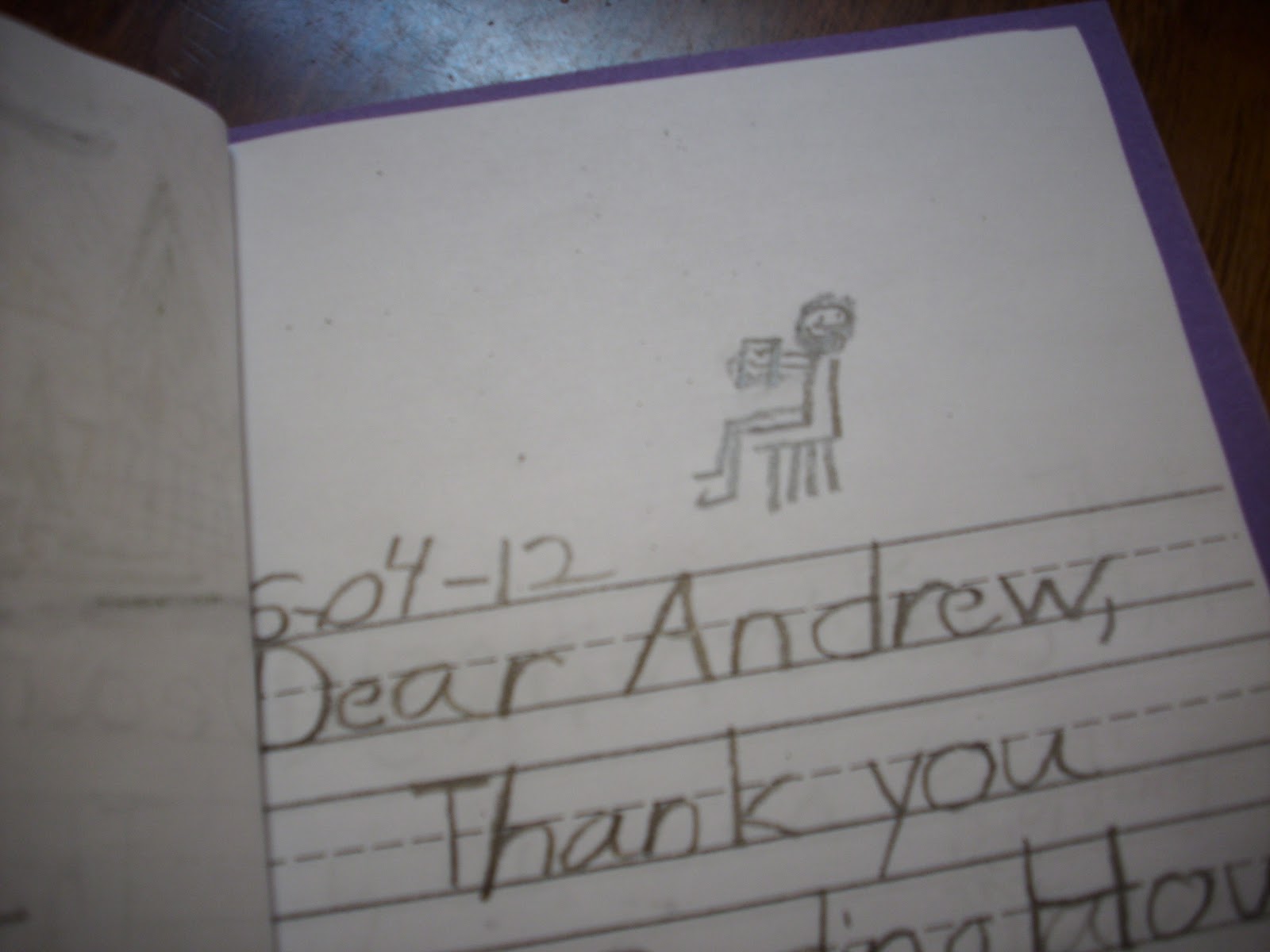
Speaking of reading in classes, I found this
in our family folder last week. It's a thank you book from one of the classes I was reading in last year. Each kid wrote me a note, and some drew pictures.
A picture of the house.
Me reading to the class.
The thank you book was completely unexpected and completely awesome.

Since I'm going to get to spend more time on the technical aspects of writing this year, I'm going to be doing some posts related to that stuff. It makes me glad to be able to work with kids interested in writing and help them to develop their technique at an earlier age than most people get to. I mean, most of the writing samples I run across online aren't any better developed than middle schoolers', anyway, which makes me wonder what happened to their schooling, except, then, I remember the state of the education system and the lack of importance given to anything in the arts, which includes knowing how to write a decent sentence, and I quit wondering, but, then, I wish they would take it seriously enough to learn how to do it rather than just blowing it off and writing in 1st person because they think they can get away with it that way. I don't know... maybe, grammar lessons will be boring, but they will probably be accompanied by a decent amount of ranting, which can make pretty much anything entertaining, so I guess we'll see.

Hmm... It seems like I had one other thing for this post, but, if there was something else, it's gone now. At any rate, for those of you with kids going back to school, I wish you a very merry school year. Or, you know, the nearest approximation.

Monday, August 20, 2012

Be Vewy Qwiet...

...I'm hunting wabbits.

One night last week, when we were out on the evening walk with the dog, we came across a rabbit in a field off the trail. Actually, it was a hare, but people always get so confused when you talk about seeing hares or wild hares, so, you know, we'll keep it simple and just call "him" (because I'm deciding it was a him) a rabbit. I'm sure he doesn't really mind, because, well, he can't read. I hope. Because, if he can read, humanity may be in trouble.

Anyway...
We were out walking; my wife and I were way ahead of the pack of kids that were lollygagging with lizards and naked ladies behind us.
This kind of naked lady. Yeah, I know what you were thinking...
Out in the field on  the other side of the fence, was a rabbit. It was sitting up with its very long ears sticking straight up, and we stopped to watch it. The tall grass in the field beyond probably starts about 60' or so away from the trail, and the rabbit was about midway between us and the grass. (and I wish I had a picture, but I wasn't carrying the camera) The girls, my daughter and her two neighbor friends, were making a lot of noise, so, as they got close enough, I called out to them that there was a rabbit. Now, this was meant to be the signal for them to approach quietly, you know, like Elmer always says; however, it actually resulted in a mad dash toward us and even more noise, and, of course, the rabbit scampered away. It did stop just before hopping into the tall grass, so they did get to see it, but it's not like they got to observe it the way my wife and I (and dog) had been before they crashed in on us. Even the dog knew to be quiet.

The problem with the girls is that they all want to talk at once, and I don't mean just to each other. They all want to talk to me at once, and it makes my head feel like it wants to explode. I have flashes of that scene from the Grinch with all the noise all the noise all the noise from Whoville every time they walk with us.

So, last night, there was a squirrel. I love squirrels. I've probably mentioned that before. He (yes, he gets to be a he, too) was sitting up in a branch on a tree eating and chattering away.
Unfortunately, he was too far away for my flash to do any good.
My daughter was, again, lagging far behind, because she was looking for lizards, but my wife and I had stopped (with the dog and the younger boy), so she came running up making a ton of noise, and the squirrel dashed off farther up into the tree (so I didn't get a chance to try and get a better picture). She got to see the squirrel, but she was sad she only got to see it running away.

Is anyone seeing a pattern here?

At that point, my daughter wanted to go ahead of everyone else to see if we could find the rabbit again. I left the dog with my wife and younger son, and my daughter and I went off ahead wabbit hunting.

But not quietly as she was talking talking talking and not with an "inside voice," either. So I told her that if she wanted to see the rabbit, I mean, if she wanted to get a chance to see the rabbit and not just watch it running away, she would need to be quieter. She got mad at me. In fact, she told me I was being mean.

Yeah, seriously. She told me I was mean for telling her that she was being too loud to see the animals. So I explained to her about how the rabbit had run off when she and her friends had come up because of all the noise they were making, and I explained how the squirrel had run off because of all the noise just she had been making. Really, she knew that stuff, but I had to remind her of it. After that, I asked her what was more mean, to tell her that she was being too loud or to allow her to keep being too loud which would mean that she wouldn't be able to see the animals. She mumbled out something about wanting to see the animals and that I wasn't really being mean to tell her she was too loud. She just didn't like it.

I'm hoping that some of the more astute of you are seeing where I'm going with this, because I was immediately struck with the similarity to the way that people react to bad reviews and negative critiques. The reaction is almost always that the reviewer/critiquer is "being mean." The act of telling someone that they are being "too loud" is seen as some malicious act when, really, it may just be that the reviewer person is trying to help the reviewed to "see the rabbit."

Yeah, sure, I know some people are just being mean, but those usually aren't accompanied by the "why"s. In a review, if all you get is "this piece sucked! It was the worst piece of crap ever written!", you might be able to say that the reviewer was just being mean. Not always, though. However, when a reviewer takes the time to say, "I didn't like this and here's what didn't work for me," you can probably be pretty sure that s/he is not being mean but trying to point out some issues with the writing that legitimately need to be improved.

Just like me telling my daughter she was being too loud. She had a goal; she wanted to get to observe the animals, but her goal was not being achieved because she was being so loud she was scaring them away. It was an act of kindness borne from the desire to help that prompted me to tell her that she would need to be more quiet if she didn't want the animals to run away.

In the same way, if I give a review that points out mistakes in the grammar or story structure, it's not out of any desire to "be mean" but is meant as an assistance to the author so that s/he doesn't scare the readers away with the noise of bad grammar, poor punctuation, and weak plots. No, I can't speak for everyone, but I would imagine that anyone out there that's taking the time to say, "hey, this story didn't work and here are the reasons," is not doing that out of spite or any desire to be mean or to hurt someone.

I think it's time we, as a culture, stopped being so adverse to being told we're doing it wrong, to having our feelings hurt, to taking correction. It's the act of being told what we're doing incorrectly that helps us to get it right so that we can achieve our goals.

And, no, we didn't see a rabbit that night, but, if we had, my daughter was being quiet enough that it wouldn't have run away.

Tuesday, June 19, 2012

Unexpected Applause: The Crystal Bridge

I recently mentioned, here, about how disappointing it can be to read a book that you've been looking forward to reading and finding it doesn't quite live up to what you expected. Sometimes, this can make the experience worse than it would have been if you hadn't had expectations. The absolute best example of this phenomenon from pop culture is The Phantom Menace. In many ways, that movie was just doomed to fail in the eyes of the fans. I mean, give a group of people 20 years to dwell on something and build it up in their minds, and there's just no way you can win. But I digress...

I'm usually pretty good at avoiding this issue, of building something up and, then, being let down by it, but it may be part of what's going on with this book, The Crystal Bridge,
by Charlie Pulsipher. I honestly can't tell. I expected to enjoy this book, and it started out well enough, so I thought my expectation was going to be rewarded, but... well, I'm getting ahead of myself.

First, let's talk about the technicals. As is pretty common with independently published works, Mr. Pulsipher could have greatly benefited from an editor. It's not the worst self-edited job I've seen, and, according to the author, he's made revisions as he's become aware of mistakes, but I can't actually speak to any corrections that have been made, especially since I have an older (physical) copy of the book. There are formatting issues, spelling issues, grammar issues, and, especially, comma issues. The comma issues include one that is becoming, possibly, my biggest comma peeve: starting a sentence with a conjunction, following it with a comma, and following that with an independent clause. For example: "But, he went home." [my example]
This is just wrong. The comma goes in front of the conjunction, so, if you're starting a sentence with one, you don't need a comma. It should be: "But he went home."
There are even more instances of what is probably my second biggest peeve: <independent clause> comma <conjunction> <dependent clause/sentence fragment>. For example: "He felt sick, and threw up." [my example]
Because "threw up" is a fragment, no comma is necessary. It should be: "He felt sick and threw up."

The other major technical issue that has to do with grammar and punctuation is kind of a borderline thing. It's a usage issue, but, in and of itself, it's not actually incorrect. He uses the word "then" over and over to signify a chain of events. However, when you are depicting action within a paragraph, the chain of events is implied so usage of "then" becomes redundant. Generally speaking, you should only use "then" if the action is dependent upon the previous action and, possibly, not even then. [heh] Basically, we have this:
Kaden did <action>.
Kaden then did <action>
The frequency of this increased as the book went on, sometimes occurring several times on the same page (sometimes within the same paragraph), and it became very distracting.

As the book stands, I'd give it a C on the technicals. The comma issues are pretty common, and most people probably won't notice them. The author is planning on a revised edition at some point with the help of a copy editor, so, if these are the kinds of things that will get in your way of enjoying a book, you should probably wait for the revised edition before looking into reading this book.

Normally, this is the point where I'd go into my reaction to the book, but there are some larger, structural issues with the story that I would place in a more objective category; although, some people might disagree with me. At any rate, I'm going to talk about some of these things before I get into what I felt about the story itself.

The author has a tendency to start paragraphs with the name of whatever character is doing something in that paragraph. There is no variety. For example, in the first section of the first chapter, there are 29 paragraphs which include 8 paragraphs that start with dialogue (or are entirely dialogue). Of the remaining 21 paragraphs, 9 start with "Aren," 5 start with "Tracy," and 2 start with "Steph." That leaves just 6 paragraphs that have some variation of language to start them off. The repetition is boring and, for me, slows down the reading.

This next one is debatable, I suppose, but the author breaks up narration by including the character's thoughts in italics. This seems very redundant to me. When you're writing from a character's perspective, you are experiencing the world through that character's eyes (this is true for both 1st and 3rd person), and this book, while written in 3rd, is always done from the perspective of the character rather than watching the character from the outside. When you are experiencing the action through the perception of the character, the thoughts of the character are implied in the narration. You don't need to say "he thought" because you're already seeing those thoughts. You also don't need to show those thoughts in italics. I found this incredibly annoying throughout the book, especially since we experienced the thoughts of every character ever introduced, even characters that were there for just one page. And every thought from every character had the same tone.

Which brings me to the next thing I'll mention: all the characters spoke in the exact same manner. There was nothing to differentiate the characters. There was nothing to distinguish any of the characters, including alien-type beings and computers, so it was really difficult to identify with any of them, since they all felt the same.

And a related thing, once any character knew anything, everyone knew it. During the middle of the book and the build up to the big battle, I found this extremely annoying, and, if I hadn't been planning to review the book, I actually would have quit reading it. So the bad guys begin their march and everyone knows. No one has a reason to know. There have been no indications, but, oh, yes, let's get ready for war. And that's not the only thing.

And related to that, the author had an issue with divulging author knowledge through the perception of the characters. Kaden is the best example, but this happens to some extent throughout the book with all sorts of things. With Kaden, though, he has the ability to create this thing he refers to as an egg. As the concept is being introduced, Kaden explains to us how it works. However, a couple of pages later, he reveals that he's only ever used his egg once, and he has no idea how it really works, but  the author wants the audience to know how it works, so he dumps the info to us through Kaden even though Kaden shouldn't have that knowledge. To make matters worse, in relation to explaining about the egg, Kaden "tells" us that he's had to move a dozen times in the last year; the implication is that it's because of the egg, but, then, he's only ever used the egg once, so that just doesn't fit together.

Which brings us to continuity in general. There are two time lines that we're following. The first is Kaden and Aren, two high school students with extra abilities. The second is James, a research scientist working at a secret facility. The author switches back-and-forth between these two groups which implies that the action is happening simultaneously. Granted, this is convention, and convention can be ignored, but the book is set up in a way that says it's following this convention. As you go along, though, you find that, on the teenagers' side, only a week or two has passed, and, on James' side, months and months have passed. Eventually, the two time lines come together, but that's late in the book, and the disjointed nature of the story up to that point makes it hard to piece the action together.

So... taking these issues as more objective measurements, I'd give this aspect of the book a D. These are pretty typical issues, I would think. Sort of average problems for newer writers. If there weren't so many of them, I'd say a C, but the issues just kept stacking on top of each other, and, all together, they bring the grade down.

But what it really comes down to is the story. Was the story worth the other issues? There was some amount of redemption at the very end. The author brings the story around in a circle that ties the ends together pretty well. But it wasn't quite enough for me. As I mentioned, if I hadn't been planning to review this book, I wouldn't have finished it. Too much of the middle of the story was standard fantasy fare to be interesting. It wanted to be interesting, but the author had so much in the book that he stopped short of really becoming interesting with any individual aspect of the story.

And that was really my biggest issue with the book: it just had too much stuff in it. Well over 1/3 of the way into it, we're still being introduced to new groups of characters and stories. Some of these characters were completely unimportant to the actual plot. Like Taggers. Now, this is a character I like, but we spend a lot of time with him, and he has no bearing on the actual story.

The worst offender in this is James. His story is interesting. The science in the science-fiction of his story is pretty well handled. If there was any character I wanted to spend more time with, it was James and what was going on at Omegaphil. But, in the end, even though a main character, he was a totally non-essential character. He didn't do anything other than just show up. That was his contribution to the plot. Showing up. To be fair, his story line is essential to the post-story, so his presence is necessary for the ending, but the author needed to give the character a greater purpose within the story itself.

In the end, I think the author had some great ideas, but he would have been better served to do one of two things:
1. Break the story in half so that he could spend the time giving one of the stories the actual depth it deserved.
2. Significantly lengthen the story so that he could take the time to develop his stories more fully and, possibly, present it in multiple books.
As it stands, I couldn't give the book better than a C, and, given the fact that I actively wanted to stop reading it at several points, I'd lean more towards a D. It's too bad, too, because he handled the ending well enough to make it almost worth reading to get to that. Almost.