It has been my general policy since I started doing reviews and stuff to only review books that I've finished. Mostly, I made that decision based on the reading of one book many years ago. It was a horrible book (an author requested review), but the very end was just good enough to take it from a 1-star to a 2-star rating. Because of that, I figured I ought to see a book all the way through before reviewing it. So I've slogged through many terrible books, the L'Engle time quintet, for example.
However, for the most part, a book that is a struggle to read is not going to redeem itself at the end. I mean, a step up from a 1-star to a 2-star doesn't mean that I liked the book. It was still bad, and I would never recommend it to anyone. And, honestly, as a whole work, the book was probably still just a 1-star, but I was surprised enough that the author pulled his threads together at the end that I bumped the rating up to 2.
Anyway... All of that to say that I have read some bad books over the past several years. Really bad. When I start a book, almost always, I will finish it.
But there have been two books during this same time period that I have not finished. Yes, two books that weren't even as good as Many Waters, which stands out to me as the worst book I've read (all the way through) in years. Or maybe that was An Acceptable Time; they're both so bad it's hard to tell which is worse. At any rate, having made my way through both of those, I think it's significant when I say that there are books that I actually couldn't make myself read.
One of those, I will share with you.
Initially, I decided to pick up Where You Belong by Pat Dilloway because he said it was the very best of his books. He said he was inspired and that he would never write anything better than that novel. I think that's what he still says about it. I figured that sounded like a good place to start. I mean, if an author says about one of his books that it's the best thing he's capable of writing, you may as well start with that, right? Yeah, that's what I thought, too.
It didn't take me very long to realize that if this was the best that Dilloway had to offer, then I wouldn't be reading any of his books.
First, it's written in first person. I'm sure you all know by now how I feel about first person. But it's worse, because it's written in first person omniscient and, well, that's just not a thing. I mean, unless your protagonist is God (or, maybe, Charles Xavier), omniscient and first person do not go together. That's the whole reason for writing in first person, to have a limited view of what's going on. A view limited to only what the protagonist knows and observes. That's why first person works so well in detective fiction, because the whole point of that is the protagonist trying to work out what he doesn't know from his rather limited perspective. This issue of allowing the first person protagonist to know too much is very pervasive in first person stories, but I'd never seen full-on first person omniscient before. Yes, it set me against the book right from the start, because, again, first person omniscient is not a thing.
[Note: Dilloway has spoken on his blog and various other places that the book was originally written in third person and that he later went back and converted it. I think he must have done this through a simple replacement of pronouns, because he didn't do anything to adjust the viewpoint. I'm saying this based on my experience with my middle schoolers. There have been many times when I have given writing assignments to write from a particular perspective. It is not infrequent that I will get stories that were originally written from a different perspective so the student just went in and changed the pronouns. That's not enough when making a perspective shift and, anytime I have asked, for instance, "Did you originally write this in first person," the answer has always been "yes."
So that would explain the omniscience problem. He originally wrote it in third person omniscient but didn't narrow the viewpoint to first person when he converted it to a first person story. I'm just going to call it what it is: a middle school mistake.]
The next issue with the book is that it shifts back and forth from past to present tense, but not in a way that makes sense. For instance, it would make sense if part of the story was being told "now" and part of the story was being told "then." However, what we have are clearly places that are "then" that are being told in past tense, followed by a section that is still "then" but now in present tense, followed by a section that is still "then" but back in past tense. These are chronological events, so the shift in tense didn't work for me.
[Note: This is a thing I am extremely sensitive to, because it's an issue my middle schoolers struggle with a lot. The most common reason I hand a story back to a student is because of an issue with tense shifts. My comment is generally, "Pick one, past or present, and stick to it."]
Then there's the issue of the voice, and this, also, is probably related to the shift the author made from third to first person. When you write in third person, the voice can be whatever you want it to be, because it's the narrator's voice, not the character's. When you write in first person, though, the voice needs to be the character's voice and, thus, reflective of the character. The protagonist starts out at age three or four, but the voice is definitely that of an adult. That would be okay if it was clear that it was an adult reflecting back on his childhood, but the feel of the story is that it's being told by the kid, especially since some of it is in present tense, but not in a kid's voice. Now, I get that writing from a child's perspective can be difficult but, if you can't do it, don't choose to do it.
I put the book down. At the time, I decided it wasn't worth the effort to wade through it when there was no indication that it would get any better. Sure, the kid grows up to fit the voice, so to speak, but it was already messed up for me by that point, and none of the other problems were going to work themselves out. And I haven't even talked about the editing issues (and being years ago that I read this, I don't specifically remember what they were; I just remember being bothered by things). [Note: It should tell you something that these other things stood out to me so much that I still remember them now. I did not go back and re-read this so that I could do this review.]
Basically, if I want to read stuff with these kinds of... issues, I get plenty from my students, and they don't cry and go on a rampage when I tell them they have things that need to be fixed. They take the manuscripts back and, mostly, do the best they can to fix the problems. And, honestly, some of the stuff I get from my middle school students is of a much higher quality than I see from a lot of adults. Not much of it, granted, but I have had a handful of very gifted writers over the last few years. The point, though, is that if you can't handle criticism of your manuscript with at least the grace of a middle schooler, you have no business putting your manuscripts out for public consumption. And I have never had any student, to be blunt, lose his/her shit over me handing back a story and saying, "It needs work." Sure, the middle schoolers I teach aren't trying to make a living at writing, but some of them are very invested in their stories, and middle schoolers are emotional volcanoes, and, yet, all of them have taken criticism better than Dilloway does.
Now, Dilloway will probably take this as a "revenge review" for what transpired in this post but, really, it's not (which is not to say that I won't take some amount of satisfaction in posting it; I am only human). This is an example of "my medicine," a review reflecting my experience of a product with the actual reasons for the response that I had. The reasons have nothing to do with how I feel about Dilloway nor did my dislike of the book. For instance, from what I know of Orson Scott Card, I would not like him as a person, but Ender's Game is, at the very least, a very good book. On the other side of that, I like the person of John Scalzi quite a bit. I like the things he has to say and I follow his blog; however, I did not enjoy either of the books I read by him despite the fact that I really wanted to like them. The product is not the person and should be evaluated separately from any feelings having to do with that person. At the time I tried to read Where You Belong, I had no particular feelings of antipathy toward Dilloway. I did know that he was petty and disliked my notion of honest reviews, but I didn't, yet, know he was one to go around down-rating books out of some erroneous stance of righting the wrongs done to him, real or perceived. [Because, as in the case of Alex Cavanaugh, there was no wrong done to him other than that Alex is more successful and more liked than Dilloway.] I just knew that I did not want to fight my way through Dilloway's book, so I made the decision to not finish it.
Now, it's not that I think it's only authors who have maturity issues, because, actually, I think people in general tend to have maturity issues. Or maybe it's just Americans. I can't really speak for the rest of the world. However, the writing profession does seem to have more than its share of people who can't maintain a professional detachment from their work. Rather than go into it again, though, I'll just refer you back to part one of this series. If you feel offended at any part of it, you probably need to grow up.
Showing posts with label 1st person. Show all posts
Showing posts with label 1st person. Show all posts
Wednesday, April 15, 2015


Friday, April 3, 2015
Side Jobs (a book review post)

This book is a good reason why I don't generally tend to care for short stories and why I don't generally care to like first person very much.
So let's have a writing lesson (yeah, I know it's a book review, but I can't talk about this issue without the writing lesson):
First person is seductive, especially to the beginning writer. It's easy and it feels natural. But, see, it's a trap. When you're writing in first person, the author isn't writing from his/her voice, s/he's writing from the character's voice. The problem, then, is that most authors can't differentiate between their own voice and their characters'. And, you know, that's fine as long as you only ever write the one character in first person. But that's not what usually happens, and it's not what happened here.
Butcher's been writing Dresden a long time. Dresden's voice is distinct. But, see, it's that seduction of the young writer to write in first person, and Dresden's voice is really Butcher's (which is why we get the occasional preachy episode in the Dresden books). It hadn't occurred to me nor would I have ever noticed if Butcher hadn't decided to write from some other characters' POVs in these short stories.
There's a story from the POV of Thomas and, other than that Thomas reminds us that it's him, the story reads just like it's from the POV of Harry. Sure, it's an interesting story with all of the Oblivion War stuff in it, but Butcher should have switched to third person so that it didn't feel like Harry talking.
And there's a story from the POV of Murphy which is only differentiated by the fact that she spends a lot of time talking about Harry and that there are sections describing her hand-to-hand fighting. However, those sections have the exact same feel as Harry describing how he uses magic, essentially making it the same voice. The only other thing is the reference to men speaking Martian, but it's not enough to set the piece apart from all of the Dresden pieces.
A first person character voice should be as distinctive as listening to someone speak in person. Butcher doesn't pull that off, which was more than a little disappointing.
Then, there is the issue that the stories are of vastly variable quality with only a few feeling like they actually added anything to the Dresden world. And when the heck did Georgia become Butcher's Lois Lane? Really, we had to have two different stories about her getting kidnapped? I get that Will and Georgia are the only characters that Butcher has allowed to have any kind of long term relationship and they have to be the default for that kind of story, but, sheesh, damsel in distress much?
All of that said, if you're a fan of The Dresden Files, you'll want to read the book. "Day Off" and "The Warrior" were both very good and, actually, so is "Something Borrowed" (despite the Georgia kidnapping). And, then, "Aftermath" is almost essential reading. Almost. You could get by without it, but it's worth the read to fill in some space between books 12 and 13. And, of course, you get rescue Georgia again.
Friday, March 27, 2015
Lyon's Legacy (a book review post)

So, yeah, the idea that anyone would expect Joanna Lyon to follow in the footsteps of her great-grandfather just didn't make any sense. I couldn't suspend my disbelief for that. Maybe that's my issue and no fault of the book.
Then, there was the issue of first person. I've mentioned before that I'm no real fan of 1st person writing (despite my love of The Dresden Files), and this book pushed all of my buttons on the reasons why I don't like 1st person. It (first person) offers way too many shortcuts, and Almazan took them all, frequently telling us how other characters feel and what they think without actually showing us the interactions to back those things up. But, at least, she didn't have Joanna stand in front of a mirror and describer herself to us, because that is the worst.
There was also the issue of the love story, which is of the insta-love variety, and another of things that push my dislike buttons. It's too frequent that we have a female protagonist telling us how she just can't find the right guy and she doesn't know how to act around guys and, besides, guys aren't that important, anyway, and BOOM! there's the perfect guy and she loves him and he loves her and there's never any question about what's going to develop. Then, once the characters have sex, the deal is sealed. That's it for life. Does that even happen in real life? Ever? And it's not that I expect a fantasy (in the sense that all writing is fantasy) to necessarily be true to life, but there could be some complexity to it other than the neurosis of the protagonist.
All in all, the book didn't feel fleshed out. There are too many gaps, too many things not followed through to their logical conclusion, too many things left unexplained.. Then, to top it all off, the book just stops. It's like Almazan got tired of writing and cut it off without any kind of resolution. Reading it on the Kindle made it even worse, because I was only at the 85% mark when Lyon's Legacy stopped. The rest of the book is promo stuff for her other works.
As I've said in other reviews, maybe these issues are with me. The book has generally very positive reviews, so, maybe, my standards are just too high. But, then, they are my standards for what is enjoyable reading for me. Either way, this book didn't work for me.
Wednesday, July 16, 2014
No Respecter of (Third) Persons: Part Two -- The God Problem (an IWM post)
All right, so we were talking about third person and why it's preferable to first, especially when you use it. Again, I don't necessarily mean you you, but I do mean the general you that's out there, 95% of whom are all writing in first person. Seriously, there was a study. Okay, well, I bet there really was a study, but I'm not actually citing any study. I'm just saying... The actual study was actually with ewes, and that study found that all ewes, all ewes that write, that is, write in first person. As it turns out, ewes aren't very imaginative, and most of the stories they write, something like 99.8% of them, contain a wolf or a big bad wolf as the antagonist. The other .02% contain a bear. The most frequent line in manuscripts by ewes is "I was scared," followed closely by "I was afraid," and even more closely by "I was terrified." Some of them write in present tense, too, so it's "I am scared."
The literary history of sheep. It's a thing.
So anyway...
Why shouldn't you write in first person? You should definitely go back and read part one of this to find out the obvious reasons. The other reason is larger but more subtle. Not as noticeable in general but more pervasive. It's the thing I think that most often wrecks first person manuscripts. I call it the "God Complex."
The literary history of sheep. It's a thing.
So anyway...
Why shouldn't you write in first person? You should definitely go back and read part one of this to find out the obvious reasons. The other reason is larger but more subtle. Not as noticeable in general but more pervasive. It's the thing I think that most often wrecks first person manuscripts. I call it the "God Complex."
* * *
And this is the part where you need to hop over to Indie Writers Monthly to find out the rest. If it was me, I'd want to know. I mean, having a God Complex is a serious thing, and you have to diagnose it early if you want to do anything about it. God viruses are hard to beat. Go read!
Tuesday, August 21, 2012
Back in the School of Things
School is in full swing again. It started last Wednesday for the younger two and on Monday for the oldest. Back to school means a lot of things:


- back to biking -- and, oh, man, after, really, all of the spring and summer away from it, it was a lot harder adjustment than I thought it would be. Not the actual doing of it, but, evidently, my butt got out of condition, and it had an argument with the bike seat the first few days. My younger son said the same thing. My daughter, however, just gloated about how comfy her seat is. [I have to add here that it was my daughter's fault we didn't bike through the spring. She caused an accident by arbitrarily stopping that ended up with me flipping over my bike and breaking the rear axle. Yeah, it took me a while to get around to getting it fixed.]
- back to making lunches in the mornings -- Of all the things related to school, I hate getting up and making all of the lunches the most. I've tried doing it in the evenings ahead of time, but, evidently, I hate that even more, because I just won't do it on a consistent basis.
- back to badgering the kids about getting their homework finished -- Yeah, I hate this one, too, but lunches are worse.
- back to quiet during the day allowing me to focus on writing for more than 12 minutes at a time before I'm interrupted
- back to teaching creative writing! The class will be two days a week, this year. One day will be for writing and reading and the other day will be for technicals such as grammar, punctuation, and story structure. [My son will only get to be in the class half of the year because of Spanish and art, which are both required while my class is just an elective. He's not happy about it.]
- back to reading The House on the Corner! I've been asked to read the book to a new class of kids this year. I'm actually pretty sure none of these kids have ever heard any of the book before, or, if they have, it was years ago while I was still writing it. I think, though, this is the in between group that has not had any overlap from the reading in either of my son's or my daughter's class. At any rate, none of my kids are in this class this year, so it was a nice surprise to be asked to come in and read by a teacher that does not have one of my kids in her class.

in our family folder last week. It's a thank you book from one of the classes I was reading in last year. Each kid wrote me a note, and some drew pictures.

A picture of the house.
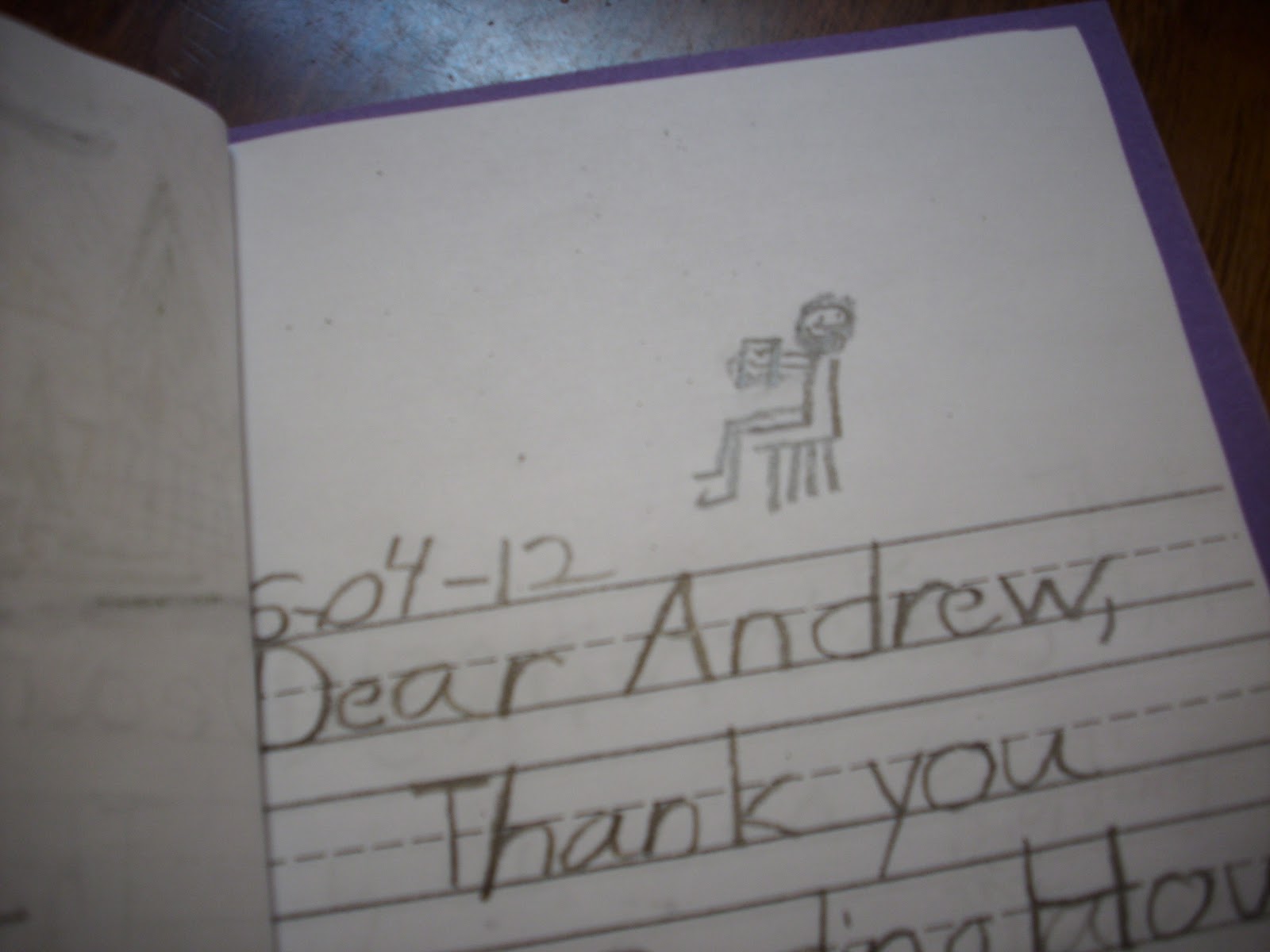
Me reading to the class.
The thank you book was completely unexpected and completely awesome.
Since I'm going to get to spend more time on the technical aspects of writing this year, I'm going to be doing some posts related to that stuff. It makes me glad to be able to work with kids interested in writing and help them to develop their technique at an earlier age than most people get to. I mean, most of the writing samples I run across online aren't any better developed than middle schoolers', anyway, which makes me wonder what happened to their schooling, except, then, I remember the state of the education system and the lack of importance given to anything in the arts, which includes knowing how to write a decent sentence, and I quit wondering, but, then, I wish they would take it seriously enough to learn how to do it rather than just blowing it off and writing in 1st person because they think they can get away with it that way. I don't know... maybe, grammar lessons will be boring, but they will probably be accompanied by a decent amount of ranting, which can make pretty much anything entertaining, so I guess we'll see.
Hmm... It seems like I had one other thing for this post, but, if there was something else, it's gone now. At any rate, for those of you with kids going back to school, I wish you a very merry school year. Or, you know, the nearest approximation.
Tuesday, June 12, 2012
The Picasso Syndrome and the First Person
I'm jumping back again to an older post I hadn't gotten around to finishing, but, since I was just talking about Picasso here, I figured I'd go back to the post that inspired the Picasso comment and finish it up.
But let's get into some history, first:
Picasso showed skill and interest in art at an early age, so much so that his father started him on formal training at age seven, much to the detriment of his regular school work. Picasso was admitted into the advanced class at the School of Fine Arts in Barcelona at just 13. Not only was he much younger than the average student of that level, but he completed the entrance exam in just one week, a process that usually took an entire month. At 16, Picasso was admitted into Madrid's Royal Academy of San Fernando, Italy's most prestigious art school.
All of that to say that Picasso was no slouch in the art department. He was classically trained and, possibly, the greatest classical artist of his day. The problem was that it bored him. He wanted to do something new and different, and that lead to experimentation and the development of many new art styles, especially Cubism. Cubism was born from a desire to go where no other artist had gone before not because Picasso couldn't draw. So to speak.
Of course, there were two responses to Cubism:
1. People hated it. Especially traditionalists. It was viewed as trash that no "respectable" artist would even deign to recognize. They didn't understand it.
2. People loved it. It was new and exciting, something that had never been done before. They didn't understand it, either, but they tried to. People are still arguing over what Picasso's paintings mean.
Of course, the most important response to Picasso, other than the group trying to ignore he existed, was to imitate him. After all, it looked easy enough. Just paint some weird stuff that people couldn't understand, and you had it, right? No, not really. Most of what ended up happening was people painting weird crap that was just crap. Some of the crap was good enough, though, especially when it was all new and exciting, that it got elevated to art status, too.
Sometimes, the imitation was from people that could actually do "real" art ("real" art being art that's not just weird stuff that no one understands because it really has no meaning). These were people that saw Picasso as a visionary and wanted to follow after him. There is, after all, skill involved, even if the result is something that's weird. However, some of the imitation was by people that used Picasso as their reason to not bother to know how to do "real" art at all. They saw Picasso as the short cut. Basically, these are the people that were looking at Picasso and thinking, "That's crap. I can do that. And look at how much money that guy's making!" And they went about making crap and trying to get rich from it. Some of them did, of course. Most of them did not.
Which brings me to writing and the cult of 1st Person that's going on these days.
Over the centuries, fiction writing has mostly happened in 3rd person. I suppose it developed that way because it seems more logical. You're telling a story about someone that's not you, so you tell it that way, "that way" being 3rd person. [Interestingly enough, the book that's most widely considered the first (Western) novel, Pamela, is written in 1st person.] From that perspective (the centuries of 3rd person writing perspective), I can understand the attraction to writing in 1st person, especially 1st person present; it feels new and exciting!
However, 1st Person is the new Cubism in that people are using it as a short cut to actually knowing how to write. The idea that you can write it from the perspective of your character is very attractive, because, if you make mistakes, you can chalk it up to being "the way the character talks." And, since it's 1st person, the whole thing is "the way the character talks." It's a nice bit of sleight-of-hand, and other people who don't know the rules (the readers) often fall for it.
I didn't really really become aware of this issue until I started teaching the creative writing class that lead to this (yes, go back and read that post if you haven't already). Their very first assignment was to introduce me to a character. I used the first of my Tib stories, "The Tunnel" (hopefully, this will be available again soon (I'm waiting for art)), as my example of character introduction. "The Tunnel" is written in 3rd person; everything I got back was 1st person (which wasn't a problem in and of itself). But that's not what did it. One of the stories I got back introduced about five different characters, and they were all written in 1st person, and the author hadn't included any cues in the story to let the reader know that we'd switched to some other character. Much discussion followed.
And this is when I became aware that everything they (they being the kids in my class (minus my son, because he's reading a different class of books)) were reading was YA stuff written in 1st person. But it was really through blog interactions that I realized that the reason everything they were reading was in 1st person was because it's just all in 1st person these days. And 1st person present on top of everything else. And that's when I started understanding why I kept coming across comments like, "That's just how my character talks" on various blogs.
It really hit me, though, when I looked at a couple of writing samples from a couple of people. Both were written 1st person present, and both were full of grammar and punctuation errors, and, when I pointed them out, I got the "that's the way my character talks" response, but, when I looked at their blogs, I found out, no, that's just the way they wrote, and neither of them were interested in fixing the mistakes or learning how to not make those mistakes. Neither of those are blogs I follow anymore, because, really, I don't have time for people that are bad writers and blow it off as being the character, especially when their characters were not writing their blogs.
Personal responsibility, people!
And this is where it gets difficult. I don't actually have anything against 1st person writing. I mean, I wrote The House on the Corner (mostly) in 1st person. Of course, at the time, if I'd realized how endemic 1st person had become, I wouldn't have done it that way, but I was experimenting with what I remembered about The Pigman (you can read all about that here) and didn't realize that 1st person writing was taking hold of the marketplace. Which is why I have such an issue with 1st person writing.
No, not because it's everywhere; however, because it's everywhere, I see, more and more, how many people are using it as an excuse to allow sloppy writing and brushing it off as just being the character. And I'm not just talking about independently published works, because the problem is rampant in traditionally published works, too.
For example:
Percy Jackson: I only read the first one of these, but there's very little chance I'll go back and read anymore of them. Riordan used the fact that it was 1st person to have his character tell us what we should believe about him as a person but used the action to tell us a different story about the character. The two things were at odds with each other, yet we were supposed to believe what the character said about himself for no better reason than he said to.
Miss Peregrine (which I reviewed here) also does the same thing with the character telling us what to believe even when his actions don't support those things. It's just sloppy, lazy writing.
I'd give more examples, but I have not been overly inclined to read any more of the current generation of 1st person YA books coming out. My experience, thus far, has not been a positive one. Add to that the fact that people want to use their 1st person storytelling as an excuse for bad grammar (and I'm sure I'm gaining a reputation for my stance on grammar and punctuation), and I'm not in favor of 1st person writing. It's just not where people should start their writing careers.
I understand the attraction. I do. It's so easy to just write away and believe that you're writing from the standpoint of your character rather than yourself; it's a problem in 3rd person, too (in fact, I'm reading a book in 3rd person, right now, in which none of the characters are distinguishable from each other), but the temptation is so much stronger in 1st, because everything you write is that one character, and it's easy to fall into the trap that that voice you're writing in is your character's instead of your own. At least, with 3rd person, you have the ability to distinguish between the narration and the dialogue.
At any rate, I'm ready for the fad of lazy 1st person writing to slip past us. I'm also waiting for editing to make a comeback. Seriously. I was just reading an article on CNN last week about how copy editing is one of the quickest shrinking fields, right now. Properly edited work is considered "too expensive," so publishers are cutting costs by letting their editors go.
But that's not an excuse for those of us in the "indie" publishing world to do the same. In fact, it's every reason to rise above the mainstream. Show you care enough about your writing to know how to do it. And, if you don't know how to do it, get help from someone that does. Don't let your 1st person writing be your excuse for bad grammar and lousy punctuation.
But let's get into some history, first:
Picasso showed skill and interest in art at an early age, so much so that his father started him on formal training at age seven, much to the detriment of his regular school work. Picasso was admitted into the advanced class at the School of Fine Arts in Barcelona at just 13. Not only was he much younger than the average student of that level, but he completed the entrance exam in just one week, a process that usually took an entire month. At 16, Picasso was admitted into Madrid's Royal Academy of San Fernando, Italy's most prestigious art school.
All of that to say that Picasso was no slouch in the art department. He was classically trained and, possibly, the greatest classical artist of his day. The problem was that it bored him. He wanted to do something new and different, and that lead to experimentation and the development of many new art styles, especially Cubism. Cubism was born from a desire to go where no other artist had gone before not because Picasso couldn't draw. So to speak.
Of course, there were two responses to Cubism:
1. People hated it. Especially traditionalists. It was viewed as trash that no "respectable" artist would even deign to recognize. They didn't understand it.
2. People loved it. It was new and exciting, something that had never been done before. They didn't understand it, either, but they tried to. People are still arguing over what Picasso's paintings mean.
Of course, the most important response to Picasso, other than the group trying to ignore he existed, was to imitate him. After all, it looked easy enough. Just paint some weird stuff that people couldn't understand, and you had it, right? No, not really. Most of what ended up happening was people painting weird crap that was just crap. Some of the crap was good enough, though, especially when it was all new and exciting, that it got elevated to art status, too.
Sometimes, the imitation was from people that could actually do "real" art ("real" art being art that's not just weird stuff that no one understands because it really has no meaning). These were people that saw Picasso as a visionary and wanted to follow after him. There is, after all, skill involved, even if the result is something that's weird. However, some of the imitation was by people that used Picasso as their reason to not bother to know how to do "real" art at all. They saw Picasso as the short cut. Basically, these are the people that were looking at Picasso and thinking, "That's crap. I can do that. And look at how much money that guy's making!" And they went about making crap and trying to get rich from it. Some of them did, of course. Most of them did not.
Which brings me to writing and the cult of 1st Person that's going on these days.
Over the centuries, fiction writing has mostly happened in 3rd person. I suppose it developed that way because it seems more logical. You're telling a story about someone that's not you, so you tell it that way, "that way" being 3rd person. [Interestingly enough, the book that's most widely considered the first (Western) novel, Pamela, is written in 1st person.] From that perspective (the centuries of 3rd person writing perspective), I can understand the attraction to writing in 1st person, especially 1st person present; it feels new and exciting!
However, 1st Person is the new Cubism in that people are using it as a short cut to actually knowing how to write. The idea that you can write it from the perspective of your character is very attractive, because, if you make mistakes, you can chalk it up to being "the way the character talks." And, since it's 1st person, the whole thing is "the way the character talks." It's a nice bit of sleight-of-hand, and other people who don't know the rules (the readers) often fall for it.
I didn't really really become aware of this issue until I started teaching the creative writing class that lead to this (yes, go back and read that post if you haven't already). Their very first assignment was to introduce me to a character. I used the first of my Tib stories, "The Tunnel" (hopefully, this will be available again soon (I'm waiting for art)), as my example of character introduction. "The Tunnel" is written in 3rd person; everything I got back was 1st person (which wasn't a problem in and of itself). But that's not what did it. One of the stories I got back introduced about five different characters, and they were all written in 1st person, and the author hadn't included any cues in the story to let the reader know that we'd switched to some other character. Much discussion followed.
And this is when I became aware that everything they (they being the kids in my class (minus my son, because he's reading a different class of books)) were reading was YA stuff written in 1st person. But it was really through blog interactions that I realized that the reason everything they were reading was in 1st person was because it's just all in 1st person these days. And 1st person present on top of everything else. And that's when I started understanding why I kept coming across comments like, "That's just how my character talks" on various blogs.
It really hit me, though, when I looked at a couple of writing samples from a couple of people. Both were written 1st person present, and both were full of grammar and punctuation errors, and, when I pointed them out, I got the "that's the way my character talks" response, but, when I looked at their blogs, I found out, no, that's just the way they wrote, and neither of them were interested in fixing the mistakes or learning how to not make those mistakes. Neither of those are blogs I follow anymore, because, really, I don't have time for people that are bad writers and blow it off as being the character, especially when their characters were not writing their blogs.
Personal responsibility, people!
And this is where it gets difficult. I don't actually have anything against 1st person writing. I mean, I wrote The House on the Corner (mostly) in 1st person. Of course, at the time, if I'd realized how endemic 1st person had become, I wouldn't have done it that way, but I was experimenting with what I remembered about The Pigman (you can read all about that here) and didn't realize that 1st person writing was taking hold of the marketplace. Which is why I have such an issue with 1st person writing.
No, not because it's everywhere; however, because it's everywhere, I see, more and more, how many people are using it as an excuse to allow sloppy writing and brushing it off as just being the character. And I'm not just talking about independently published works, because the problem is rampant in traditionally published works, too.
For example:
Percy Jackson: I only read the first one of these, but there's very little chance I'll go back and read anymore of them. Riordan used the fact that it was 1st person to have his character tell us what we should believe about him as a person but used the action to tell us a different story about the character. The two things were at odds with each other, yet we were supposed to believe what the character said about himself for no better reason than he said to.
Miss Peregrine (which I reviewed here) also does the same thing with the character telling us what to believe even when his actions don't support those things. It's just sloppy, lazy writing.
I'd give more examples, but I have not been overly inclined to read any more of the current generation of 1st person YA books coming out. My experience, thus far, has not been a positive one. Add to that the fact that people want to use their 1st person storytelling as an excuse for bad grammar (and I'm sure I'm gaining a reputation for my stance on grammar and punctuation), and I'm not in favor of 1st person writing. It's just not where people should start their writing careers.
I understand the attraction. I do. It's so easy to just write away and believe that you're writing from the standpoint of your character rather than yourself; it's a problem in 3rd person, too (in fact, I'm reading a book in 3rd person, right now, in which none of the characters are distinguishable from each other), but the temptation is so much stronger in 1st, because everything you write is that one character, and it's easy to fall into the trap that that voice you're writing in is your character's instead of your own. At least, with 3rd person, you have the ability to distinguish between the narration and the dialogue.
At any rate, I'm ready for the fad of lazy 1st person writing to slip past us. I'm also waiting for editing to make a comeback. Seriously. I was just reading an article on CNN last week about how copy editing is one of the quickest shrinking fields, right now. Properly edited work is considered "too expensive," so publishers are cutting costs by letting their editors go.
But that's not an excuse for those of us in the "indie" publishing world to do the same. In fact, it's every reason to rise above the mainstream. Show you care enough about your writing to know how to do it. And, if you don't know how to do it, get help from someone that does. Don't let your 1st person writing be your excuse for bad grammar and lousy punctuation.
Subscribe to:
Posts (Atom)