I gave my thoughts about Tron way back in this post. It's probably not necessary for this post, but it goes along with what I'm saying here... and it's interesting. Sure, that's me saying that it's interesting, and I wrote it, but still...
Anyway...
My boys love Tron. My daughter likes it, too, but not the way the boys do. We were even watching Tron: Uprising but that got derailed because of school. Now that summer is here, I'm sure we'll finish it up. They were very excited about the sequel to Tron: Legacy that has been in the works and was scheduled to begin filming in a few months.
Look, this is a big deal. The movie was in pre-production. It had stars attached to it. It was getting geared up to start filming... and Disney pulled the plug.
end of line
Dude.
My boys were devastated. Well, okay, that's a rather transitory experience for teenagers, but it lasted at least 10 minutes and no one can mention Tron in the house, now, without hearing "awww..." from one of them.
So what happened? Tomorrowland happened.
Now, see, I liked Tomorrowland, but that doesn't change the fact that it had a rather underwhelming opening weekend. So underwhelming that Disney pulled the plug on a completely unrelated project: Tron 3. I suppose you could say that Disney got a little insecure.
So, see, it's not just you. Even the big guys have moments of doubt and insecurity and, sometimes, it makes people do dumb things because they start focusing on what could go wrong instead of focusing on how to make it work.
Just sayin'.
About writing. And reading. And being published. Or not published. On working on being published. Tangents into the pop culture world to come. Especially about movies. And comic books. And movies from comic books.
Showing posts with label Tron. Show all posts
Wednesday, June 3, 2015
Wednesday, August 29, 2012
The Happiest Place on Earth: Part 3
Some of us got up early on Friday, because the plan was to get into the park ahead of the crowd. That was actually a possibility, because we had these passes that let us in an hour before the parks opened. However, when I say that "some of us got up early," what I mean is "I got up early." In all actuality, I didn't get up any earlier than I usually get up, which is 6:00am, but everyone else was supposed to also get up at 6:00am, and that just didn't happen. By the time everyone had been dragged out of bed (kicking and screaming, in some cases (okay, so I'm exaggerating a little (but only a little))), showered, and dressed, it was 7:30 before we got into the park, and we still had to eat breakfast. Clearly, we didn't have this whole thing figured out. By the time we got some food, it was 8:00am, and the park had opened for real and we'd missed the whole hour of extra time we'd had.
One of the first things we passed going into Disneyland on Friday morning was
which I thought was SO cool. See, I took a picture of it! But, seriously, it's an old fire engine; what's more cool than that? Okay, lots of things, but, still... Anyway, so I was being all "wow!" over the fire engine, and there was this old guy washing windows nearby, and he saw me being all "wow!" over the fire engine and the fire station and stuff, and he came over and told us that Walt Disney himself had lived in the apartment over the fire station while the park was being built and that he'd used it as his room for years when he'd come to stay. That was pretty cool, and I'm guessing a bit of inside info that most visitors don't get to hear about. Yeah, this guy was old enough that I bet he's been working at the park since it was being built and knew the information first hand. It was that kind of experience.
The first ride we went on on Friday morning was
and I have to say that the line, which, actually, was almost non-existent at 8:00am, was just as good as the ride. The detail they put into the place was amazing, and there was so much to look at, but we were able to just rush through, so it wasn't until we came back to ride it again (on Saturday) that I was actually able to fully take in the details of the line area.
One of the first things we passed going into Disneyland on Friday morning was
which I thought was SO cool. See, I took a picture of it! But, seriously, it's an old fire engine; what's more cool than that? Okay, lots of things, but, still... Anyway, so I was being all "wow!" over the fire engine, and there was this old guy washing windows nearby, and he saw me being all "wow!" over the fire engine and the fire station and stuff, and he came over and told us that Walt Disney himself had lived in the apartment over the fire station while the park was being built and that he'd used it as his room for years when he'd come to stay. That was pretty cool, and I'm guessing a bit of inside info that most visitors don't get to hear about. Yeah, this guy was old enough that I bet he's been working at the park since it was being built and knew the information first hand. It was that kind of experience.
The first ride we went on on Friday morning was
and I have to say that the line, which, actually, was almost non-existent at 8:00am, was just as good as the ride. The detail they put into the place was amazing, and there was so much to look at, but we were able to just rush through, so it wasn't until we came back to ride it again (on Saturday) that I was actually able to fully take in the details of the line area.
Going in.
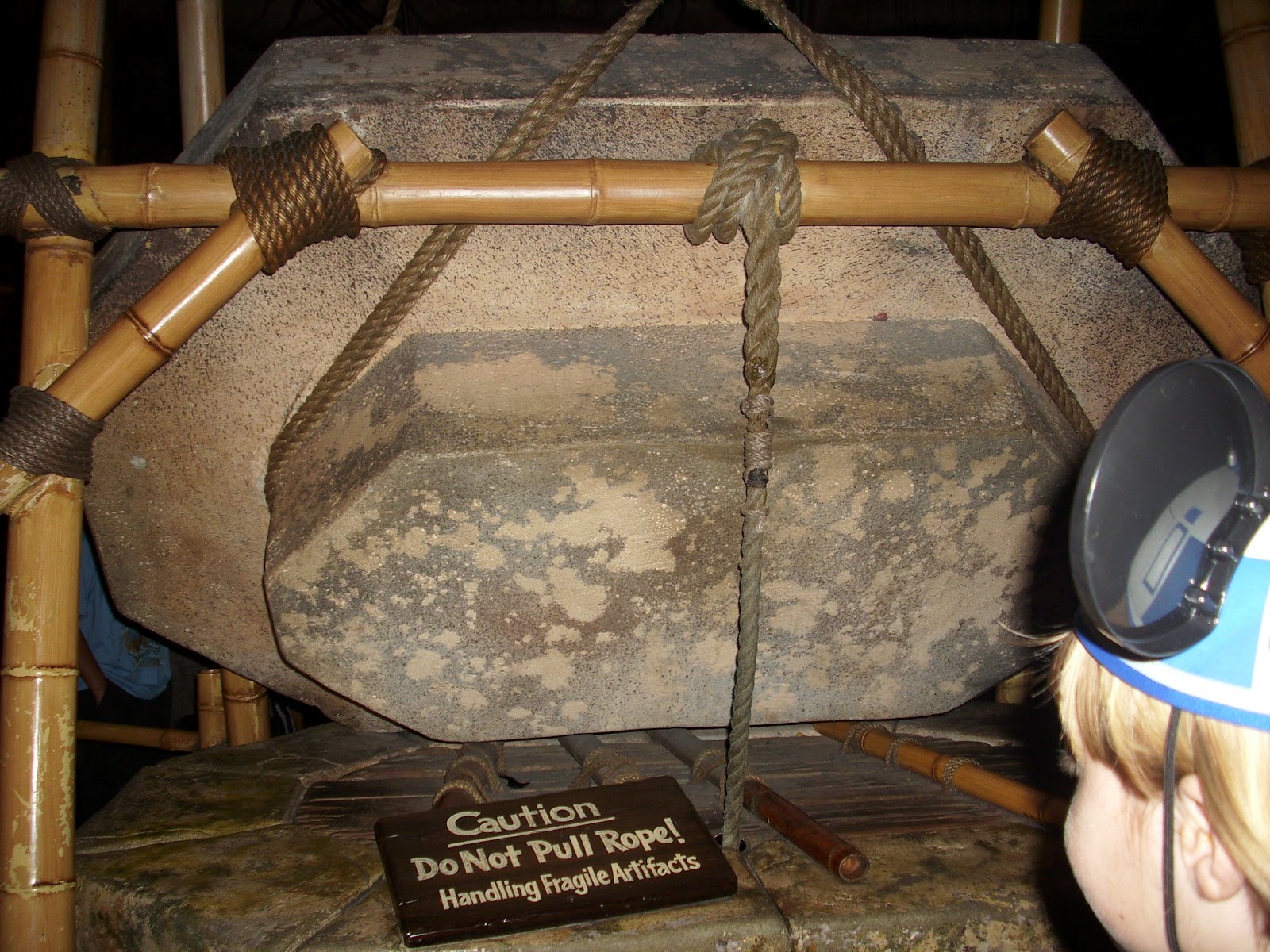
A death trap.
Of course, all the kids had to pull the rope.
Oh, and, yeah, the ride was a blast!
After Indiana Jones, we went up into Tarzan's tree house.
We explored the jungle.
And we rode a steamboat.
We did some other things, too, but, well, my camera decided it didn't want to work anymore. Oh, it works again now, but that was the end of the pictures for the trip. Friday morning, it just decided that it was taking its own vacation and refused to turn on again. Yes, I checked the batteries. I'd actually just put fresh batteries in not long before it quit working. After we got home, I was able to upload the pictures I got before it died, which I wasn't sure was going to work since the camera wouldn't function. I swapped out the batteries again, just on a whim, and something in the combination of those two things made the camera decide that it would work again. But I have no more pictures...
Which means I don't have pictures from Cars Land, which is... Oh, man, I wish you could have seen it! It was like they pulled Radiator Springs right out of the movie and brought it to life. But, you know, with people walking all around in it.
So we're sitting over at Flo's waiting for my wife's dad and step-mother, and, across the street, at the traffic cone hotel place is Lightning McQueen. Now, he's just sitting there, so, you know, I'm thinking he's a decoration. Just a model car sitting out in the driveway. But we're sitting there, and, suddenly, he comes to life and starts driving out of the driveway, and he's talking to people as he goes by, and it was just incredible! He pulled through the driveway and turned onto the street and drove right by us, and I wanted to reach out and touch him so bad, but, you know, if I was all famous and stuff, I wouldn't want people I don't know coming up and trying to touch me, so I refrained. Anyway, he drives off, and, a moment later, Mater drives up the street from the direction Lightning had gone, and he goes over and parks in the same place, and it was all SO COOL! I mean, it was seriously cool, and I can't even imagine what that would be like if I was six and Lightning McQueen drove up to me and talked to me. Well, I can, because it would have been about like Luke Skywalker walking up to me and talking to me, and I used to dream about that kind of thing all the time when I was that age, so, apparently, I can actually imagine it.
We rode The Tower of Terror, and that was amazing. The hotel is awesome! I mean, well, it's like everything there; the attention to detail is stunning, and it's like being in some abandoned hotel, and we wondered if they have some guy somewhere that just specializes in putting cobwebs on things or if they actually hire spiders to take care of it. At the time, I didn't know this, but it's not just a simple drop ride. No, Disney was not content to be satisfied with something as simple as gravity, so the car that you sit in actually has cables that pull it down so that you achieve a speed faster than free fall. Riding that with my wife and younger son was awesome. They're both into screaming, but, see, my wife would scream and then burst into hysterical laughter, so I was laughing at her laughing, and my son was screaming but trying to also laugh, and that may have been the best ride of the trip with the way she screamed and laughed.
The boys and I went off to the Mad Tea Party while the rest of the group went off to get wet. I'm not a fan of wet rides. Well, it's not the rides; I like them just fine; in fact, when I was a kid, the log ride may have been my favorite thing; however, I hate walking around wet after the fact, and if the stuff in your wallet gets wet... and I hate having wet shoes. It's just gross, especially later when you finally take your shoes off. Anyway, we were trying to see this Tron thing that they had when the oldest boy was there in the spring, but it's gone, now, and has been replaced with the Mad Tea Party, which was pretty cool and included a band playing 80s covers with a lead singer that looked like Tom Petty. But the coolest thing there, and the thing I regret most not having pictures of, was these two guys on stilts wearing pink flamingo bodies so that they looked like they were riding giant pink flamingos. And they jousted. It was awesome.
But, you know, my camera was on strike, so I don't have any pictures.
Labels:
Cars Land,
death trap,
Disney,
Disneyland,
fire truck,
Flo's,
Indiana Jones,
Lightning McQueen,
Luke Skywalker,
Mad Tea Party,
Mark Twain,
Mater,
Radiator Springs,
Tom Petty,
Tron,
Walt Disney
Tuesday, April 24, 2012
The A to Z of Fiction to Reality: Virtual Reality
Back in the mid-80's, on a trip to (the one, true) Six Flags, I had my first encounter with virtual reality. They had a station set up where you could experience it yourself for the low, low price of $10 (or something like that). You put on a set of VR goggles, walked on a treadmill, and shot at things. What made it interesting is that they had a monitor set up so that other people could see what you were seeing. There were obstacles that you had to dodge; some of them would fly out at you suddenly, so it was amusing to watch as the people doing the simulation would duck and, um, sometimes, actually fall down because they were caught off guard by something. I didn't actually do the thing, because I didn't want to spend $10 on something that lasted two minutes, but I had a couple of friends who did; one of them even did it twice. They were very impressed and said it felt like they were right there with things flying at their heads. It was, of course, the '80s when the idea of virtual reality really leaped into popular awareness. Right along with the personal computer. Of course, back in the '80s, we all thought we'd be in a virtual world by this point.
But how far back does virtual reality go?
Well, that's an interesting question, and I'm going to answer it from two perspectives:
First, in the 1950s, Morton Heilig decided that going to the theater should be a fully immersive experience. He began working on his Sensorama which finally came out in 1962. The only piece ever produced was of the viewer riding the streets of Brooklyn on a motorcycle. It was much more than 3D, also providing the vibrations of the motorcycle, the wind on the face, and the smells of the street as the viewer "rode" along. However, the cost of producing the 3D films was just too high, and the Sensorama failed to catch on.
But what we think of as virtual reality really was a product of the '80s and stemmed almost solely from the work of Jaron Lanier. He founded VPL Research in 1985, which is the company that produced the famous goggles and gloves that we all think of when we think of VR.
The biggest issue with VR at the moment is that it's actually much more advanced than we realize. Quite advanced, in fact, within the medical field and the military. I suppose the high cost of VR systems is still keeping it out of the consumer market.
Except in one thing... the building of virtual worlds. The video game industry has become adept at creating worlds, and there have been some amazing strides in that area in recent years. The one I think is the most important is the development of the virtual world in The Force Unleashed. It's the first game world to apply "real" physics to the environment rather than just having the same programmed response every time. Here's a short video that talks about it a bit (although this one is not as good at explaining the significance of what they're doing as the couple I saw back when the game was first coming out, but I couldn't find those):
Some of this technology is related to the stuff ILM developed for Peter Jackson for The Lord of the Rings so that the armies would behave... well, autonomously instead of having groups of soldiers all doing the same thing.
So that's kind of where we are, right now, but from where did all of this come from from a fiction standpoint?
For that, we're going to go back to 1935 and the short story "Pygmalion's Spectacles" by Stanley Weinbaum. In the story, a professor has invented a pair of goggles that allows you to experience a movie as if you were in the movie including interacting with the characters. How familiar does that sound?
Remember Stanislaw Lem (from this post)? Well, in 1960, he had a short story, "IJON TICHY'S MEMORIES," in which a scientist creates an entire virtual world (and, evidently, traps people within it). Trapped in this virtual world is another scientist who creates a virtual world. Yes, within the first one.
And, of course, there's William Gibson with Neuromancer, which I find to be less of virtual reality, as such, and more just a visual representation of cyberspace, even if it is a virtual world.
We also have to jump right back to this post about Snow Crash.
In movies, we have Tron and The Matrix as two of the best examples of virtual reality in fiction.
For me, there was Tad Williams' Otherland series. Virtual reality is to the point where people have jacks implanted in the base of their skulls so that they can plug directly into the virtual network and experience everything by having their brains directly stimulated. It's interesting, though, in that during the course of the books, he shows us how the technology evolved in the world he created. What's interesting is that some of our newest advances in virtual reality have an eerie resemblance to antiquated VR tech in his books.
Here's what it comes down to for me:
When VR becomes a thing that people can enter into and experience as if it was real life, people will not want to leave it. There are already issues with people and the virtual worlds they already have access to, and these worlds are not... well, we don't experience them as if they are happening to us. But there have been cases of child neglect and abuse from parents becoming too immersed in these worlds. There have been cases of people going without food or water to the point of death. And these are just worlds that you experience through a keyboard. Imagine what it will be like when you can have full sensory input. Feel things. Smell things. Even taste things. And it can be better than your life in the "real" world.
Of all things I've talked about in this series, this is the one that I find the scariest. I think we're closer to realizing this one than many of the others. And, more than any of the others, this is the one into which we will go voluntarily.
[Oh, and I did some more digging, and I found the other videos I was talking about.]
But how far back does virtual reality go?
Well, that's an interesting question, and I'm going to answer it from two perspectives:
First, in the 1950s, Morton Heilig decided that going to the theater should be a fully immersive experience. He began working on his Sensorama which finally came out in 1962. The only piece ever produced was of the viewer riding the streets of Brooklyn on a motorcycle. It was much more than 3D, also providing the vibrations of the motorcycle, the wind on the face, and the smells of the street as the viewer "rode" along. However, the cost of producing the 3D films was just too high, and the Sensorama failed to catch on.
But what we think of as virtual reality really was a product of the '80s and stemmed almost solely from the work of Jaron Lanier. He founded VPL Research in 1985, which is the company that produced the famous goggles and gloves that we all think of when we think of VR.
The biggest issue with VR at the moment is that it's actually much more advanced than we realize. Quite advanced, in fact, within the medical field and the military. I suppose the high cost of VR systems is still keeping it out of the consumer market.
Except in one thing... the building of virtual worlds. The video game industry has become adept at creating worlds, and there have been some amazing strides in that area in recent years. The one I think is the most important is the development of the virtual world in The Force Unleashed. It's the first game world to apply "real" physics to the environment rather than just having the same programmed response every time. Here's a short video that talks about it a bit (although this one is not as good at explaining the significance of what they're doing as the couple I saw back when the game was first coming out, but I couldn't find those):
Some of this technology is related to the stuff ILM developed for Peter Jackson for The Lord of the Rings so that the armies would behave... well, autonomously instead of having groups of soldiers all doing the same thing.
So that's kind of where we are, right now, but from where did all of this come from from a fiction standpoint?
For that, we're going to go back to 1935 and the short story "Pygmalion's Spectacles" by Stanley Weinbaum. In the story, a professor has invented a pair of goggles that allows you to experience a movie as if you were in the movie including interacting with the characters. How familiar does that sound?
Remember Stanislaw Lem (from this post)? Well, in 1960, he had a short story, "IJON TICHY'S MEMORIES," in which a scientist creates an entire virtual world (and, evidently, traps people within it). Trapped in this virtual world is another scientist who creates a virtual world. Yes, within the first one.
And, of course, there's William Gibson with Neuromancer, which I find to be less of virtual reality, as such, and more just a visual representation of cyberspace, even if it is a virtual world.
We also have to jump right back to this post about Snow Crash.
In movies, we have Tron and The Matrix as two of the best examples of virtual reality in fiction.
For me, there was Tad Williams' Otherland series. Virtual reality is to the point where people have jacks implanted in the base of their skulls so that they can plug directly into the virtual network and experience everything by having their brains directly stimulated. It's interesting, though, in that during the course of the books, he shows us how the technology evolved in the world he created. What's interesting is that some of our newest advances in virtual reality have an eerie resemblance to antiquated VR tech in his books.
Here's what it comes down to for me:
When VR becomes a thing that people can enter into and experience as if it was real life, people will not want to leave it. There are already issues with people and the virtual worlds they already have access to, and these worlds are not... well, we don't experience them as if they are happening to us. But there have been cases of child neglect and abuse from parents becoming too immersed in these worlds. There have been cases of people going without food or water to the point of death. And these are just worlds that you experience through a keyboard. Imagine what it will be like when you can have full sensory input. Feel things. Smell things. Even taste things. And it can be better than your life in the "real" world.
Of all things I've talked about in this series, this is the one that I find the scariest. I think we're closer to realizing this one than many of the others. And, more than any of the others, this is the one into which we will go voluntarily.
[Oh, and I did some more digging, and I found the other videos I was talking about.]
Labels:
a to z,
Force Unleashed,
ILM,
Matrix,
Morton Heilig,
Neuromancer,
Otherland,
Pygmalion's Spectacles,
Snow Crash,
Stanislaw Lem,
Stanley Weinbaum,
Star Wars,
Tad Williams,
Tron,
virtual reality,
William Gibson
Monday, July 25, 2011
The Legacy of Tron
Greetings, Programs...
It doesn't always take great writing to make a great film. Of course, I'm sure there are many out there that would argue that Tron is not a great film. I don't feel like debating the definition of greatness, at the moment, though, so I'm just going to say that based upon it's cultural impact and cult status, it's a great film. After all, how many movies get an actual sequel after almost 30 years. Not a re-boot. Not a re-make. An honest to goodness sequel. It's almost a singular achievement (it may be a singular achievement, for all I know).
Tron is the movie that opened the door to computer generated special effects. In fact, John Lasseter has said that without Tron there would have been no Toy Story as it was Tron that opened his eyes to the potential of computer animation. Despite that, Tron contains far less computer generated material than most people might suspect, but what was there was completely new, much of which was never used again due to the costs involved. Interestingly enough, Tron was not even nominated for a special effects Oscar possibly because of the use of computers, which was considered "cheating" by many in the Academy, at the time.
The story of Tron is fairly straightforward and ironically appropriate for Disney. The conflict revolves around a corporation (Encom) taking advantage of the little guy (Kevin Flynn) by stealing his work and the little guy trying to prove the work is actually his. Even at 12, when the movie came out, I knew that the story was just the vehicle to get Flynn into the "digital" world of the computer so they could show off their stuff. Still, it's a solid plot even if it's not original. We still seem to be having issues with that aspect of corporate greed in America, so I can't say it's not a story that needs to be told anymore. They may have done better to have centered Tron: Legacy on that same type of story since it opens with those same overtones, but Disney isn't brave enough to do that story again, or, perhaps, realizes it's a message that strikes at the heart of their business model, so they abandon it as soon as the younger Flynn enters The Grid.
There is, however, one bit of story genius that I was struck with at the time, and it has always stayed with me. This one thing made the movie for me, made it great in my mind, as it completely fascinated me at 12. I thought it was SO cool, and, yet, most people miss it entirely (along with the significance of it within the confines of the story), and some have even argued that it didn't happen that way at all. The key to the weight of the story of Tron is getting Flynn into the digital world himself. Flynn is our connection, the eyes that allow us to see this digital world as real. But they have to get him inside the computer. Utilizing another emerging technology (lasers), they have him zapped by a laser that is being developed as a quantum teleportation device. Early in the movie, we get to witness this laser being tested on an orange. The process only takes a few seconds. Zap target with laser. Digitize target. Reintegrate target. The implication, then, is that Flynn's sojourn in the digital world happens within this span of a few seconds. [They support this idea in the sequel by quantifying the time discrepancy, although I'm not remembering the ratio, right off the top of my head.] It was a fabulous notion.
Still, it took time for Tron to really grow on me. And repeated exposure to the video games. There was, of course, the Tron arcade game, which made more money than the movie. We owned it for our Atari. Although I liked the game, it was never one of my favorites. However, Discs of Tron... that one, I loved. It was more than just a joystick game. None of my friends liked it because it was "too hard," and, indeed, it was one of the most complex games around. For years. But I loved it. Except for one thing, it wasn't just a quarter to play it. I don't remember what the actual cost was, but I remember being constantly put off by the fact that it cost so much. However, when I was in college, they put a Discs of Tron in the student center (at the one quarter/play cost) during my freshman year, and I ruled that game. Literally. Not only did I have the high score, but no one could beat me at head-to-head play, either. I was extremely sad when they removed the game at the beginning of my sophomore year. For that game alone, Tron holds a special place of nostalgia in my heart.
And, then, there's Jeff Bridges. Between Harrison Ford and Mark Hamill, Bridges had a lot of competition back when I was 12, but I noticed him, which is saying a lot. I noticed him more with Starman in 1984, but it was Tucker: The Man and His Dream that really convinced me of how great an actor he is. I spent my 20s telling people that he was the most underrated actor in Hollywood, and I wasn't wrong. It's great that he's now getting the recognition that he's deserved for so long. The fact that he has been so instrumental in the return of Tron says a lot both for whom he is and the film. The legacy of Tron.
My boys were immediately excited when they heard there was going to be a sequel (to the original), and the initial trailers for it sent them both into a frenzy of excitement over it. It's hard to fault them for that. The trailers were nearly as visually stunning as the movie. And it was. Visually stunning. The film is worth seeing just as a visual masterpiece, and it was... well, it was spectacular in 3D. It's true that the plot is a bit more contrived and, therefore, weaker than the plot for the original, but, again, the story is really only there as a vehicle to display the digital landscape they've created. I will say, though, that it's only upon reflection that the holes in the story become apparent. Bridges' talent is enough to make everything believable, and Garrett Hedlund, who plays Flynn's son, is more than adequate in supporting him. Truthfully, the film is dazzling enough just on its own that it's hard to contemplate any weaknesses while watching it. At least on the big screen.
A new Tron trilogy is supposedly in the works. At any rate, there should be a Disney television series next year and, at least, one movie sequel. Assuming that Bridges is now out of the equation (although I don't know that I believe that he's gone for good), I hope they actually write a really compelling story. It would be a shame for this to become another fiasco like The Matrix. It could. There is some promise, though, in that Disney is planning ahead on this instead of just having the "oh, this made buckets of money, let's make another" reaction. I have to say that I'm very curious to see where Tron takes us next. I only wish it could take us there on our very own light cycles.
end of line
It doesn't always take great writing to make a great film. Of course, I'm sure there are many out there that would argue that Tron is not a great film. I don't feel like debating the definition of greatness, at the moment, though, so I'm just going to say that based upon it's cultural impact and cult status, it's a great film. After all, how many movies get an actual sequel after almost 30 years. Not a re-boot. Not a re-make. An honest to goodness sequel. It's almost a singular achievement (it may be a singular achievement, for all I know).
Tron is the movie that opened the door to computer generated special effects. In fact, John Lasseter has said that without Tron there would have been no Toy Story as it was Tron that opened his eyes to the potential of computer animation. Despite that, Tron contains far less computer generated material than most people might suspect, but what was there was completely new, much of which was never used again due to the costs involved. Interestingly enough, Tron was not even nominated for a special effects Oscar possibly because of the use of computers, which was considered "cheating" by many in the Academy, at the time.
The story of Tron is fairly straightforward and ironically appropriate for Disney. The conflict revolves around a corporation (Encom) taking advantage of the little guy (Kevin Flynn) by stealing his work and the little guy trying to prove the work is actually his. Even at 12, when the movie came out, I knew that the story was just the vehicle to get Flynn into the "digital" world of the computer so they could show off their stuff. Still, it's a solid plot even if it's not original. We still seem to be having issues with that aspect of corporate greed in America, so I can't say it's not a story that needs to be told anymore. They may have done better to have centered Tron: Legacy on that same type of story since it opens with those same overtones, but Disney isn't brave enough to do that story again, or, perhaps, realizes it's a message that strikes at the heart of their business model, so they abandon it as soon as the younger Flynn enters The Grid.
There is, however, one bit of story genius that I was struck with at the time, and it has always stayed with me. This one thing made the movie for me, made it great in my mind, as it completely fascinated me at 12. I thought it was SO cool, and, yet, most people miss it entirely (along with the significance of it within the confines of the story), and some have even argued that it didn't happen that way at all. The key to the weight of the story of Tron is getting Flynn into the digital world himself. Flynn is our connection, the eyes that allow us to see this digital world as real. But they have to get him inside the computer. Utilizing another emerging technology (lasers), they have him zapped by a laser that is being developed as a quantum teleportation device. Early in the movie, we get to witness this laser being tested on an orange. The process only takes a few seconds. Zap target with laser. Digitize target. Reintegrate target. The implication, then, is that Flynn's sojourn in the digital world happens within this span of a few seconds. [They support this idea in the sequel by quantifying the time discrepancy, although I'm not remembering the ratio, right off the top of my head.] It was a fabulous notion.
Still, it took time for Tron to really grow on me. And repeated exposure to the video games. There was, of course, the Tron arcade game, which made more money than the movie. We owned it for our Atari. Although I liked the game, it was never one of my favorites. However, Discs of Tron... that one, I loved. It was more than just a joystick game. None of my friends liked it because it was "too hard," and, indeed, it was one of the most complex games around. For years. But I loved it. Except for one thing, it wasn't just a quarter to play it. I don't remember what the actual cost was, but I remember being constantly put off by the fact that it cost so much. However, when I was in college, they put a Discs of Tron in the student center (at the one quarter/play cost) during my freshman year, and I ruled that game. Literally. Not only did I have the high score, but no one could beat me at head-to-head play, either. I was extremely sad when they removed the game at the beginning of my sophomore year. For that game alone, Tron holds a special place of nostalgia in my heart.
And, then, there's Jeff Bridges. Between Harrison Ford and Mark Hamill, Bridges had a lot of competition back when I was 12, but I noticed him, which is saying a lot. I noticed him more with Starman in 1984, but it was Tucker: The Man and His Dream that really convinced me of how great an actor he is. I spent my 20s telling people that he was the most underrated actor in Hollywood, and I wasn't wrong. It's great that he's now getting the recognition that he's deserved for so long. The fact that he has been so instrumental in the return of Tron says a lot both for whom he is and the film. The legacy of Tron.
My boys were immediately excited when they heard there was going to be a sequel (to the original), and the initial trailers for it sent them both into a frenzy of excitement over it. It's hard to fault them for that. The trailers were nearly as visually stunning as the movie. And it was. Visually stunning. The film is worth seeing just as a visual masterpiece, and it was... well, it was spectacular in 3D. It's true that the plot is a bit more contrived and, therefore, weaker than the plot for the original, but, again, the story is really only there as a vehicle to display the digital landscape they've created. I will say, though, that it's only upon reflection that the holes in the story become apparent. Bridges' talent is enough to make everything believable, and Garrett Hedlund, who plays Flynn's son, is more than adequate in supporting him. Truthfully, the film is dazzling enough just on its own that it's hard to contemplate any weaknesses while watching it. At least on the big screen.
A new Tron trilogy is supposedly in the works. At any rate, there should be a Disney television series next year and, at least, one movie sequel. Assuming that Bridges is now out of the equation (although I don't know that I believe that he's gone for good), I hope they actually write a really compelling story. It would be a shame for this to become another fiasco like The Matrix. It could. There is some promise, though, in that Disney is planning ahead on this instead of just having the "oh, this made buckets of money, let's make another" reaction. I have to say that I'm very curious to see where Tron takes us next. I only wish it could take us there on our very own light cycles.
end of line
Subscribe to:
Posts (Atom)