Over the last few decades, something has happened to the reading world. Some people probably think it's about time and, in some ways, that's true; however, that doesn't make it a good thing. Maybe it's a necessary thing; I don't know.
Historically, reading (and writing) has been a man's game. Like so many things, reading was for men and writing was done by men, and that's all there was to it. Part of that is because education was for men. Sure, girls got some basic education, but higher education was for men, and, therefore, writing was done by men. This is not to say that there were not exceptions, like the Bronte sisters, but, by and large, it was all for men by men. Even Frankenstein was somewhat of a fluke, because what Mary really did was manage Percy's career, so to speak. She was never trying to be a writer; she just ended up writing that one, excellent novel.
Then the 20th century came along and equal rights for women and everything began to change. Not noticeably at first, but most changes don't happen all at once; they happen by degrees, and you don't notice them until you've been boiled like a frog. Which is not to say that I think we have been boiled like frogs, except, maybe, men have been boiled like frogs with these current changes.
I'm not going to go tracing back through all of what I think brought us to where we are. There are really only two important things of note:
1. Women began to realize that they could write, so they did. Mostly under male sounding pen names, at first, or using their initials. This is still somewhat true today in the midst of our female-centric writing world. Note J.K. Rowling, because the publisher didn't want to scare away male readers.
2. Because women began writing (women like Judy Blume), girls began reading. Not that girls hadn't read prior to that, but the ones that did read read the same stuff aimed at male readers. When women began writing, they began, more and more, to gear their writing to female readers, so girls started reading more.
From that point on, it became a cycle rather in the same sort of way that a hurricane starts, and, so, now, we are in the midst of a storm of women writers and girl readers. Don't get me wrong, I don't have any problem at all with women writing and girls reading; I'm all for it, in fact. The problem, though, is that boys have quit reading because of all of this. In effect, reading has become a woman's game, and men don't want to play anymore.
Of course, culturally, we want to blame it on the boys. As if it has always been a problem getting boys to read, but that's just not true. I don't have any statistics for you (because, frankly, I couldn't find anything that appeared even remotely reliable (everything seemed geared toward proving whatever the author of whatever study wanted to prove with the study)), but there are a few things that were consistent among several reports:
1. Girls (traditionally and currently) begin reading fiction at an earlier age. In fact, girls begin reading by reading fiction.
2. Boys (traditionally and currently) begin reading non-fiction. (This was certainly true for me. I started out reading about things I was interested in: dinosaurs, astronomy, historical figures.)
3. Traditionally, girls' interest in reading would taper off as they got older and interested in whatever it used to be that got girls got interested in. That's where the stereotype of the nerdy girl that read all the time came from; it used to be weird for a teenage girl to be interested in reading. Not so anymore. It's rather expected, these days, for girls to be reading.
4. Traditionally, boys' interest in reading would morph from non-fiction to fiction and boys would continue to read. Not all, of course, just like not all girls continue to read these days, but it was normal for teenage boys to be interested in reading, i.e. not seen as weird. However, today, boys are no longer morphing to the fiction stage. Instead, they are losing interest in reading.
Let's focus on point 4 for a moment.
There are all sorts of arguments about why this is happening and they encompass everything from TV to video games to the fact that "boys are boys," as if that should be enough to explain it. But I really don't think any of that is what's at the root of the issue. Sure, there are many distractions to reading these days, but there have always been distractions to reading. I read a lot when I was a kid (as in I won the school reading contest in 4th grade and should have won it in 3rd grade, but that's another story (and I didn't win in 5th and 6th grade because I changed schools)), and it was still the last thing I did every day. I mean, I only read when I didn't have something more exciting to do, so distractions have always existed. Also, parents are no less likely these days to encourage reading than they've ever been, so that, also, is not a factor. So what's changed?
Books have changed. Yeah, yeah, I know. All of those older books still exist, but you also know that people don't naturally gravitate to what's older. I mean, you don't see anyone out there boasting about their Atari 2600 anymore, right? Or, even, their Wii. Generally speaking, people become invested in what's new before they begin to explore what's old. At least, if they're left to do it on their own, as most kids are with reading.
What this means is that you get books that are new and hot and geared toward... girls. Like The Hunger Games and Twilight, books that boys just aren't all that interested in. Not that no boys read them, but most boys do not. Most boys have no interest in those stories. We have a remarkably feminine market, and it doesn't have a lot of room for boys at the moment.
The writers are women. The agents are women. The publishers are... well, they're probably all old men, but they're just in it for the money and probably don't read anyway. And, so, if you're trying to sell a book through traditional publishing, as most people are still trying to do, you're writing to the market. Just recently, I was reading through the first couple of chapters of a book I was asked to critique by a male author. Good voice. No real grammar issues. Female main character. Why? Because that's what the market wants. At least, that's what we think the market wants. (And I'm not saying there's anything wrong with guys writing female leads, but, really, unless you have a specific need for that, why not write what you know?)
Oh, and before anyone says "Harry Potter!" at me, yes, I know. Harry was a male lead character, but, really, who was the backbone of that story? Who got Harry through all of his predicaments? Who was it that was talented and strong and smart? Let me just say, it wasn't Harry.
So what am I getting at here? You know, honestly, I don't know. This is all from a series of conversations I've had with my wife about how books today are not the same as books when we were kids. Honestly, when I was a kid, I didn't read anything aimed at my age group. I did read new stuff, but I shopped in the sci-fi/fantasy section of my book store, because there wasn't really a young adult section. Well, there was, but that's not what it was called, and it was full of teen romance books aimed at girls. Stuff I had no interest in. The books in the young adult section are not much different from that today. Mostly. They're still teen romance stories, they just have a bunch of paranormal stuff and killing thrown in to disguise them. So it's no wonder that boys aren't interested.
What we do know, as a society, is that we want kids to read. I mean, we say this, but we don't do much about it. Especially, right now, we want boys to read. This is not something that needs to be an either-or situation. It's not either girls read or boys read. There should be plenty of opportunity for both. Bringing boys back into the game is going to take two things:
1. Parents willing to invest the time to make their boys read. Yes, I said "make." Learning to read is like learning to ride a bike; it's hard at first, but it's easy once you get the hang of it. If you've ever taught a kid to ride a bike, you'll know that it's (generally) not a pleasant task. We used to enforce reading on all of our children just like we made our kids learn to ride bikes. It was never a fun thing making the kids sit and do reading, but, now, all of them do it because they want to do it.
2. Getting guys back into the writing game and getting them back into writing their own stories, not stories for the market. I think guys have it a bit rougher in the publishing world, right now, because of the whole thing from agents about needing to "be in love" with the story before they'll give you representation. Most agents are women. I'm not going to spell that out for you. You're smart people. I'm sure you can figure that out on your own. At any rate, what it means is that stories geared for boys just aren't making it out into the market.
I'm not preaching any kind of conspiracy here. That's not what I'm saying at all. There's nothing nefarious going on. What is going on is human nature. However, if we really want boys to start reading again, we have to start making the reading world a place that's more friendly toward boys than it currently is. And that doesn't mean pandering to them either. Boys aren't looking for books about action and mindless violence. When they want that, there are plenty of video games that do that better than a book ever will. Boys want books that speak to them, about the kinds of issues that they face, just like girls want books that speak to them. They want something deeper and more meaningful than a video game. They want something real.
Maybe it's time we start giving it to them...
Monday, August 6, 2012


Sunday, August 5, 2012
Let's go on Vacation! Part 3: The Wildlife
I don't know how it is for other people, but one of the main attractions of camping for me is the chance to see wildlife. I'm not a stranger to wildlife; I did spend a significant part of my youth on a farm in the country. Lots of deer. Lots of critters. Even getting chased by snakes. I've never grown out of that, except for the snake part. Even when a skunk moved in near our house, I had to hold myself back from going out to watch it shuffle around looking for food, because, really, it's just not worth the risk of getting sprayed.
All of that to say that I was really looking forward to seeing animals while we were camping. Even more than that, I wanted my kids to see animals. They're not as versed in wildlife as me, of course, because they've grown up in the city. Living near the creek here, helps, but not enough. My younger son, especially, is really into animals, and he's the one that never seems to be with us when we see wildlife.
I suppose we were only really marginally successful with the whole wildlife thing while there. There were lots of lizards, which made my daughter happy. She has a knack for getting butterflies to land on her finger, and she spent some time at the pool one day letting a couple of butterflies land on her. There were lots of squirrels, and our trashcan got raided the first couple of nights because my oldest son didn't put the lid down on it correctly. It was, um, probably raccoons, but I let the kids believe it was bears.
They did get to see deer. I don't think any of my kids had seen deer before. Well, maybe the oldest has, but I'm pretty sure the younger two had not. We got to see a doe with two fawns standing by the side of the road one day, but we were past before I even had a chance to think of grabbing the camera. My daughter and I chased a couple of deer on our bikes one afternoon, too. We weren't really chasing them; I was just trying to show them to my daughter, but she never did see them.
Here's a picture of a squirrel my wife and I watched run around collecting and eating on our last morning:
 Do you see it?
And, now, a funny story:
We went out for a family walk one morning with the dog. While walking along the trail, we saw a squirrel. Well, my daughter and I saw a squirrel. The squirrels up there were quite a bit bigger than the squirrels we have around here but with shorter, stubbier tails. It was just a squirrel, right? No big deal. My wife and my younger son walked on because that was their reaction. My daughter got all involved in watching the squirrel, though, and my older son came back to see it, but he couldn't find it. I was going to walk on, but, as I was walking off, my older son said, "Hey, dad, what's that yellow bird?" I passed the dog off to someone else and went back to see.
Indeed, on a branch, was a squat, yellow bird, but it was too far away, and I couldn't tell what it was. I had the bright idea of using the camera's zoom ability to figure it out. Let me just mention here that my camera mostly sucks. It's zoom ability is almost non-existent. What I got was a slightly larger view of a yellow blur. [I had pictures of this, but they were too blurry, so I deleted them all. I wish I had kept one, at least, so I could show you the yellow blur.] My daughter was standing nearby going on and on about the squirrel and what it was doing during all of this, but we weren't paying attention to her, because we were trying to figure out what kind of bird the yellow blur was. My wife and other son were at least 100 feet away by then.
As I was trying to get a clearer, more focused picture, the yellow blur moved. It moved and turned into a squirrel. The yellow blur we had been watching was the squirrel's stomach fur. It had been sitting up on its hind legs eating, and the rest of it had blended into the tree. Except my daughter had been watching it the whole time, and she knew it was a squirrel. She started laughing at us for thinking the squirrel was a bird and kept saying, "I tried to tell you!" It was a major dork moment for my son and me.
Here are some other pictures:


All of that to say that I was really looking forward to seeing animals while we were camping. Even more than that, I wanted my kids to see animals. They're not as versed in wildlife as me, of course, because they've grown up in the city. Living near the creek here, helps, but not enough. My younger son, especially, is really into animals, and he's the one that never seems to be with us when we see wildlife.
I suppose we were only really marginally successful with the whole wildlife thing while there. There were lots of lizards, which made my daughter happy. She has a knack for getting butterflies to land on her finger, and she spent some time at the pool one day letting a couple of butterflies land on her. There were lots of squirrels, and our trashcan got raided the first couple of nights because my oldest son didn't put the lid down on it correctly. It was, um, probably raccoons, but I let the kids believe it was bears.
They did get to see deer. I don't think any of my kids had seen deer before. Well, maybe the oldest has, but I'm pretty sure the younger two had not. We got to see a doe with two fawns standing by the side of the road one day, but we were past before I even had a chance to think of grabbing the camera. My daughter and I chased a couple of deer on our bikes one afternoon, too. We weren't really chasing them; I was just trying to show them to my daughter, but she never did see them.
Here's a picture of a squirrel my wife and I watched run around collecting and eating on our last morning:

And, now, a funny story:
We went out for a family walk one morning with the dog. While walking along the trail, we saw a squirrel. Well, my daughter and I saw a squirrel. The squirrels up there were quite a bit bigger than the squirrels we have around here but with shorter, stubbier tails. It was just a squirrel, right? No big deal. My wife and my younger son walked on because that was their reaction. My daughter got all involved in watching the squirrel, though, and my older son came back to see it, but he couldn't find it. I was going to walk on, but, as I was walking off, my older son said, "Hey, dad, what's that yellow bird?" I passed the dog off to someone else and went back to see.
Indeed, on a branch, was a squat, yellow bird, but it was too far away, and I couldn't tell what it was. I had the bright idea of using the camera's zoom ability to figure it out. Let me just mention here that my camera mostly sucks. It's zoom ability is almost non-existent. What I got was a slightly larger view of a yellow blur. [I had pictures of this, but they were too blurry, so I deleted them all. I wish I had kept one, at least, so I could show you the yellow blur.] My daughter was standing nearby going on and on about the squirrel and what it was doing during all of this, but we weren't paying attention to her, because we were trying to figure out what kind of bird the yellow blur was. My wife and other son were at least 100 feet away by then.
As I was trying to get a clearer, more focused picture, the yellow blur moved. It moved and turned into a squirrel. The yellow blur we had been watching was the squirrel's stomach fur. It had been sitting up on its hind legs eating, and the rest of it had blended into the tree. Except my daughter had been watching it the whole time, and she knew it was a squirrel. She started laughing at us for thinking the squirrel was a bird and kept saying, "I tried to tell you!" It was a major dork moment for my son and me.
Here are some other pictures:


Okay, so she's not wildlife, but she is cute!

I'd never seen goslings before, so that was pretty cool.

However, watching them on the shore reinforced how they are descended from dinosaurs.

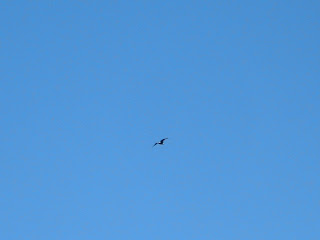
This last picture is of a bald eagle. It was the highlight of the wildlife experience. We got to watch it fly around for about half an hour. It had a nest in the tallest tree at the part of the lake where we were. It would circle around, fly away, and come back to its nest. I'm only assuming it was its nest, because it kept going back to the same tree. I'm also assuming it was fishing, but I don't know that as I never got to see it dive. The tree it was landing in was on a point sticking out into the lake, so I think it was going down on the other side from where we were. It was really cool to watch it flying around. Unfortunately, this is the only picture I have that is even remotely clear enough to see. If you look close, though, you can see the white of its tail and the white of its head.
I think that covers all the wildlife from this trip. My kids have still not actually seen raccoons, even though I've seen a couple around here in the evenings out scavenging trash cans.
Wednesday, August 1, 2012
Lawhead's Skin Map
One of the authors I mention on my Of significance... page is Stephen Lawhead. He's long been one of my favorite authors and has some wonderful books. I got my introduction to Lawhead through his Pendragon Cycle which I read because I was interested in the Arthurian content. Prior to reading Lawhead, my exposure to the Arthurian legend had been things like Excalibur which, although full of knights in shining armor and all of that, were not very historically accurate. However, The Pendragon Cycle, although a work of fantasy, was being presented as historical fiction, and I wanted to see what it was about. The original Pendragon Trilogy remain my favorite Arthurian books to date (Jack Whyte's series comes close, though).
If you are at all interested in the Arthurian mythos, I would highly suggest Taliesin, Merlin, and Arthur, the original trilogy. Lawhead did go back later and add in a few more books. I don't remember liking Pendragon (the 4th book) very much, and I can't remember how I felt about Grail, so, maybe, I need to go back and read that again. The 6th book, Avalon, is not technically part of the series. It takes place in the near future and is about the return of Arthur and was quite good. Darn... now I'm wanting to go back and re-read all of them.
Lawhead is not always a great author. Some of his works are tremendous, but some are... less than good. The works that are great, though, are really, really great and make him an author I follow. My favorite book by him is Byzantium, also a work of historical fiction. More recently, he wrote a trilogy about Robin Hood. Prior to Star Wars, Robin Hood was my childhood hero. The first two books of that series, Hood and Scarlet, are great, although I felt he dropped the ball a bit on the final book, Tuck. It's probably a good book, but Hood and Scarlet are great, so I was let down when I got to Tuck.
All of that to say that I was very excited to hear about his Bright Empires series, especially since the title of the first book is so good: The Skin Map. What a great title! [And the next book, The Bone House, also has a great title.] However, The Skin Map is somewhat of a departure from his usual style of writing. Lawhead generally sticks to just one POV at a time, even in books where more than one POV is used. Often, he will divide a book into sections so that each section is done from a different POV. Probably his most effective style is when he uses a narrator from within the story to tell the story about a different character. It's kind of a 1st/3rd person blend with a singular POV and most of his best books have been written in this style. [Now, I'm trying to think of other novels written this way, and I'm completely drawing a blank. Well, other than the Sherlock Holmes stories which are narrated by Watson.] The Skin Map, though, has five separate POVs (that I can remember off the top of my head) that he bounces between with no discernible pattern. I found this, from him, distinctly less effective than his style in his other novels.
I also didn't particularly care for his main character, although I am somewhat hesitant to call Kit the main character; he was, nevertheless, the central character around whom the story revolved, which may have been my issue with all the different POVs. We just spent too much time away from Kit for me to become invested in him. Since it seems apparent that Kit is the main character (based on the ending), it would have been nice to have more from him. Of course, like I said, I didn't much care for him. At the beginning of the book, he is a character to whom things happen only. He has no initiative, no ambition, no opinions. My response to him was, repeatedly, "Oh! My! Gosh!" There was an inkling of a change in him by the end of the book, but I'll have to reserve judgement until I read The Bone House.
So, yes, it was good enough that I want to read the next one, although I can not deny that part of that is on the strength of the author, not the book itself. It's hard to say whether I would want to read the next book if I didn't like Lawhead so much. The end of the book does open up a bit more, so to speak, but the first 2/3 were a real struggle to get through. A greater mystery is revealed towards the end, and there are some rather unexpected twists, so that may have been enough to make me want to go on even if it wasn't Lawhead. Since it is Lawhead, I'll be looking to get the next book soon.
At the moment, I'd give The Skin Map a "C," mostly because I struggled with it so much. It just seemed pretty typical. However, given that it's part of a series, my opinion on that may change as I read the next books. If, in retrospect, I can see that this was a great set up for what's going to happen, my opinion may change.
Note:
I ended the freebie special on "Part One: The Tunnel" (see the Shadow Spinner tab up top) a bit early. The first two days, it had brisk downloads, and it peaked at #26 on Amazon's contemporary fantasy list, which, I think is pretty good. However, the third day, the downloads dwindled, so I'm guessing that everyone that's going to download it, right now, has pretty much done so. I'll save the other two free days for a later date. Thank you to all of you that downloaded it! I hope you enjoy it.
"Part Two: The Kitchen Table" will be available Monday, August 13.
If you are at all interested in the Arthurian mythos, I would highly suggest Taliesin, Merlin, and Arthur, the original trilogy. Lawhead did go back later and add in a few more books. I don't remember liking Pendragon (the 4th book) very much, and I can't remember how I felt about Grail, so, maybe, I need to go back and read that again. The 6th book, Avalon, is not technically part of the series. It takes place in the near future and is about the return of Arthur and was quite good. Darn... now I'm wanting to go back and re-read all of them.
Lawhead is not always a great author. Some of his works are tremendous, but some are... less than good. The works that are great, though, are really, really great and make him an author I follow. My favorite book by him is Byzantium, also a work of historical fiction. More recently, he wrote a trilogy about Robin Hood. Prior to Star Wars, Robin Hood was my childhood hero. The first two books of that series, Hood and Scarlet, are great, although I felt he dropped the ball a bit on the final book, Tuck. It's probably a good book, but Hood and Scarlet are great, so I was let down when I got to Tuck.
All of that to say that I was very excited to hear about his Bright Empires series, especially since the title of the first book is so good: The Skin Map. What a great title! [And the next book, The Bone House, also has a great title.] However, The Skin Map is somewhat of a departure from his usual style of writing. Lawhead generally sticks to just one POV at a time, even in books where more than one POV is used. Often, he will divide a book into sections so that each section is done from a different POV. Probably his most effective style is when he uses a narrator from within the story to tell the story about a different character. It's kind of a 1st/3rd person blend with a singular POV and most of his best books have been written in this style. [Now, I'm trying to think of other novels written this way, and I'm completely drawing a blank. Well, other than the Sherlock Holmes stories which are narrated by Watson.] The Skin Map, though, has five separate POVs (that I can remember off the top of my head) that he bounces between with no discernible pattern. I found this, from him, distinctly less effective than his style in his other novels.
I also didn't particularly care for his main character, although I am somewhat hesitant to call Kit the main character; he was, nevertheless, the central character around whom the story revolved, which may have been my issue with all the different POVs. We just spent too much time away from Kit for me to become invested in him. Since it seems apparent that Kit is the main character (based on the ending), it would have been nice to have more from him. Of course, like I said, I didn't much care for him. At the beginning of the book, he is a character to whom things happen only. He has no initiative, no ambition, no opinions. My response to him was, repeatedly, "Oh! My! Gosh!" There was an inkling of a change in him by the end of the book, but I'll have to reserve judgement until I read The Bone House.
So, yes, it was good enough that I want to read the next one, although I can not deny that part of that is on the strength of the author, not the book itself. It's hard to say whether I would want to read the next book if I didn't like Lawhead so much. The end of the book does open up a bit more, so to speak, but the first 2/3 were a real struggle to get through. A greater mystery is revealed towards the end, and there are some rather unexpected twists, so that may have been enough to make me want to go on even if it wasn't Lawhead. Since it is Lawhead, I'll be looking to get the next book soon.
At the moment, I'd give The Skin Map a "C," mostly because I struggled with it so much. It just seemed pretty typical. However, given that it's part of a series, my opinion on that may change as I read the next books. If, in retrospect, I can see that this was a great set up for what's going to happen, my opinion may change.
Note:
I ended the freebie special on "Part One: The Tunnel" (see the Shadow Spinner tab up top) a bit early. The first two days, it had brisk downloads, and it peaked at #26 on Amazon's contemporary fantasy list, which, I think is pretty good. However, the third day, the downloads dwindled, so I'm guessing that everyone that's going to download it, right now, has pretty much done so. I'll save the other two free days for a later date. Thank you to all of you that downloaded it! I hope you enjoy it.
"Part Two: The Kitchen Table" will be available Monday, August 13.
Tuesday, July 31, 2012
Moving Like Glass (brought to you by IWSG)
This post is going to be a bit different from my normal kind of post in that I'm participating in Alex Cavanaugh's Insecure Writer's Support Group this month. People tend to believe that if you're a writer then you're insecure about it, that those two things go hand in hand. I'm actually not insecure about my writing, so I've been inclined to skip these posts in the past. Skip writing them, that is (I don't skip reading other people's posts), especially since many of my posts tend toward what I would consider support posts for other writers anyway.
However, although I'm not insecure about my actual writing, I am insecure about the whole writing career thing. One thing in particular constantly nags and pokes at me: everything seems to happen so slowly! I feel like a piece of glass.
Did you know that glass is a liquid? Okay, so, maybe not. Actually, the state of glass is still being squabbled over by Science, but, for my discussion, we're going to go with the "glass is a liquid" side of the argument. And, no, I'm not going to try and explain the argument, but I will say this: glass does not crystallize as other solids do when it's cooled. For this reason, it's generally called an amorphous solid or a supercooled liquid. Yeah, I know: if you go touch it, it feels plenty solid, and it can break, but if you want to go read up on all the science behind it, you go right ahead. [There's a good discussion here if you want to read up on it.]
Anyway...
Did you know glass is a liquid? The way it was explained to me (in Science) is that glass is a colloidal suspension. A simple example of this is Jello. Basically, you have a liquid into which is introduced a solid that is in suspension within the liquid causing it to hold it's shape. Or that's the case with Jello, at any rate. It doesn't actually have to be a liquid/solid suspension, but that's what works for my example. With glass, the actual glass is a liquid and has to have foreign particles introduced into it so that it will solidify and retain the shape it is cooled in. Most manufactured glass is soda-lime glass, known as such because of what is introduced into the system to help it retain its shape.
The theory is that glass then, only being a colloidal suspension, continues to flow very slowly over the years. Very slowly. Very, very slowly. So slowly in fact that this is also debated by Science, but, for my purposes, we're going to side with faction that believes in glass flow because it's a liquid.
And that's how I feel! Like a piece of glass moving so slowly that you can't tell I'm moving. I don't mean on the actual writing front. I'm not sitting here with writer's block or anything. But on the selling front, on the getting my name out there front, I feel like nothing's happening. See, I know that's not quite true, because I do have people reading my work and leaving reviews, but it's not spontaneous at this point. And that makes it feel like it's not happening at all.
And that makes me insecure. The feeling of no movement.
I suppose the good side of that is that it makes me want, even more, to finish my next project and get it out there.
Speaking of that next project, it's called Shadow Spinner (for those of you coming by for the first time today because of the IWSG thing. The rest of you should know this!). The first chapter, "Part One: The Tunnel" is available for free this week for the Kindle (only) over on Amazon. It would be so great if you'd go pick up a FREE copy of it, click the "like" button (something that seems to be difficult for most people stopping by), and, after you read it, leave a short review and rating. Yeah, okay, so I'm asking a lot, but it's a short read because it's just the 1st chapter, so there will be plenty of time left over for a short review! Make me feel like heated glass!
The cover has been done by the fantastic artist formerly known as Rusty Webb:
 Did I mention it's FREE?!?
["Part Two: The Kitchen Table" will be available soon.]
However, although I'm not insecure about my actual writing, I am insecure about the whole writing career thing. One thing in particular constantly nags and pokes at me: everything seems to happen so slowly! I feel like a piece of glass.
Did you know that glass is a liquid? Okay, so, maybe not. Actually, the state of glass is still being squabbled over by Science, but, for my discussion, we're going to go with the "glass is a liquid" side of the argument. And, no, I'm not going to try and explain the argument, but I will say this: glass does not crystallize as other solids do when it's cooled. For this reason, it's generally called an amorphous solid or a supercooled liquid. Yeah, I know: if you go touch it, it feels plenty solid, and it can break, but if you want to go read up on all the science behind it, you go right ahead. [There's a good discussion here if you want to read up on it.]
Anyway...
Did you know glass is a liquid? The way it was explained to me (in Science) is that glass is a colloidal suspension. A simple example of this is Jello. Basically, you have a liquid into which is introduced a solid that is in suspension within the liquid causing it to hold it's shape. Or that's the case with Jello, at any rate. It doesn't actually have to be a liquid/solid suspension, but that's what works for my example. With glass, the actual glass is a liquid and has to have foreign particles introduced into it so that it will solidify and retain the shape it is cooled in. Most manufactured glass is soda-lime glass, known as such because of what is introduced into the system to help it retain its shape.
The theory is that glass then, only being a colloidal suspension, continues to flow very slowly over the years. Very slowly. Very, very slowly. So slowly in fact that this is also debated by Science, but, for my purposes, we're going to side with faction that believes in glass flow because it's a liquid.
And that's how I feel! Like a piece of glass moving so slowly that you can't tell I'm moving. I don't mean on the actual writing front. I'm not sitting here with writer's block or anything. But on the selling front, on the getting my name out there front, I feel like nothing's happening. See, I know that's not quite true, because I do have people reading my work and leaving reviews, but it's not spontaneous at this point. And that makes it feel like it's not happening at all.
And that makes me insecure. The feeling of no movement.
I suppose the good side of that is that it makes me want, even more, to finish my next project and get it out there.
Speaking of that next project, it's called Shadow Spinner (for those of you coming by for the first time today because of the IWSG thing. The rest of you should know this!). The first chapter, "Part One: The Tunnel" is available for free this week for the Kindle (only) over on Amazon. It would be so great if you'd go pick up a FREE copy of it, click the "like" button (something that seems to be difficult for most people stopping by), and, after you read it, leave a short review and rating. Yeah, okay, so I'm asking a lot, but it's a short read because it's just the 1st chapter, so there will be plenty of time left over for a short review! Make me feel like heated glass!
The cover has been done by the fantastic artist formerly known as Rusty Webb:

["Part Two: The Kitchen Table" will be available soon.]
Monday, July 30, 2012
Double Fail
Do you ever have those moments where you realize you've forgotten something or mislaid something or, I don't know, lost a child? I know someone that did that, lost his child at Disneyland because he forgot she was with him and just walked off and left her. There's that moment of panic that sets in when you realize that you forgot. It's a horrible moment.
Until today (Sunday, July 29, 2012), the worst experience I've had with this was forgetting about my creative class one day last school year. It's not that I forgot the class itself, I just forgot what day it was. I was busy writing, what can I say? I was being very cognizant of what time I needed to leave to pick up my kids from school, but, about half way through class, I suddenly realized "oh crap! it's Thursday I'm supposed to be teaching class!" That was a moment of panic.
Mostly, I don't have those, though. I've never forgotten to pick my kids up from school or anything like that. When I used to wear glasses, I would have those moments where I'd wonder where my glasses were while I was wearing them (no, I didn't switch to contacts... it's a long story (okay, not that long, but I'm not talking about that, right now)), but, really, I'm pretty good with remembering things or, at least, knowing that I'm not remembering and asking. I've never even forgotten birthdays, or, um... anniversaries.
Well, until now, that is.
I realized this morning... well, I was reminded this morning (remember, this is Sunday morning) that it's my wife's step-twins' birthday is today. That's not a big deal. The problem was that as I was being caused to remember their birthday, I had the sudden realization that their birthday is after my wedding anniversary. It's after our anniversary, and my wife and I hadn't done anything for it. Or even mentioned it. Or talked about anything about it all month. My immediate response to realizing that I'd missed our anniversary was an interior "oh, crap!"
Because, see, my wife hadn't mentioned it. She also didn't seem mad. I didn't know what to do. I mean, had she also forgotten, or, as I thought was more likely, had she remembered but not said anything because I hadn't said or done anything. Was it a test? This was bad! What the heck do you do in that kind of situation?
I briefly considered just not saying anything. I mean, you know, if she had forgotten then everything was cool. But, no, because if it was a test of some sort, the longer I went, the worse things would get. And if she had forgotten but remembered and I still hadn't said anything... I had to bite the bullet. That's all there was to it.
We go out for coffee on Sunday mornings. It's the only time we have without the kids all week, and that's what we do together. We drove over to the coffee shop to get our Aztec mochas (you can read more about the whole Aztec thing here), and, as we got out of the car, I said, "I realized this morning that I've forgotten something," to which my wife responded, "What did you forget?"
That wasn't a very good response for me. So much for fishing for information, right? So I start trying to explain to her about remembering what I'd forgotten without actually telling her what the thing was while I tried to figure out if she knew, and she just kept saying to me, "What did you forget?" until I finally said, "I realized that we missed our anniversary." My wife kind of stopped, like she got stuck for a moment, and then said, "What?" I could see her figuring out days in her head until she finally asked the date and then she kind of didn't believe that we'd missed it and tried to tell me that I was wrong, but I reminded her that it was the twins' birthday, which is after our anniversary, and, then, she couldn't remember the date of our anniversary to figure out when we were supposed to have celebrated it.
So I got points:
1. Because I remembered first!
2. Because I knew when it was supposed to have been!
And, then, she said, "What does that say about us?"
Which is a good question.
And I didn't really have a good answer except that I finally answered that it says we have very busy kids, which we do, and it's so difficult keeping up with all of their stuff that we can't remember our own stuff. Which is actually true. But, still...
We forgot our anniversary. Both of us.
However, I went out Sunday afternoon and bought some good food and cooked her a great anniversary dinner for Sunday night, and that was nice. Even if we did have to share it with 2/3 of our children.
My wife's final response was, "Well, at least it wasn't our 15th or 20th that we forgot, right?" And that's true, except that we still have the opportunity to forget those. I'm trying to figure out ways to drill this into my head, now, so that I can remember not to forget next year!
I still say boarding school is the answer...
Note:
Don't forget to pick up your FREE copy of chapter one of Shadow Spinner: "Part One: The Tunnel" for your Kindle or Kindle app! "Part Two: The Kitchen Table" will be coming soon!
When you pick it up, please click the "like" button. After you read it, a short review and rating would be awesome! Thanks in advance!

Until today (Sunday, July 29, 2012), the worst experience I've had with this was forgetting about my creative class one day last school year. It's not that I forgot the class itself, I just forgot what day it was. I was busy writing, what can I say? I was being very cognizant of what time I needed to leave to pick up my kids from school, but, about half way through class, I suddenly realized "oh crap! it's Thursday I'm supposed to be teaching class!" That was a moment of panic.
Mostly, I don't have those, though. I've never forgotten to pick my kids up from school or anything like that. When I used to wear glasses, I would have those moments where I'd wonder where my glasses were while I was wearing them (no, I didn't switch to contacts... it's a long story (okay, not that long, but I'm not talking about that, right now)), but, really, I'm pretty good with remembering things or, at least, knowing that I'm not remembering and asking. I've never even forgotten birthdays, or, um... anniversaries.
Well, until now, that is.
I realized this morning... well, I was reminded this morning (remember, this is Sunday morning) that it's my wife's step-twins' birthday is today. That's not a big deal. The problem was that as I was being caused to remember their birthday, I had the sudden realization that their birthday is after my wedding anniversary. It's after our anniversary, and my wife and I hadn't done anything for it. Or even mentioned it. Or talked about anything about it all month. My immediate response to realizing that I'd missed our anniversary was an interior "oh, crap!"
Because, see, my wife hadn't mentioned it. She also didn't seem mad. I didn't know what to do. I mean, had she also forgotten, or, as I thought was more likely, had she remembered but not said anything because I hadn't said or done anything. Was it a test? This was bad! What the heck do you do in that kind of situation?
I briefly considered just not saying anything. I mean, you know, if she had forgotten then everything was cool. But, no, because if it was a test of some sort, the longer I went, the worse things would get. And if she had forgotten but remembered and I still hadn't said anything... I had to bite the bullet. That's all there was to it.
We go out for coffee on Sunday mornings. It's the only time we have without the kids all week, and that's what we do together. We drove over to the coffee shop to get our Aztec mochas (you can read more about the whole Aztec thing here), and, as we got out of the car, I said, "I realized this morning that I've forgotten something," to which my wife responded, "What did you forget?"
That wasn't a very good response for me. So much for fishing for information, right? So I start trying to explain to her about remembering what I'd forgotten without actually telling her what the thing was while I tried to figure out if she knew, and she just kept saying to me, "What did you forget?" until I finally said, "I realized that we missed our anniversary." My wife kind of stopped, like she got stuck for a moment, and then said, "What?" I could see her figuring out days in her head until she finally asked the date and then she kind of didn't believe that we'd missed it and tried to tell me that I was wrong, but I reminded her that it was the twins' birthday, which is after our anniversary, and, then, she couldn't remember the date of our anniversary to figure out when we were supposed to have celebrated it.
So I got points:
1. Because I remembered first!
2. Because I knew when it was supposed to have been!
And, then, she said, "What does that say about us?"
Which is a good question.
And I didn't really have a good answer except that I finally answered that it says we have very busy kids, which we do, and it's so difficult keeping up with all of their stuff that we can't remember our own stuff. Which is actually true. But, still...
We forgot our anniversary. Both of us.
However, I went out Sunday afternoon and bought some good food and cooked her a great anniversary dinner for Sunday night, and that was nice. Even if we did have to share it with 2/3 of our children.
My wife's final response was, "Well, at least it wasn't our 15th or 20th that we forgot, right?" And that's true, except that we still have the opportunity to forget those. I'm trying to figure out ways to drill this into my head, now, so that I can remember not to forget next year!
I still say boarding school is the answer...
Note:
Don't forget to pick up your FREE copy of chapter one of Shadow Spinner: "Part One: The Tunnel" for your Kindle or Kindle app! "Part Two: The Kitchen Table" will be coming soon!
When you pick it up, please click the "like" button. After you read it, a short review and rating would be awesome! Thanks in advance!

Sunday, July 29, 2012
A Blog in 3 Parts
Part One
The big news today is Shadow Spinner! Shadow Spinner is my next planned release. I'm hoping it will be completely finished before the end of the year, but, until then, I'm going to be releasing it serially. I experimented with this a while back here on the blog, if any of you remember, which is what prompted this experiment. Of course, I'd meant to start doing this months and months ago, but I had to wait for art. It was worth the wait!
 "The Tunnel" is now available for the Kindle. I'd really like to make it free, but Amazon is being... problematic and telling me that they have no "option" for that. Duh, I knew that. I also know that they can go in and make something free, so I'm working on it. However, even though it's $0.99 as its set price, I'm making it FREE for the next many days, as many as Amazon will allow me for this selling period. Since it is free, I'd really appreciate it if you'd (yes, you, the person reading this post) go over and download it. I mean, you can't beat the price, and, even if you don't have a Kindle, there are plenty of free Kindle apps for whatever platform you have. After you read it, please click the "like" button, because I'm just gonna assume you're going to like it. What's not to like? If you could see your way around to leaving a short review and a rating, that would be great, too. This is just the first chapter of Shadow Spinner, and it's quite short, so it won't take up much time. Look, here's the link! Go get it now while it's FREE!!!
Oh, and I didn't forget: The incredible art has been done by the artist who may or may not be Rusty Webb. He's kind of undecided at the moment, but it's incredible despite his identity crisis. Somewhere around chapter 4 or 5, there will be an alternate cover, and it's even more cool than this one!
Part Two
I ran a contest last week. It may have been a bad week to run a contest as traffic was down and comments were way down. Oh, well. It is what it is. You can go back and look at the contest post if you missed it. At any rate, Donna, over at Mainely Write, has walked off with the prize. At least, she will have once I hear back from her so that I know which option she wants. By the way, if you haven't visited Donna before, you should. She posts lots of great poems. I find most modern poetry less than satisfying, but Donna's stuff tends to the great, so go check her out.
Part Three
Remember back in April when everyone was A-to-Zing? Back during that whole thing, I discovered a bunch of books and stories I wanted to read about things that were fictional at the time but are now, if not real, on their way to being real. My "V" entry was about virtual reality, and I mentioned a short story by Stanley Weinbaum, "Pygmalion's Spectacles." It was an appropriate follow up to my recent read of the After, as they both deal with themes of reality and what, exactly, reality is.
However, Weinbaum's story was written in the 1930s and has an incredibly accurate look at what virtual reality might be like. How real does "real" need to be. How much will our own brains supply to fill in the gaps? Is virtual reality as real as real reality? It's pretty short and well worth reading. And it's FREE for the Kindle, so you should follow the link and go check it out.
The big news today is Shadow Spinner! Shadow Spinner is my next planned release. I'm hoping it will be completely finished before the end of the year, but, until then, I'm going to be releasing it serially. I experimented with this a while back here on the blog, if any of you remember, which is what prompted this experiment. Of course, I'd meant to start doing this months and months ago, but I had to wait for art. It was worth the wait!

Oh, and I didn't forget: The incredible art has been done by the artist who may or may not be Rusty Webb. He's kind of undecided at the moment, but it's incredible despite his identity crisis. Somewhere around chapter 4 or 5, there will be an alternate cover, and it's even more cool than this one!
Part Two
I ran a contest last week. It may have been a bad week to run a contest as traffic was down and comments were way down. Oh, well. It is what it is. You can go back and look at the contest post if you missed it. At any rate, Donna, over at Mainely Write, has walked off with the prize. At least, she will have once I hear back from her so that I know which option she wants. By the way, if you haven't visited Donna before, you should. She posts lots of great poems. I find most modern poetry less than satisfying, but Donna's stuff tends to the great, so go check her out.
Part Three
Remember back in April when everyone was A-to-Zing? Back during that whole thing, I discovered a bunch of books and stories I wanted to read about things that were fictional at the time but are now, if not real, on their way to being real. My "V" entry was about virtual reality, and I mentioned a short story by Stanley Weinbaum, "Pygmalion's Spectacles." It was an appropriate follow up to my recent read of the After, as they both deal with themes of reality and what, exactly, reality is.
However, Weinbaum's story was written in the 1930s and has an incredibly accurate look at what virtual reality might be like. How real does "real" need to be. How much will our own brains supply to fill in the gaps? Is virtual reality as real as real reality? It's pretty short and well worth reading. And it's FREE for the Kindle, so you should follow the link and go check it out.
Wednesday, July 25, 2012
Nolan Again Impresses...
...with his ability to obfuscate.
I do realize that I'm going to be in the vast minority with my stance on The Dark Knight Rises, but I'm used to that, so I'm just going to go with it.
I have one thing to say for Christopher Nolan: he's a magician when it comes to making movies. I mean that in a very literal sense. He uses flashy action to distract us from the holes he leaves behind in the story. We can't see them, because we're too busy looking in the other direction.
Or maybe it's just that Marvel has set the bar so high with their string of excellent adaptions that I'm just no longer satisfied with interpretations. Maybe if it was more explicit that these are interpretations, I'd be happier. DC/Warner Brothers could just slap their Elseworlds label on these things, and I might be more accepting of them. As it is, though, there are so many things that aren't Batman in these movies that I have a hard time dealing with it. Like in Burton's Batman when Alfred brings Vicki Vale down into the Batcave. What?
Unfortunately, Nolan has plenty of those moments himself. Like in Batman Begins when Wayne allows Lucius Fox to know that he's Batman. Whereas that was almost acceptable in that movie, those inconsistencies with the source material have continued to snowball to the point that by the time we get to Rises, I can't accept them. I mean, by the end of The Dark Knight Rises half of everyone knows that Wayne is Batman. And we're just supposed to believe that some random cop walks up to Wayne and just knows? Seriously. I get that Nolan needs that for his story, but, give me a break, he knew because he saw it in Wayne's face? At least Tim Drake did the research to figure out that Wayne is Batman. And I don't want to give spoilers, but having his actual name be Robin? It just makes me cringe.
However, the big issue for me, the thing that set the big disconnect for me, is that we're supposed to believe that this is 8 years later. That Bruce Wayne just quit being Batman and went into seclusion. I get that Nolan is trying to give us a sense of Miller's Dark Knight comics in which Batman had quit and was in seclusion, but that was because he got old. He even gives us a cane like Wayne uses in Batman Beyond, but, again, in those he got old; Nolan wants us to believe that Wayne just quit. I can't buy it. I absolutely can not buy it.
This is where I understand the difference between me, someone that grew up reading Batman comics and was heavily invested in Batman lore for...well, longer than I should have been, and the vast majority of people out there that don't have that same investment. These details aren't important to them. I get that. I also get that I am not really the target audience for the movie. I was the target audience for Batman Begins, because that one was more focused on the fans of the comic, but these last two, after hooking everyone in, have been focused on the general consumer.
Even so, the idea with Nolan's Batman is that he is set in the "real world," and, as such, I still can not accept this 8 year hiatus. He wants us to buy into too many unrealistic ideas:
1. After 8 years of no Batman, people are still talking about him. Give me a break. Culturally, we barely hold onto anything for 8 days, and Nolan expects us to believe that people are still saying, after 8 years, "is he coming back?" Not to mention the fact that he has kids, like 10-year-old kids, talking about Batman as if he's a reality to them. Or was a reality to them. Yes, all of this bothers me, because none of it's how the real world works.
If he'd made it a year after the events of Dark Knight, maybe even two, it would have been plausible.
2. There's a Harvey Dent Day and people care about it. See point 1. No one would care after 8 years. Well, they wouldn't care beyond the fact that it was a day off from work. And it's not clear that they, the common people, do get a day off from work.
3. After 8 years, Wayne just puts the suit back on, and it's like he never quit. There are so many problems with this:
If Nolan wants us to believe that this is a Batman that could be in the real world, he needs to keep him in the real world. And don't get me started on the "fusion bomb," because all of that was just bad science. I'll buy into Wayne creating a fusion reactor, but not turning it into a "time bomb" in the way it was done in the movie. They're equating it to a meltdown in a nuclear reactor, and those things just don't happen on a schedule. Not to mention the last minute save after 5 months. It just doesn't get more cliche than that.
Nolan also uses sleight-of-hand to hide facts from us. I don't have an issue with this in a general sense, but it takes away from the enjoyment of watching it again. He did this very successfully in The Prestige, because, in that one, he gave us the clues to figure out what was going on so that when the reveal happened it was your own fault for not figuring it out. I like that kind of cleverness, and doing it that way does make for good repeat viewing, because you can go back and see where the clues were that you missed (like in The Sixth Sense). I dislike, though, when not only is the information hidden but the fact that there is information hidden is hidden. Of course, then, when you do see that coming because you have more lore than the average viewer, there's no surprise, so that twist didn't throw me at all, and that made the viewing experience... less than it could have been.
Having said all of that, don't take it that I'm saying that it's a bad movie. It's not. It's a good movie, and I'm glad I saw it in the theater. The acting is good (Oldman is still great as Gordon, Hathaway was good, Gordon-Levitt is quite good), and the action and fight sequences are spectacular. But the movie, if you look beyond those things, is not great.
Here's the way I look at it:
After I saw The Avengers, I wanted, immediately, to see it again. After seeing it the second time (opening weekend), I wanted to go back and see it again. I still want to see it again. I have no desire to see Rises again.
I had the same experience with The Dark Knight when it came out alongside Iron Man. I saw Iron Man three times in the first week and still would have gone back to see it. I could barely sit through my second viewing of The Dark Knight because I got bored even though I'd been on the edge of my seat during my first viewing. After 4 years, I barely want to re-watch Dark Knight and that desire is only related to the release of Rises (in fact, I have not seen Dark Knight again since I saw it last in the theater even though I own the movie). I've seen Iron Man numerous times in the intervening years and talking about it makes me want to go put that one in right now. That, to me, is what makes a movie great, the desire to watch it over and over again. I just don't get that from Nolan.
I've said that I'm not in favor of re-boots, and I'm not, but I would certainly be in favor of a Batman re-boot. As long it's more in line with the comics. I really don't want someone coming along and trying to continue on from the point where Nolan left things. Of course, that's part of why Nolan left things the way he did (by his own admission).
I'd say that maybe I'm just getting crotchety in my old age, but that's just not it. In truth, I've always been like this. Even in high school, my friends would be upset because I'd point out inconsistencies in movies. I'd enjoy them just fine anyway, but, then, I'd pop their bubbles of the movies by pointing out the flaws, and they would lose enjoyment of them. So... I like Rises. It was a good movie, certainly big enough to be worth seeing in the theater. It just wasn't great, and it wasn't great because it lacked in the story department. Anyway, I'm not trying to make anyone else not like the movie, but I would like to peel back the whitewash of "greatness" that has been slapped onto it so that people can see past the action smokescreen.
[And, remember! I have a contest going on! Check out yesterday's post for details.]
I do realize that I'm going to be in the vast minority with my stance on The Dark Knight Rises, but I'm used to that, so I'm just going to go with it.
I have one thing to say for Christopher Nolan: he's a magician when it comes to making movies. I mean that in a very literal sense. He uses flashy action to distract us from the holes he leaves behind in the story. We can't see them, because we're too busy looking in the other direction.
Or maybe it's just that Marvel has set the bar so high with their string of excellent adaptions that I'm just no longer satisfied with interpretations. Maybe if it was more explicit that these are interpretations, I'd be happier. DC/Warner Brothers could just slap their Elseworlds label on these things, and I might be more accepting of them. As it is, though, there are so many things that aren't Batman in these movies that I have a hard time dealing with it. Like in Burton's Batman when Alfred brings Vicki Vale down into the Batcave. What?
Unfortunately, Nolan has plenty of those moments himself. Like in Batman Begins when Wayne allows Lucius Fox to know that he's Batman. Whereas that was almost acceptable in that movie, those inconsistencies with the source material have continued to snowball to the point that by the time we get to Rises, I can't accept them. I mean, by the end of The Dark Knight Rises half of everyone knows that Wayne is Batman. And we're just supposed to believe that some random cop walks up to Wayne and just knows? Seriously. I get that Nolan needs that for his story, but, give me a break, he knew because he saw it in Wayne's face? At least Tim Drake did the research to figure out that Wayne is Batman. And I don't want to give spoilers, but having his actual name be Robin? It just makes me cringe.
However, the big issue for me, the thing that set the big disconnect for me, is that we're supposed to believe that this is 8 years later. That Bruce Wayne just quit being Batman and went into seclusion. I get that Nolan is trying to give us a sense of Miller's Dark Knight comics in which Batman had quit and was in seclusion, but that was because he got old. He even gives us a cane like Wayne uses in Batman Beyond, but, again, in those he got old; Nolan wants us to believe that Wayne just quit. I can't buy it. I absolutely can not buy it.
This is where I understand the difference between me, someone that grew up reading Batman comics and was heavily invested in Batman lore for...well, longer than I should have been, and the vast majority of people out there that don't have that same investment. These details aren't important to them. I get that. I also get that I am not really the target audience for the movie. I was the target audience for Batman Begins, because that one was more focused on the fans of the comic, but these last two, after hooking everyone in, have been focused on the general consumer.
Even so, the idea with Nolan's Batman is that he is set in the "real world," and, as such, I still can not accept this 8 year hiatus. He wants us to buy into too many unrealistic ideas:
1. After 8 years of no Batman, people are still talking about him. Give me a break. Culturally, we barely hold onto anything for 8 days, and Nolan expects us to believe that people are still saying, after 8 years, "is he coming back?" Not to mention the fact that he has kids, like 10-year-old kids, talking about Batman as if he's a reality to them. Or was a reality to them. Yes, all of this bothers me, because none of it's how the real world works.
If he'd made it a year after the events of Dark Knight, maybe even two, it would have been plausible.
2. There's a Harvey Dent Day and people care about it. See point 1. No one would care after 8 years. Well, they wouldn't care beyond the fact that it was a day off from work. And it's not clear that they, the common people, do get a day off from work.
3. After 8 years, Wayne just puts the suit back on, and it's like he never quit. There are so many problems with this:
- There is an implication, a strong implication, that Wayne has been doing nothing to "stay in shape" during his seclusion (except, maybe, shooting some arrows). He's just been sulking about. Bodies deteriorate pretty quickly. After just a few months, he would have lost his edge and begun losing muscle mass. After a year, it would have taken considerable training to be able to get back into shape. After 8 years?
- Aside from the staying in shape aspect of it, Wayne has definitely not been sparring or doing any kind of combat training in those 8 years. As an example of what not sparring can do, you can look at the Foreman/Ali championship fight. Foreman was unable to spar for the entire month leading up to the bout due to an eye injury, and just that one month of not training threw his fighting off so much that he couldn't compete. (Ali won and refused to ever allow Foreman a re-match.)
- On top of all the not staying in shape and not sparring, Wayne has suffered some sort of debilitating injury that has caused him to need a cane to walk. His body is in bad shape. No, it's in horrible shape. So... 8 years of lounging in seclusion and he can't even walk under his own power, but we're supposed to believe that a high tech knee brace returns him to fighting form? Are you kidding me?
If Nolan wants us to believe that this is a Batman that could be in the real world, he needs to keep him in the real world. And don't get me started on the "fusion bomb," because all of that was just bad science. I'll buy into Wayne creating a fusion reactor, but not turning it into a "time bomb" in the way it was done in the movie. They're equating it to a meltdown in a nuclear reactor, and those things just don't happen on a schedule. Not to mention the last minute save after 5 months. It just doesn't get more cliche than that.
Nolan also uses sleight-of-hand to hide facts from us. I don't have an issue with this in a general sense, but it takes away from the enjoyment of watching it again. He did this very successfully in The Prestige, because, in that one, he gave us the clues to figure out what was going on so that when the reveal happened it was your own fault for not figuring it out. I like that kind of cleverness, and doing it that way does make for good repeat viewing, because you can go back and see where the clues were that you missed (like in The Sixth Sense). I dislike, though, when not only is the information hidden but the fact that there is information hidden is hidden. Of course, then, when you do see that coming because you have more lore than the average viewer, there's no surprise, so that twist didn't throw me at all, and that made the viewing experience... less than it could have been.
Having said all of that, don't take it that I'm saying that it's a bad movie. It's not. It's a good movie, and I'm glad I saw it in the theater. The acting is good (Oldman is still great as Gordon, Hathaway was good, Gordon-Levitt is quite good), and the action and fight sequences are spectacular. But the movie, if you look beyond those things, is not great.
Here's the way I look at it:
After I saw The Avengers, I wanted, immediately, to see it again. After seeing it the second time (opening weekend), I wanted to go back and see it again. I still want to see it again. I have no desire to see Rises again.
I had the same experience with The Dark Knight when it came out alongside Iron Man. I saw Iron Man three times in the first week and still would have gone back to see it. I could barely sit through my second viewing of The Dark Knight because I got bored even though I'd been on the edge of my seat during my first viewing. After 4 years, I barely want to re-watch Dark Knight and that desire is only related to the release of Rises (in fact, I have not seen Dark Knight again since I saw it last in the theater even though I own the movie). I've seen Iron Man numerous times in the intervening years and talking about it makes me want to go put that one in right now. That, to me, is what makes a movie great, the desire to watch it over and over again. I just don't get that from Nolan.
I've said that I'm not in favor of re-boots, and I'm not, but I would certainly be in favor of a Batman re-boot. As long it's more in line with the comics. I really don't want someone coming along and trying to continue on from the point where Nolan left things. Of course, that's part of why Nolan left things the way he did (by his own admission).
I'd say that maybe I'm just getting crotchety in my old age, but that's just not it. In truth, I've always been like this. Even in high school, my friends would be upset because I'd point out inconsistencies in movies. I'd enjoy them just fine anyway, but, then, I'd pop their bubbles of the movies by pointing out the flaws, and they would lose enjoyment of them. So... I like Rises. It was a good movie, certainly big enough to be worth seeing in the theater. It just wasn't great, and it wasn't great because it lacked in the story department. Anyway, I'm not trying to make anyone else not like the movie, but I would like to peel back the whitewash of "greatness" that has been slapped onto it so that people can see past the action smokescreen.
[And, remember! I have a contest going on! Check out yesterday's post for details.]
Subscribe to:
Posts (Atom)