Tuesday, October 9, 2012

Allegory of the Miniatures (part 1)

[Disclaimer: Some of this information is located in my "crafty" tab. There are also pictures there, if you haven't already seen them.]

I started painting when I was pretty young. Not like finger painting, either. What I mean is that I got serious about it at a point when most kids aren't interested in devoting that much time to something that requires that much sitting. Now, I loved to play outside as much (or more) than the next kid, but I also wanted my models to look good. Maybe it was my love of Star Wars that did it.

See, it was Star Wars that really sparked my interest in models. I'd had a few kits, but, like everyone else, I just put them together right out of the box with only the naked plastic to show for it. That meant airplanes that were completely white or cars that were completely black. Or red. But, mostly, black. That all changed when, around the age of 8, I got my first Star Wars model kit: an X-wing fighter. I loved it! Except I wasn't happy with it when it was all finished, because X-wing fighters, while mostly white, are not completely white, and I needed my model kit to look like an X-wing fighter. A real one. So I demanded model paints.

Just to be clear for those of you that don't know, model paints are oil based. Yes, this will be important. They have to be oil based, because water based paints, acrylics, won't stick to plastic. They just run off. Unless you prime the miniature, first, with a base coat of paint that acrylics will stick to, but I was 8, and I had no idea about any of that stuff. What I knew was that there were special paints for models in the model section of the toys, and I wanted some.

You do know that there is no longer a model section in most toy departments, right? It kind of makes me sad. Model building is actually something I would love to do with my kids, but, even if stores did still carry models, they are now much too expensive, which, I'm sure, is why stores don't carry them anymore. The same kit I might have paid $3.00 for when I was kid would be at least $30.00 these days, and, unfortunately, it's just not worth it.

Anyway... I started painting my models, but I still wasn't happy with them. For one thing, I wasn't really able to get them to look as good as I wanted them to look, but, mostly, it was that the idea, as it was presented to me, that you put the kit together, and, then, you painted it. This caused some problems, especially with airplane kits, in that, when you were finished, you'd have a painted exterior, but everything in the cockpit (or the interior of the car) was bare plastic, and it really detracted from  the overall look of the models.

During this same time period, I was learning about various painting styles from my mother in her ceramics class at my church. The real issue, though, was that we used acrylics on the ceramics, and they are a lot more versatile than oils. Really, the only way you can do anything interesting with oils is by doing airbrushing, which I wanted to do, but airbrush kits were expensive, and I wasn't willing to save up to buy one when I didn't know how to use it. Let me just say that you can't do any kind of real detail work with oils without an airbrush because the paint dries too quickly on any kind of detail brush, and the oil paints completely ruin brushes that aren't made specifically for them, and those brushes don't come in detail size.

The important things to know are that by middle school, I had
1. learned a pretty good bit about painting on a large scale by doing ceramics.
2. taken to painting the pieces of my model kits as I assembled them so that the interiors were also painted.

What all of this lead to was me owning a bunch of models that I didn't really want anymore, because I'd progressed so far beyond the skill I was at when I first did the older kits. Although I could go back and paint the exteriors, I couldn't take them apart and paint the insides. This lead to some creativity.

I had a thing for magnifying glasses, and I had pretty cool one that had a 6" diameter. I liked setting off firecrackers with it when we had fireworks at the 4th of July. Sometimes I'd  lite the fuses, but, sometimes, I'd burn right into through the body of the firecracker. We never got a lot of fireworks, so this kind of stuff made them last a lot longer. A lot of my friends would blow up their models at the 4th every year, but that was too easy and no fun. What I decided to do was to use my magnifying glass to make "battle damage" on the models. I eventually worked out some cool techniques which left them looking like they had smoke damage and all sorts of things. Once I finished giving a model I didn't want anymore "enough" battle damage, I would completely melt it down with the magnifying glass. Yeah, it probably wasn't the safest thing to be doing, but it was a lot of fun.

This went on until I got to some airplane that the kid across the street really liked. I mean, he really liked it, and he protested me destroying the plane. After a prolonged argument, he decided he would buy it from me to keep me melting it down. How could I refuse that? That first model, I sold for the same thing I paid for it. I figured it was a bargain, and I went out and bought a new kit. Pretty soon, I had kids from all throughout the neighborhood buying models from me. I sort of couldn't keep up with the demand. In fact, I sold off all of the models I didn't really want at an increasing rate that allowed me to buy more and more kits. I sold them all until I was down to the models I really wanted to keep, and I got offered some pretty high prices for some of those. Well, they seemed high to me. There was this one plane in particular that I got consistent offers of $15 for, a kit I'd paid, probably, $3 for, but I wouldn't sell it, because it was my favorite one. Sometimes, kids would go buy kits and pay me to build and paint them for them. It was a pretty sweet business for a 12-year-old is all I can say.

All of this continued until I discovered giant robot models.
I had most of these, and, actually, theoretically, they are still in storage at my parents' house, though I have no idea what kind of condition they may be in after all of this time. I wish I had pictures of my actual work, but this was 30 years ago, so you're just out of luck. I had almost every kit they made, though, and they were really cool as the robots stood over a foot tall. But more on all of this next  time...

Note:
Just to relate all of this to writing in a more direct way than the overall allegory I'm building:
Learning to write is rather like building a model kit. At first, everyone just puts the kit together and ends up with a rather plain looking whatever with no embellishment. Eventually, you figure out about painting and decals so that the it's a little dressier, but it's still not much on complexity. And even more eventually, you learn how to build your writing piece by piece just like painting the interior portions of the model first. Your writing gains depth and complexity and, maybe, even your own customizations like battle damage or mixing kits or whatever. You don't start out at the end, though. You have to learn to just glue the kits together in the beginning.

Sunday, October 7, 2012

Don't go to The Shack

Overall, I'm not having the best of luck with books this year, especially not with traditionally published books. I'm not sure, exactly, what that says, but there it is. The last several have been less than what I wanted, and this one, The Shack is no different. It's somewhere down around the level of Snow Crash, but not quite for the same reasons.

As with Snow Crash, my negative opinion began before I even started reading the actual book. In case you don't know, The Shack is being called the new Pilgrim's Progress, so my expectation was that the book is some kind of allegory. And it is, except that the author doesn't want us to think that it is. So he lies to us. Yeah, in the foreword... So you do all know what a foreword is, right? It's a piece of non-fiction about the book written by someone other than the author. Basically, someone else writes the foreword for your book which should then be about the book or you or you writing the book or whatever. But Young uses a character from the book, except you don't know it's a character from the book since you haven't read it yet, to write a "foreword" about  the book in which the (fictional) character claims that the book is a true story.

So here I am with this book in my hand not really knowing what to think. Because the author lied. Yeah, it's a lie, because that bit at the front of his story is not a foreword at all. At best, it should have been the prologue. That would have worked, because that puts it into the context of "story," not the context of "fact," so I almost right away have to go look up to see whether the books is supposed to be true or based on real events or whatever, and I find out that it's not, so I started out pissed that the author felt like he needed to give his story more weight by lying to me about it.

And I would have put it down right then except that my neighbor loaned me the book because it's one of his favorite books ever, so I felt kind of obligated to read it. Or, at least, give it more of a chance.

Now, this has nothing to do with reading the book, but I always carry a book around with me, and The Shack has been the book I carry around with me lately, because it's a paperback, and that's what I carry with me. So I always carry a book around with me, but it's a rare thing that anyone ever says anything to me about the books I'm reading. Not so with The Shack. I had many people come up to me and ask me about this book, ask me how I'm liking it, and, as soon as my face twisted into my "not much" look, before I actually said anything in some cases, I got "oh, I hated it, too." From every single person that came up to me. They were all women, and they all had the same reason for not liking it, which has nothing to do with my reasons, but, still, it was a weird thing to have so many people coming up to me telling me how much they also didn't like the book.

The next thing is that the writing is just bad. Amateurish. The first third of the book is all "tell" and no "show," and I found it tedious and without any real tension despite the fact that the set up for the book is that Mack loses his daughter. We're never brought into the story, so it's really difficult to care about any of the characters. And, oh! my! gosh! I got so tired of the words "then," "now," and "again." People did things again and again and again. "Again he turned." "Again he turned." I'm surprised all the characters weren't puking from dizziness.

So... once we get through all the "telling" to what the book is really about, we spend the virtually the rest of the book involved in a philosophical conversation with "god." I'm sorry, but, really, if you want to have a philosophical conversation, write a book of philosophy; don't write a story to act as a thin veil to cover that philosophy. And don't lie about it on top of all of that to try and get me to believe that what you believe is actually the truth. Because, and I have to say it, this guy's theology is pretty shaky in spots and just wrong in others. Which isn't to say that I don't think he gets some of it correct, but what we really have is the author's personal philosophy of God that he's trying to pass off to us as a true story, and it offended me more than a little.

Not to mention that his picture of God is most often just silly and, frequently, offensive. At least to me. But that may be that I grew up in the South. His presentation of God the Father is that of a large, Aunt Jemima-style black woman. Now, I appreciate his attempt to go beyond a picture of God as an old, white guy. And I'm not offended by his presentation of God as a woman, because I do actually agree that God is above male and femaleness and that God could choose to present "himself" in whatever form "he" might want to. What I do find offensive is the stereotypicalness of Young's presentation of God as the large, black woman, "Oh chile, let's get you some food!" Not that that is an exact quote from the book, but that's how he portrays god, and I don't think God would ever be so callous as to incarnate himself as such a racial stereotype. At least, not the God I believe in. Yes, this really bothered me.

At any rate, I waded through all of the philosophical conversation (just like I waded through it all in Snow Crash), and I found it tedious as well, but what I really didn't like was that Young would frequently have Mack ask some question (a logical, common question that we might all ask) and then have God respond with "we'll talk about that later" and never go back to it. Why bring it up if you're not going to address it? Seriously. That's just dumb.

When we finally get to the end of the book, and, yes, this is a spoiler, he completely destroys everything he's done (which, granted, wasn't much in my estimation) by having Mack be involved in a life-threatening car crash. You know, to cast doubt over the weekend the character just spent with God. Was it real or was it an hallucination? What the heck? Really? That's where you want to put it. That's your out for your bad theology? Maybe Mack didn't quite remember everything correctly, so you can't be held accountable for anything that isn't correct? Well, if you'd just owned up to the fact that you made it all up to begin with, Mr. Young, that wouldn't be necessary at all, would it?

So, yeah... I couldn't recommend this book to anyone. I understand why my neighbor liked it, and I suppose it could be a good book for people caught up in religious dogma to read, because it could certainly present God to them in a way they hadn't thought about before, but, really, those people should just read C. S. Lewis and apply their brains to what he says about stuff before getting caught up in some dude's ideas that are no better formed than "ooh! what if language was a virus?!"

Wednesday, October 3, 2012

Too Many Positives Equal a Negative

I was listening to the radio the other day in the car, because that's almost the only time I can just listen to music. However, as the kids and I headed home from grocery shopping, we hit that time on Sunday night where they have their little talk show. >eye roll here< (I'm not going into why I'm rolling my eyes, but let's just say that it's when they gather together a bunch of men that are basically out of touch with the real world and discuss issues that are meant to help us out. It's a mostly worthless program.) ANYWAY... The topic was stress and how to get rid of bad stress and only have good stress, whatever that is, because they sort of skipped over that other than to say there's good stress and there's bad stress. Whatever. To the body, stress is stress.

They're babbling along, and I was only half listening, because I didn't want to be listening at all, because I wanted there to be music, but I caught one of the guys saying that one of the best ways to deal with stress is to avoid negative people. Yes, yes, surround yourself with happy, bubbly people, and all of your stress will just melt away. And that's when I reached up and turned the radio off.

My son, as he is wont to do, immediately asked me why I did that, and I found myself needing to explain to him that that view, the view of cutting negative people out of your life, comes from an illegitimate arm of popular psychology called positive psychology which, by and large, is worthless and completely made up. This is not me saying this, although I agree with it, positive psychology has no basis in research. It is a series of hypotheses that adherents have made without any proof. I think it was the guy that founded the movement that said something like, "We are hoping that one day the research will prove our claims." Great.

Going with the theme of pointing back to old posts on Shadow Spinner release days, you should all go back and read this post talking about the excellent book Bright-sided by Barbara Ehrenreich. After you read my post, you should probably pick up that book. I think it will be quite an eye opener. On the other hand, if you're totally bought into all of this positive thinking crap, you should just ignore everything I just said.

But don't ignore this!

Today is the FREE! release of "Part Six: The Man with No Eyes." It will be FREE! all day Thursday, October 4 and Friday, October 5. Make sure you go pick it up as it is the first appearance of Michael in the pages of Shadow Spinner. If you want to know more about  him, you'll have to check out "The Evil That Men Do." It's only $0.99. Oh, as a special bonus, you can also get for FREE! "Part Five: The Police Car" today only. I'm pretty sure I said FREE!, so don't miss out!
And remember, because, well, honestly, I'm begging, especially if you've picked up previous installments and liked them, please click the "like" button when you download. You could always go back and click "like" on all of the other ones, too. It's not hard. Just a slight twitch of the finger on your mouse. A little more time consuming would be a short review and a rating. It doesn't even have to be a long review. I think Amazon requires something like 20 words, so, you know, you could write something like "This was the most awesomest story ever written, and everyone should read it!" and you'd be more than half way there. And there are even some words left over so you could personalize the review in some way. Seriously, every review helps.

Have a wonderful weekend!

Tuesday, October 2, 2012

Doing Your Best With What You Have (an IWSG post)

I hate my camera...

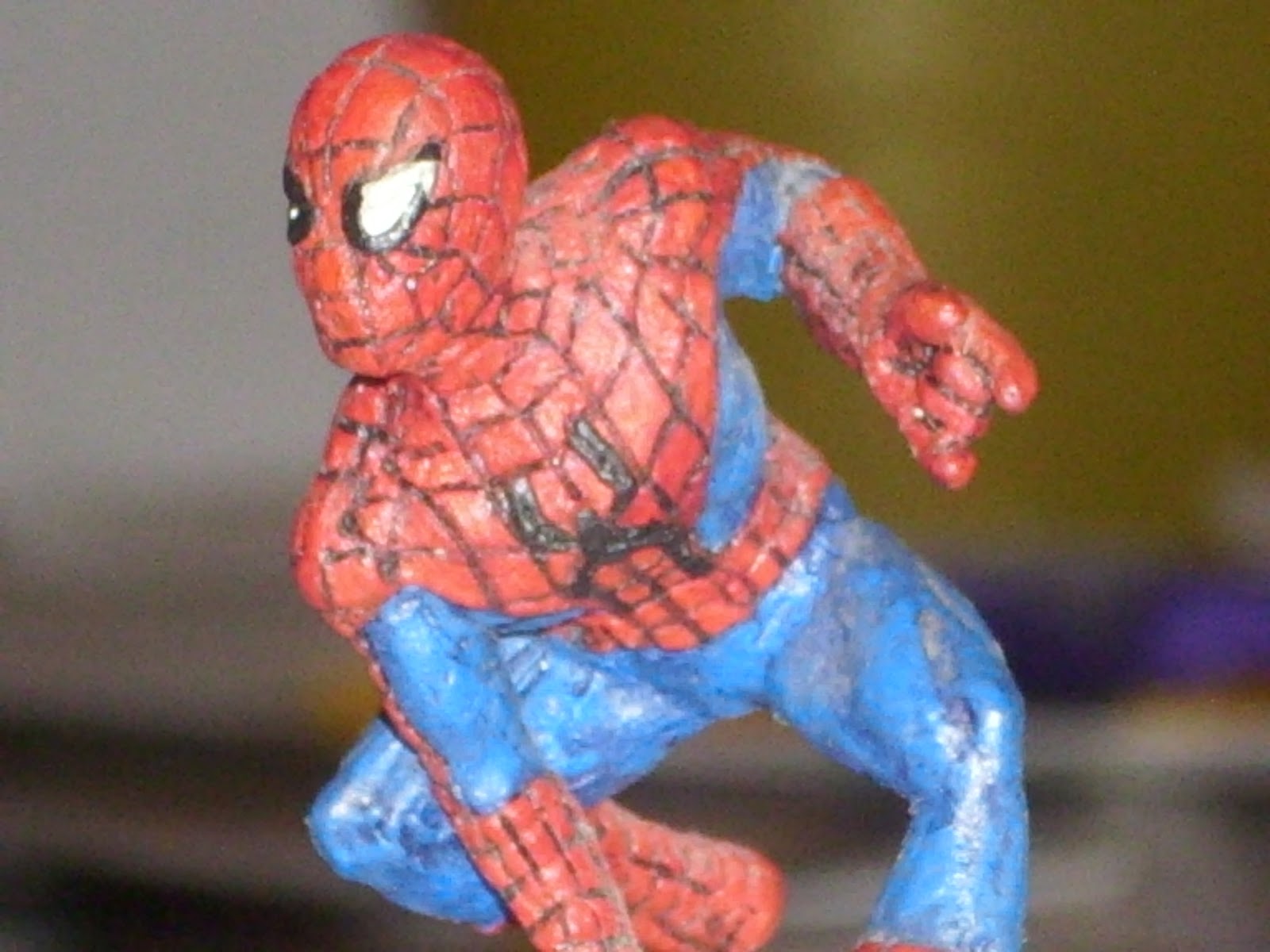
I've been taking pictures of some old miniatures I pulled out of storage recently. Well, I didn't exactly mean to go digging around for miniatures, but, a couple of weeks ago when I was pulling bikes out of the garage, I noticed that the clasps on my miniature case had, um, exploded. From the heat. Not that it gets all that hot in the garage, but the case was on top of a stack of boxes that stopped just under a window, so it had been in  the sun all summer. The case is old (like 20 years old) and plastic, so I suppose the daily exposure to the sun caused the clasps to shatter. I brought it in to make sure the miniatures were okay (they were) and decided I should get some pictures up on Facebook with my other miniature pictures. [I think this link should allow anyone that wants to see what I've posted so far to see. I think.]

[But here's a teaser:


All of that to say, "I hate my camera." It's old, and it's wearing out. It often refuses to focus. I can hear the mechanism inside trying, but it just won't do it. Then, of course, there was the whole episode while at Disneyland when the camera refused to even turn on.

But it's what I have at the moment, so I do the best I can with it. Yeah, I could go buy a new one, but I don't want to just go out and buy another cheap camera that wouldn't really be any better than this one, so I'm working with the one I have until we can actually get something better.

And that's how life is a lot of the time. You do what you can with what you have rather than just do nothing. Not that some people don't choose to just do nothing, but how much sense does that really make? When you wait for everything to be "perfect," you don't ever do anything.

I mean, for most of us, owning a car is always like this. You drive the piece of crap you have, right? Do you ever really go outside to go to work and look at your car and think, "I can't go to work in this. I'll wait till I have a better car, a new car, before I go to work." If you don't go to work, that new car will never happen, so you make do with the car that ought to be wearing a diaper and needs chemo for the cancer it has because it won't quit smoking.

All of this goes for writing and everything related to writing. You do what you can with what you have at the moment and keep trying to make it better. Better by degrees. And you learn from it.

When I finished The House on the Corner, I didn't have any money to pay for anything like, oh, a cover or marketing or anything. Which is still true, but, you know, doing the best I can. Anyway, I'd finished it and, after some research, knew I wasn't interested in pursuing traditional publishing, so it was time to do the best I could, which was this:
It's  not what I wanted, but it's what I had, so I went with it rather than not drive to work, as it were. The thing is, if I hadn't gone with that, I would never have gotten to this:
Better by degrees.

It can be hard to look at what other people have and look at what you have and decide to keep going. It would be so much easier to just give up. Let the piece of crap in the driveway continue to sit in the driveway and hide in your house because you're too ashamed to be seen driving around in that book with no cover.

And I have to mention it: editing.

Editing is a big deal. A poorly edited book can be a huge issue for a lot of people. BUT! As hard as I seem to be on the whole editing thing sometimes, I'm not as bad as I sound. As I said back in this post, my real issue is with people who have the "I'm not gonna leave the house" attitude about editing. "I could do better, but I'm going to choose not to because it's too much trouble." That bothers me. If you have a good story, it's well written, and you've utilized all of you editing avenues, you should not stick your book in a drawer because it doesn't look good. Drive that "piece of crap" (being metaphorical here -- I don't mean it's a piece of crap necessarily) to work, just like I drove my coverless book, and keep making it better by degrees. As you learn new things or have more resources, make it better. Make it the best that it can be at any given moment.

That's all anyone can do -- the best you can with what you have at any given moment. And don't be intimidated by the fact that some people have better than you. Some people just start out with more. No, it's not fair, but that's how life is. It shouldn't stop you from doing the best that you can right now.

end of line...

But don't forget to come back tomorrow for the FREE! release of part 6 of Shadow Spinner:

Monday, October 1, 2012

Remembering Miniatures

I haven't talked about the fact that I paint in a while. Mostly, it's because I haven't done any painting in a longer while. Since I got serious with the whole writing thing back in 2010, I pretty much set the brush aside. I just haven't had the time for it. Not to mention the fact that all of my painting stuff is still packed up since we moved last year, and I haven't worked out yet where to set any of it up.

But I've really been wanting to paint, lately. And do some gaming. Tabletop gaming. Oh, yeah, before you get all confused, I don't do canvas painting; I paint miniatures. I used to also do tabletop wargaming with them, but it's been even longer since I've done that. Like 20 years. Not that I haven't done tiny bits of tabletopping in there, but I haven't done anything serious in 20 years. It's one of the things I miss doing, but there's just not time or space for it, right now.

But I digress...

All I really want to do today is show you some pictures of some of my old figures from when I played Warhammer Fantasy Battle. My main army was Wood Elves.
This is not an army. This is a unit of rangers.
All of the shields are individually painted. No decals.
One of the reasons I loved Wood Elves is that the Wood Elf army gets Treemen.
Who wouldn't want one of those on your side?
They also got beast masters, which were pretty cool, too.
But the main thing about the Wood Elf army that I loved was the Wardancers.
They didn't wear armor, because they had magic tattoos. Yeah, my guy doesn't have any tattoos (long story that has nothing to do with the miniatures -- maybe one day I'll explain), but he's still cool.
Here is the commander of the ranger unit:
And the sorceress:
And the musician:

Anyway... that's just a look. I have some more stuff coming up about miniatures and painting, so I thought I'd let you guys see what I'll be talking about before I talk about it.

Sunday, September 30, 2012

Getting the Wrong Message

We live in an age of t-shirts. They're like membership badges. You wear a shirt, and people comment on it, and it let's you know whether or not they're in your club. Unsurprisingly, I have several Star Wars t-shirts. I used to have a lot more, but most of them have been retired. Okay, so, yeah, I still have them; I just don't wear them anymore, because an awful lot of them are 20 years old and not really fit for wearing anymore. A have a couple of Sandman t-shirts, I have Animaniacs and "Pinky and the Brain" t-shirts, and I have this t-shirt:
(I also have a lot of other comic book related shirts, but I don't really have time to list all the shirts I have!)

I imagine that emblem is familiar to most of you out there, but, surprisingly, it's one of the least recognized shirts I have. It's also one of the most commented on shirts I have. Whedon fans will almost always say something, but, frequently, people who don't know anything about Firefly will say something like, "Nice message. We could all use more serenity." I just sort of nod and grin and say, "Yeah, we could," while thinking something like "if you only knew."

When I was in college, I was in this writing group. A lot of (pretentious) poetry was batted around during the meetings. One of the rules was that you were not allowed to claim your own work. We were also encouraged to comment on our own work so that no one would know it was ours by our silence. Non-committally comment, of course. That was hard for a lot of people, so most everyone just sat silently when one of their pieces was being read and commented on.

One night, there was a particular poem that was read. I don't remember what it was about, but, evidently, no one was getting it. The author of the poem was trying to restrain himself, but I could tell he was getting frustrated, and he was really fighting with himself to keep from blurting out how wrong everyone was. Including the professors. One professor in particular. Awkwardly enough, I was the one that caused him to explode, but it was because I got it right. I gave my interpretation, and he slapped the table, jumped up, and pointed at me yelling "Yes! Finally! Someone gets it!"

I felt kind of bad. Bad in that it was my fault he lost his cool. It was kind of weird that he lost it over his message getting through when he'd managed to hold it together through everyone getting the "wrong" message. But that's kind of the point: there is no "wrong" message. There is a failure to communicate the intended message, but it's hard to say that a message pulled from a reading is wrong. Unless, of course, you're Barney Stinson rooting for the bully in The Karate Kid. Barney just gets it wrong, but it's not like that for most of us.

No, most of us carry away a valid message even if it isn't quite the one the author intended, and you know what? That's okay. None of the people giving the "wrong" interpretation of the poem that night had messed anything up; they just didn't quite understand the point the author was trying to make. That doesn't mean those other points weren't there, because we weave into our writing things we have no idea are there until someone else points them out to us. And that's okay, too. That's why other people can see things about us that we can't always see, and it's why we can learn about ourselves through other people and the way other people read what we've written.

You know what else? I don't think Joss would be upset about people coming away with a message of serenity because if the t-shirt based on his movie. I think he'd say, "That's okay."

Friday, September 28, 2012

Before Ever After

Before Ever After is Samantha Sotto's debut novel. Samantha was one of the first bloggers I met, and she's a
Doctor Who fan, which has nothing to do with anything other than that I tend to like people that are Doctor Who fans. At least, I haven't yet met a Who fan I don't like, although you don't need to be a Who fan for me to like you. It just makes it better. But I digress...

Samantha is one of those tiny percentages of authors that get picked up by a big, old traditional publisher with their first book. Normally, I would start with the technical stuff, but, having been edited by a big, old publishing house, there's not much to talk about there. Okay, there's nothing to talk about there. Which is not always the case, but it is in this case (for instance, there were editing issues with Snow Crash; I just didn't bother to talk about them because there was so much else to talk about). I didn't notice even a misplaced comma during the whole read. Not that I was looking, but those commas like to jump out and try to poke you in the eyes with those little hooked tails, and I didn't have to even swat one away while reading Sam's book.

In fact, the whole book is just well written. It's clever. It's witty. It has great prose. From a qualitative standpoint, this is a great first novel. It even has a story that is interesting. I mean, it's interesting beyond the tension of "will boy get girl?" See, it's not just a romance; it's kind of a sci-fi romance.

But this book is the reason for many of the posts I've done this past week, because this is one of those books about which I would say, "This is good, but I didn't like it." And it's not that I disliked it; I just didn't like it. (See yesterday's post for more on all of this.)

But, see, I know why I didn't like it! The reasons I didn't like it are completely subjective to me and probably won't be a problem for other people. Well, unless these particular things are a problem for you.

The first thing that posed a problem for me is the style in which the story is presented. Not the writing, because  the writing style is (mostly) fine. As I said, Sotto is witty and clever and the writing is snappy and fun, so it's not the writing. The issue is one of flow... Let me explain:

I'm a chapter reader. That means I like to sit down and read until the end of a chapter where I have a clear cutting off point. It's not that I can't stop in the middle of a chapter, I just prefer not to. Books that have tremendously long chapters can wear on me, because I don't always (in fact, almost never) have time to sit down and read a 30-page long chapter. My comfort zone is probably in the range of about 12 pages. Unless! see, there is an unless, the author has scene breaks within long chapters, and I'm fine using those in lieu of getting to the end of the chapter.

Before Ever After actually had the opposite problem: too many scene breaks. I've never actually run into this before, aesthetically speaking, but reading the book was almost like looking at a series of snapshots from someone's vacation. Someone you don't know very well, at that, and don't have a lot of interest in. On top of that, the photos aren't really of interesting things but just of the people sitting or standing or eating and, every once in a while, there might be some landmark in the background, but, mostly, it's just lots of pictures. Now, this is kind of a theme in the book, the photo taking, so, if the author wrote it this way deliberately, it's brilliant, but I still had a hard time getting into the flow of the story because of it. Often, there would be multiple scene breaks on the same page, and it made me feel like I could just put the book down at any time, so I rarely read more than a couple of pages at a time. The result of that was that I spent six months reading the book, which was just too long.

Like I said, this is something about the way I read that got in my way and is totally subjective. It says nothing about  the quality of the writing.

Now, the book is loosely divided into three sections:

  1. Now -- what is happening between Shelley and Paolo
  2. Five years ago -- the story that Shelley is telling Paolo about her meeting Max
  3. Various historical time periods -- the stories that Max is telling Shelley during their trip five years ago
In relation to all of that, I liked the historical passages the best. They tended to be longer (fewer scene breaks). I don't know if I just liked those bits more or if I was able to get into them more because they lasted longer, but those were those most interesting to me.

Now, remember the other day when I was talking about David Eddings and I told you to remember the bit about clever, witty dialogue? Well, this is why. The present day characters (I'm including both the "Now" and the "Five years ago" characters, here) were all too witty and clever for me. That's kind of a problem for me and, also, probably my own hangup, and it may go back to Eddings. Maybe, if I never read Regina's Song this wouldn't be an issue. I don't know. What I know is that during almost all of the conversations, I felt like I was back in that book with all the characters trying to outdo all the other characters with their snappy patter, and it was distracting to me. It also felt unrealistic, because, even though we all like clever banter, most of us can't sustain it. It comes in fits and bursts and, usually, the witty comments don't occur to us until well after the conversation is over, so the fact that these characters seemed to always talk in witty banter made me roll my eyes a lot. Even Shelley has internal dialogue that is full of wit.

But it is witty! And clever! And I like witty and clever! It was just too much. Again, my own subjectivity, because, objectively, it's good writing. Any isolated passage you pull it will be good writing.

In the end, Before Ever After feels a bit like lobster to me. Or crab legs, because I did the same with both, but I think lobster makes a better example. When I was younger, I always thought I should like lobster. Not that I should but that, being me, I ought to. I like shrimp. I like crawfish. I ought to like lobster, too, right? But any time I tried it, I just came away thinking, "I really didn't like that." But I spent years trying it every time there was an opportunity to do so, because, you know, I ought to like it. Finally, I had to just admit to myself that I didn't like lobster.

Before Ever After has everything in a book I ought to like. Objectively speaking, it's a good book. It's well written. It has an interesting plot that, while not entirely unique, is presented from a perspective that I haven't seen before. It's witty and clever! I ought to like, but I could just never get into it. I do think it might make a really good movie, though, as long as it wasn't trimmed down too much.